
Canvas, Colour and Concept: Inside Nitin’s Resonant Debut at London Art Exchange
By Melody Weston
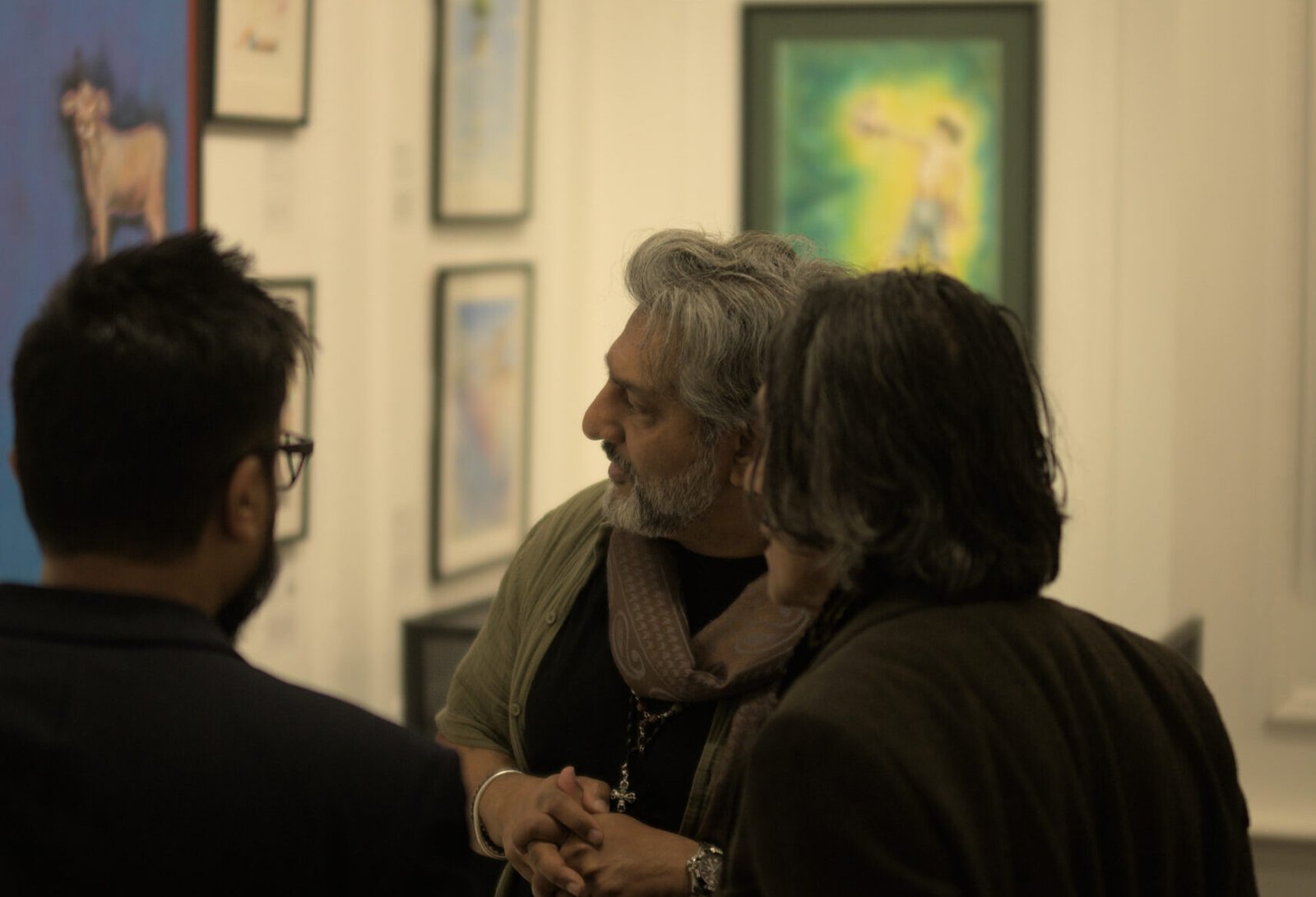
On 27th September, London Art Exchange opened its doors to unveil one of its most anticipated exhibitions to date. The walls, alive with canvas, colour and concept, carried the weight of both personal and universal stories. For an artist making his official debut, Nitin has already achieved what many take years to master: the ability to draw a crowd into silent awe, to hold them in the palm of his vision, and to send them away changed.
This was no small beginning. Half a decade of preparation, the unveiling of ten collections, and an artistic voice that speaks of resilience, identity, and belonging. The opening night was less about formality and more about feeling. From the moment I stepped inside, there was a current in the air – as though the works themselves were in dialogue with every person present.
A First Encounter with Nitin’s Work
Nitin’s art does not merely hang on the wall. It confronts, engages, and provokes. Each canvas feels like a meeting place between the artist’s internal world and the viewer’s interpretation. The brushstrokes are deliberate yet unrestrained, often carrying the immediacy of lived experience. Colours are chosen with precision – muted palettes that still carry weight, demanding the eye to linger, while occasional surges of intensity disrupt with raw emotion.
Every piece seems to ask a question rather than provide an answer. They whisper of belonging, of cultural navigation, of the fragile yet unyielding human spirit. It is this ability to hold space for both struggle and triumph that sets Nitin apart.
Homage to Struggle and Belonging
Walking through the collections, I noticed a recurring theme: homage. Each piece is a nod to something larger than itself, to the communities and challenges that have shaped the artist. There are moments of conflict, images that lean into hardship, yet always an undercurrent of resilience. The works are a reminder that struggle is not the end of the story, but the soil from which identity and purpose emerge.
This is especially evident in the series that many visitors were drawn towards – the boy with the boxing glove. A motif that became a quiet centrepiece of the evening, it held both a sense of vulnerability and immense strength.
The Boy with the Boxing Glove
Perhaps the most talked-about collection of the night, this series captured the attention of every corner of the room. Groups gathered around the canvases, voices low, eyes fixed, as though in the presence of something sacred. There was a shared recognition, even among strangers, of what these works represented.
The boy with the boxing glove is not just an image; it is a metaphor. Here is a figure marked by innocence, yet prepared for battle. The glove becomes a symbol not only of conflict but of protection, of readiness, of resilience in the face of overwhelming odds. There is no arrogance in the boy’s stance, only quiet defiance and dignity.
Victory of the Underdog
From this collection, one piece stood out above the rest for me personally: Victory of the Underdog. It is a canvas that feels deceptively simple at first glance – muted colours, restrained composition – yet the longer you spend with it, the more powerful it becomes.
The boy’s stature is upright, commanding, but not boastful. His expression is one of resilience, not victory in the traditional sense, but of something deeper: endurance. There is a purity in the way the muted tones convey strength without spectacle, the way the canvas seems to breathe both pain and perseverance.
It is moving, motivational even, to stand before it. You cannot help but feel called to your own battles, reminded of the quiet dignity in perseverance. The underdog, in this moment, is no longer defined by circumstance but by spirit.
Nitin’s Leap into the Deep
What strikes me most about this debut is not just the work itself but the courage behind it. To dedicate years to one’s craft, to labour over ideas and expression, and then to step into the public eye – it is no small feat. It takes not just skill but conviction.
There is something profoundly inspiring about witnessing someone take their passion so seriously, so unapologetically, and leap headfirst into the deep end of the art world. This exhibition is not a tentative test of waters; it is a declaration.
Beyond the Opening
As the evening came to a close, the conversations did not fade but deepened. Guests lingered, unwilling to leave the resonance of what they had experienced. Many spoke of returning, of bringing others to witness it. That, perhaps, is the truest testament to an artist’s success: the ability to create work that lives beyond its frame, that insists on being revisited.
Nitin’s debut is more than an exhibition. It is a landmark, both for him as an artist and for those of us fortunate enough to encounter it. His canvases are not mere images; they are stories, struggles, and triumphs captured in colour and form.
As I left the London Art Exchange that evening, I carried with me the lingering image of Victory of the Underdog. A boy with a glove, standing tall, reminding us all that strength often wears the face of resilience. It is a piece, and indeed an exhibition, that will not easily be forgotten.
Melody Weston is a cultural critic and writer based in London, exploring the intersections of art, identity, and contemporary expression.
Other Articles

Llangollen Eisteddfod to ‘showcase international artists’
Art Now celebrates 10 years as the Prairies’ premier fine art fair