
[ad_1]
How do artists build in broken times? Is artificial intelligence (AI) unlocking a better world—curing diseases and transforming education—or unleashing our destruction? When hype and fear drown out nuance and discussion, perhaps in art we can find a quiet moment for reflection—even resistance.
After all, artists have long guided society through uncertainty—think Dada amid the First World War or Jikken Kōbō in Japan following the Second World War. They do not offer solutions so much as new responses: ways of expressing curiosity, imagining alternatives or holding room for ambiguity. As the critic Hal Foster recently described, two tendencies have historically emerged when art confronts crisis: one rooted in Constructivism, aiming to create new order; the other more chaotic, echoing Dada, amplifying disorder.
These historical impulses connect to the present day, mapping onto AI art. In this context, artists could be seen as builders and breakers. Builders imagine AI as a medium for collaboration and new aesthetics—even hope. Breakers critique, negate and disrupt. But leading makers and curators in the field see this as no simple dichotomy. Both offer strategies for reckoning with a world in flux.
Builders see possibilities
What motivates builders is not simply using the newest AI tool—or even fashioning their own from scratch. It is aligning multidisciplinary tools with concepts to produce works that were previously impossible—while urging us to imagine what else may soon be possible. Builders leverage AI to embrace the artistry of system creation, novel aesthetics and human-machine collaboration.
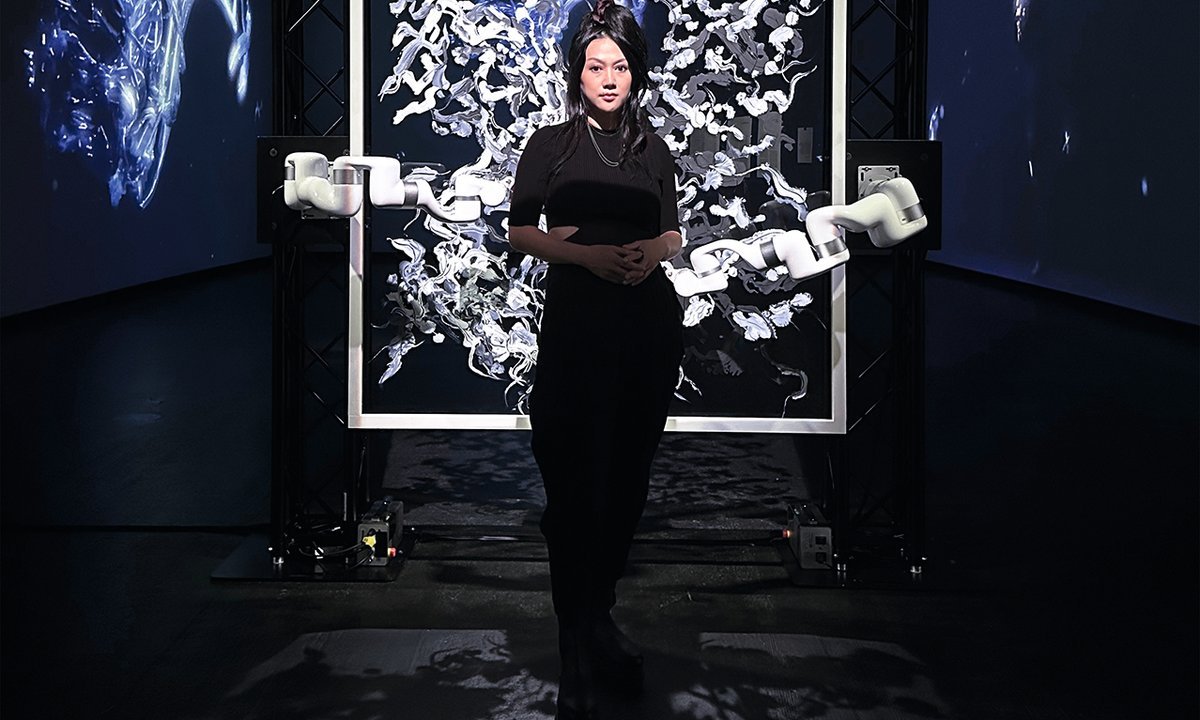
Take Sougwen Chung, the Chinese Canadian artist and researcher into human-machine collaboration. “I view technology not just as a tool but as a collaborator,” Chung says. Their work explores shared agency—even identity—between human and machine, code and gesture. In Mutations of Presence (2021), Chung collaborated with D.O.U.G._4, a custom-built robotic system driven by biofeedback: specifically, electroencephalogram signals captured during meditation and real-time body tracking. The resulting pieces reveal both performance and painting, a hybrid body co-authoring with machine memory. An elegant web of painterly gestures—some made via robotic arm, others by Chung’s hand—traces a kind of recursive duet.
I see combining AI and robotics with traditional creativity as a way to think more deeply about what is human and what is machine
Sougwen Chung, artist and researcher
The work demonstrates how Chung’s novel physical creations become interconnected with new conceptual frameworks—reframing authorship as a distributed, relational process with machines—inviting new forms of aesthetic exploration. It also reasserts a long-held, often feminist belief—dating back to Donna Haraway’s A Cyborg Manifesto (1985)—that the distinction between human and machine is illusory. As Chung puts it, “I see combining AI and robotics with traditional creativity as a way to think more deeply about what is human and what is machine.”
Chung’s intimacy with these systems goes further still: “I’ve started to see them as us in another form.” That is because they are trained as extensions to Chung’s very self. “I draw with decades of my own movement data or create proprioceptive mappings triggered by alpha [brain] waves. These systems don’t possess agency in a mystical sense but they reflect back our own: our choices, biases, knowledge.” This builder tendency aligns with earlier avant-gardes that saw technology as a path toward reordering the world, including the Bauhaus and aspects of the 1960s Experiments in Art and Technology movement. Builders are not naïve. They are aware of AI’s risks. But they believe that the minimum response is to participate in the conversation.
“My artistic practice is also driven by hope and an exploration of the promises and possibilities inherent in working with technology,” Chung says. Their vision affirms a cautious optimism through direct engagement with these tools.
Breakers see warning signs
Where builders see AI’s possibility, breakers see warning signs. Breakers are sceptics, critics, saboteurs. They distrust the power structures underpinning AI and its predilection for promoting systemic biases. They highlight how corporate AI models can be trained on scraped datasets—often without consent—while profits remain centralised. They expose how AI systems exacerbate ecological challenges only to promulgate aesthetic homogenisation.
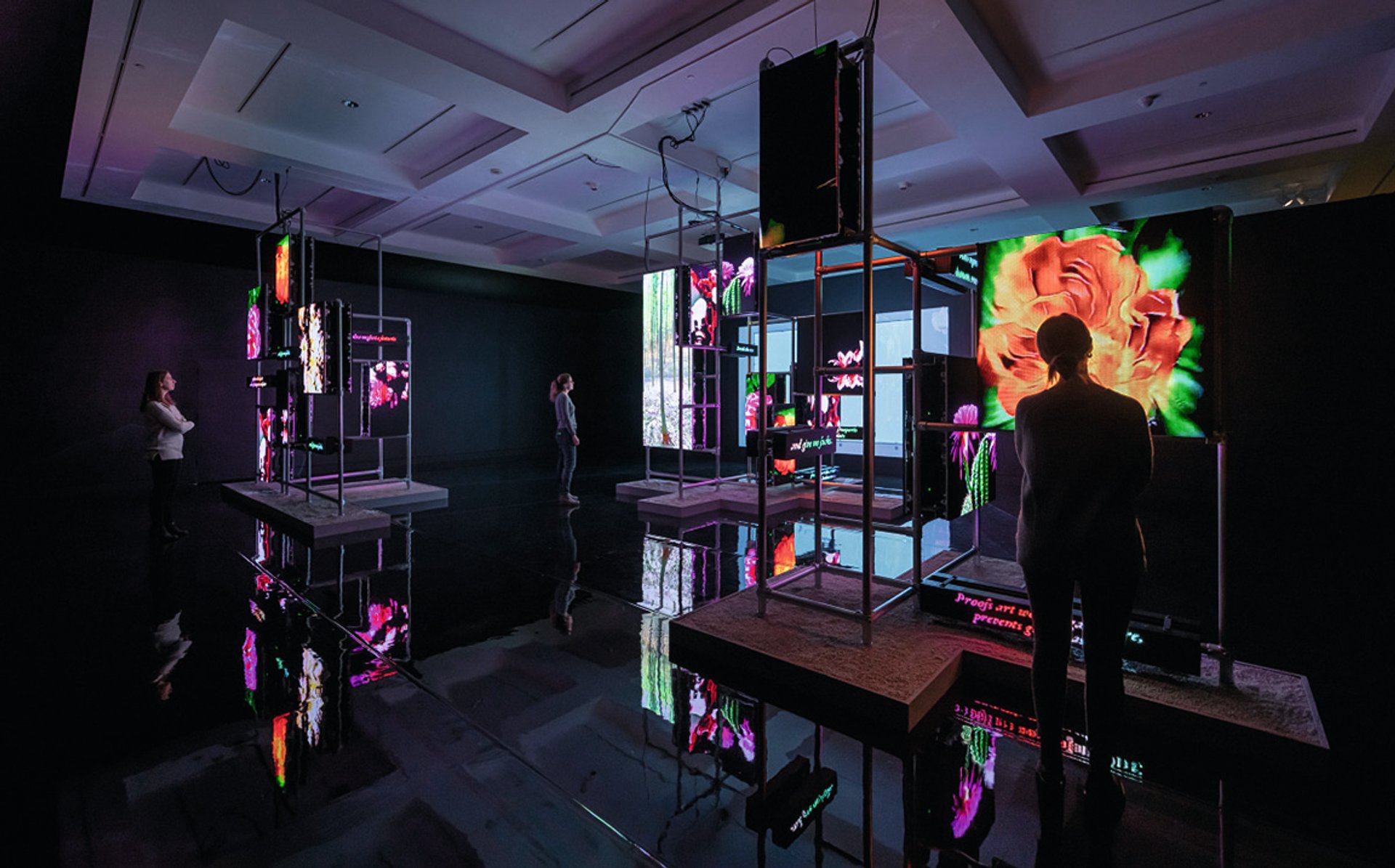
In her work This is the Future, Hito Steyerl uses neural networks to imagine medicinal plants evolved to heal algorithmic addiction and burnout Photo: Mario Gallucci; courtesy of the artist; Andrew Kreps Gallery, New York and Esther Schipper, Berlin
They are also label resistant: “Breaking and building have become indistinguishable,” the German artist, thinker and archetypal breaker Hito Steyerl says. “The paradigm of creative destruction merges both in order to implement tech in the wild, without testing, thus externalising cost and damage to societies while privatising profit.”
Breakers do not emphasise AI’s aesthetic potential; they interrogate its extractive foundations, social asymmetries and the harms it makes visible. Breakers take a far bleaker view of AI’s impact on art than builders: “Art used to be good at testing, planning, playing, assessing, mediating, sandboxing. That element has been axed—or automated—within current corporate breakbuilding,” Steyerl says.
But in Steyerl’s own work, such as This is the Future (2019), the meticulous co-ordination, criticality and sceptical spirit are evident. The artist uses neural networks to imagine medicinal plants evolved to heal algorithmic addiction and burnout. The work shows how machine learning’s inner workings, prediction, can be weaponised, satirising techno-optimism while exposing AI’s entanglement with ecological and psychological ruin.
Christiane Paul, the long-time digital art curator at the Whitney Museum of American Art in New York, underscores these issues: “In terms of ethics and bias, every artist I know working in this field is deeply concerned. You need to keep that in mind and engage with it on the level of criticality—what you would call the breakers, highlighting how ethics filter in.” An extreme breaker might reject AI entirely. But Paul suggests that artists working with AI are essential precisely because they inhabit that edge where culture and ethics are encouraged: “Art in this field, using these tools, making them, building on and with them, is deeply needed.”
Breakers remind us that celebrating new tools without understanding their costs is a form of denial. Sometimes, to truly see a system, you have to dismantle it. That clarity brings insight—but contradictions as well.
Neither utopian nor dystopian
Is it really as simple as a builder-breaker duality? “My whole life, I’ve been very suspicious of dichotomies,” Paul says. Exploring the space between seeming contradictions can even be fertile creative ground. “A steering question for my work,” Chung says, “is ‘how do we hold fear and hope in our minds at the same time?’”
Steyerl, like a true breaker, rejects the contradiction to begin with: “Breaking is a cost-cutting element of building, taking out mediation; there is no more distinction between both.” Neither position suggests retreat. Instead, they ask us to face the paradox directly. Builder and breaker are not identities; they are strategies. The distinction is porous, performative. Most artists move fluidly between them or hold on to both at the same time.
Chung continues: “My art doesn’t strictly sit within either a utopian or dystopian camp. Instead, I actively navigate and explore the complex space between potential fears and hopes concerning technology and human-machine interaction.”
Michelle Kuo, the chief curator at large at the Museum of Modern Art in New York, says: “When artists intervene in existing technologies or systems, or take action in changing the outcome of technological development, they are not only building something—they are implicitly challenging the status quo.” Kuo links “builders” with “challenging the status quo”, reinforcing the roles’ fluidity. “It is this combination of challenge and experimentation that characterises some of the most exciting work at the intersection of art and AI today,” Kuo says. For her, the AI work that can achieve both breaking and building—challenge and experimentation—truly confronts our moment, neither retreating from technology nor surrendering to it.
Artists who speak out
So, what does this all mean for the viewer living through a future that arrived faster than we feel equipped to handle?
Artists take a tool and make it do something it’s not supposed to do. They don’t reject technology wholesale
Michelle Kuo, chief curator at large, Museum of Modern Art
It means active engagement with AI—even to break it. Kuo says: “Especially when the pace of change—of AI in particular—is even more accelerated than in previous eras, it is all the more crucial that artists and others outside the tech sector learn, test, speak up and act out.” Further, we might take cues from the artists engaging with AI themselves. Kuo describes what they do: “Artists take a tool and make it do something it’s not supposed to do. They don’t reject technology wholesale. They embrace it—and then make it strange.”
The best artists urge viewers to keep an open mind, slow down, appreciate nuance, accept ambiguity and recognise that we are a crucial part of the final outcome; they break, then build.
• Peter Bauman is editor-in-chief of the digital generative art institution Le Random
[ad_2]
Source link
Other Articles

New York artists explore Base Materialism in London show