
[ad_1]
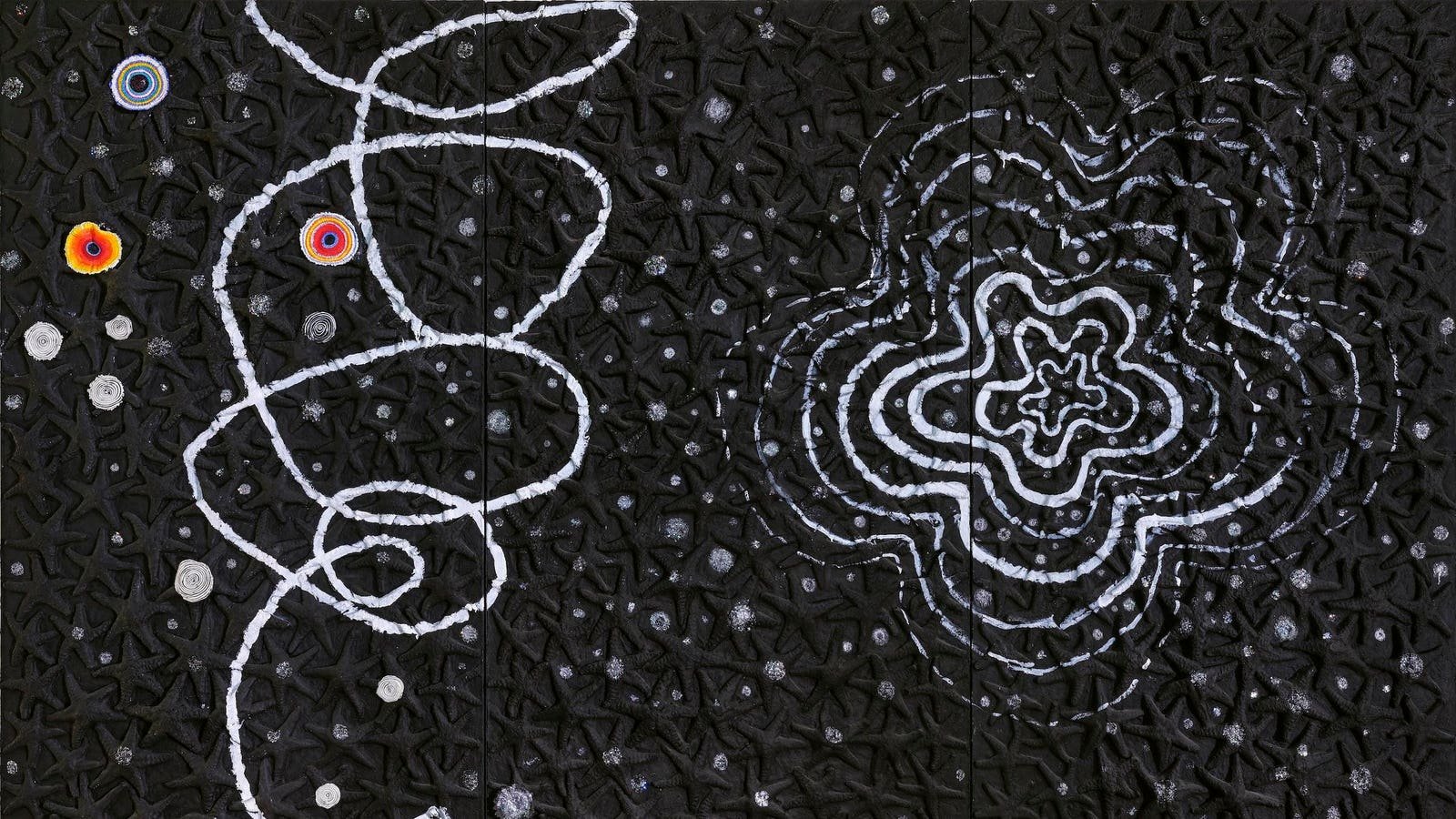
Nabil Nahas, Untitled, 2022, acrylic on canvas, 290x 450 cm
Nabil Nahas is an artist known for his vibrant, textured paintings that often explore the interplay between nature and abstraction. Born in Beirut in 1949 and educated in the United States, he draws inspiration from both his Middle Eastern heritage and Western modernist traditions. His work frequently incorporates motifs such as fractals, spirals, starfish, trees and organic forms, investigating the relationship between microcosm and macrocosm, as well as cosmography and telluric energy, rendered in thick layers of paint that create a sense of depth and movement. His art reflects a deep engagement with the patterns and structures of the natural world, as well as a nuanced understanding of color and form. His pieces have been exhibited internationally, making him a significant figure in contemporary art. He shares how his Lebanese roots inform his paintings and the origins of his themes of predilection.
Tell me about your background.
I was born in Beirut and I used to spend my school years in Cairo and my summer vacations in Lebanon in the mountains with my grandparents. The bad part was the school years, I hated that. So Lebanon for me was vacation time. Of course it was associated with family, but when I think about it, I was already quite taken by its archeology. My parents didn’t want me to go to New York for art; you go to London, Paris, Milan or Rome. I have an aunt who lives in New Orleans. She said, “Come and from here, you go wherever you want to.” So that’s what I did. I spent a couple of years in New Orleans, and then I went to Yale. Yale was great because I met all those artists, all the big names, who would come and visit us once a week. Some of them were terrific, others jerks, so it undeified them. Then when I moved to New York, it was easy because I knew a lot of people who were in the art world in New York.
Today your studio is still in New York. Do you create mostly in New York or also in Lebanon?
During the COVID-19 years, I started creating in Lebanon a lot because I was there and it was much more comfortable being there than being in New York, but I create in both places, and I work a lot. I don’t wait for inspiration. My atelier in New York used to be in Manhattan where I live, in Tribeca, then in Chelsea and then I moved it to Long Island City. I got a fabulous space because the rents were so outrageous in the city. I have a very big atelier in Lebanon. If I hadn’t gone back to Lebanon, I would never have painted those tree paintings, not in a million years.
Nabil Nahas, Untitled, 2022, acrylic on canvas, 250 x 200 cm
When had you started the tree series?
I went back to Lebanon for the first time in ’93, to the mountains, and I said to myself, “Gee, I wish I were a landscape painter.” I did not reconcile both things, but in 2006 in New York, I started painting trees and hiding them. Then I said, well, that’s pretty damn good. I started showing both things at the same time. It shocked people at first, but then they got accustomed to it, and now I think there are two or three painters that work like me. Why limit yourself to a signature if you have the ability of having five signatures?
Do you live in the countryside in Lebanon?
Yeah, in the mountains. The cedar trees are quite high up, but the olive trees that are 1,500 or 2,000 years old, they’re like Roman trees, which I had transplanted from southern Lebanon. You know you can transplant them? You have to hack them up, and then five years later, they give you a tree again, and olives, and I make olive oil, a very good olive oil. I’m very fond of archeology, so I collect a few archeological pieces, especially pottery. I like sharing an object that is like 3,000 or 4,000 years old in my hands, and that link between the person who made it and me holding it. But with the trees that will become suddenly those olive trees, what is quite fascinating to me is that they’re alive, they’re not dead objects. If you think about it, it’s kind of amazing to have that link to history, and those poor trees are still witnessing disaster after disaster, and they’re there. If they could talk, they’d be tragic, and they look tragic.
Do the trees stem from your imagination and your memories?
Listen, I have a few of them and I’m very interested in gardens and preserving the wild flora of Lebanon. I’m very, very close to nature. Once you know how an olive tree really grows, because this tree has a way of growing, you can grow it yourself on canvas. It’s you, it’s me, it’s somebody. But they have become really a major part of the work I’m doing.
Nabil Nahas, Untitled, 2014, acrylic on canvas, 4 x 4 feet
Tell me about your technique for creating the life-size starfish that are dotted all over your paintings.
Originally, they were real starfish, but I wasn’t very sure what might happen over time. So I made silicone molds that are 5 feet by 5 feet and filled them with acrylic until it is thick enough to hold, and then they’re mounted on canvas. The big spirals came out of that, which is really the way nature proceeds by accretion. I’m not interested in copying what nature looks like, but I’m interested in the process that nature has and replicating that. So you can go from the deep sea to the cosmos.
What does the three-dimensionality of your canvases, these multiple layers, bring to the viewer?
It wasn’t premeditated, it’s just like when I started making those monochromatic paintings. Then I got bored with that, so I started adding color to them, then the paint factory came up with this crushed pumice mixed in acrylic, so I was using that. It happens step by step. And the painting got very three dimensional.
You had always considered yourself to be an abstract painter at the beginning, and now your paintings today are both abstract and figurative at the same time.
Yeah, I used to think of myself as an abstract painter, but now when I think about it, even the geometric paintings were like crystallized structures. They’re complicated and you can read them in as many different ways as you want.
[ad_2]
Source link

The solstice begins! | Meer
New Banksy artwork ‘stolen’ from above London shop