
Mr Phantom
By Ashton Wilde
Head Art Journalist, Contemporary Fields
My Art Investor
Mr Phantom Has Moved Past Mystery. Now the Market Is Trying to Price the Myth.
When Art Plugged published Mr Phantom: The Artist Who Would Rather Not Be Seen, it did something most coverage of anonymous artists fails to do. It did not reduce the London-based artist to a Banksy-shaped riddle. It asked the more useful question: what happens when an artist removes himself from sight, but the work keeps gaining public, financial and cultural weight?
That question now feels less theoretical. Over the past year, Mr Phantom has moved from underground intrigue into a sharper kind of market visibility. The anonymity is still there. The refusal is still there. But the market has started to behave differently around him. Collectors are no longer asking only who he is. They are asking what they can still get, what has already gone, and how high the most important works can realistically travel.
That is the shift. Mystery brought attention. The work now has to carry value.
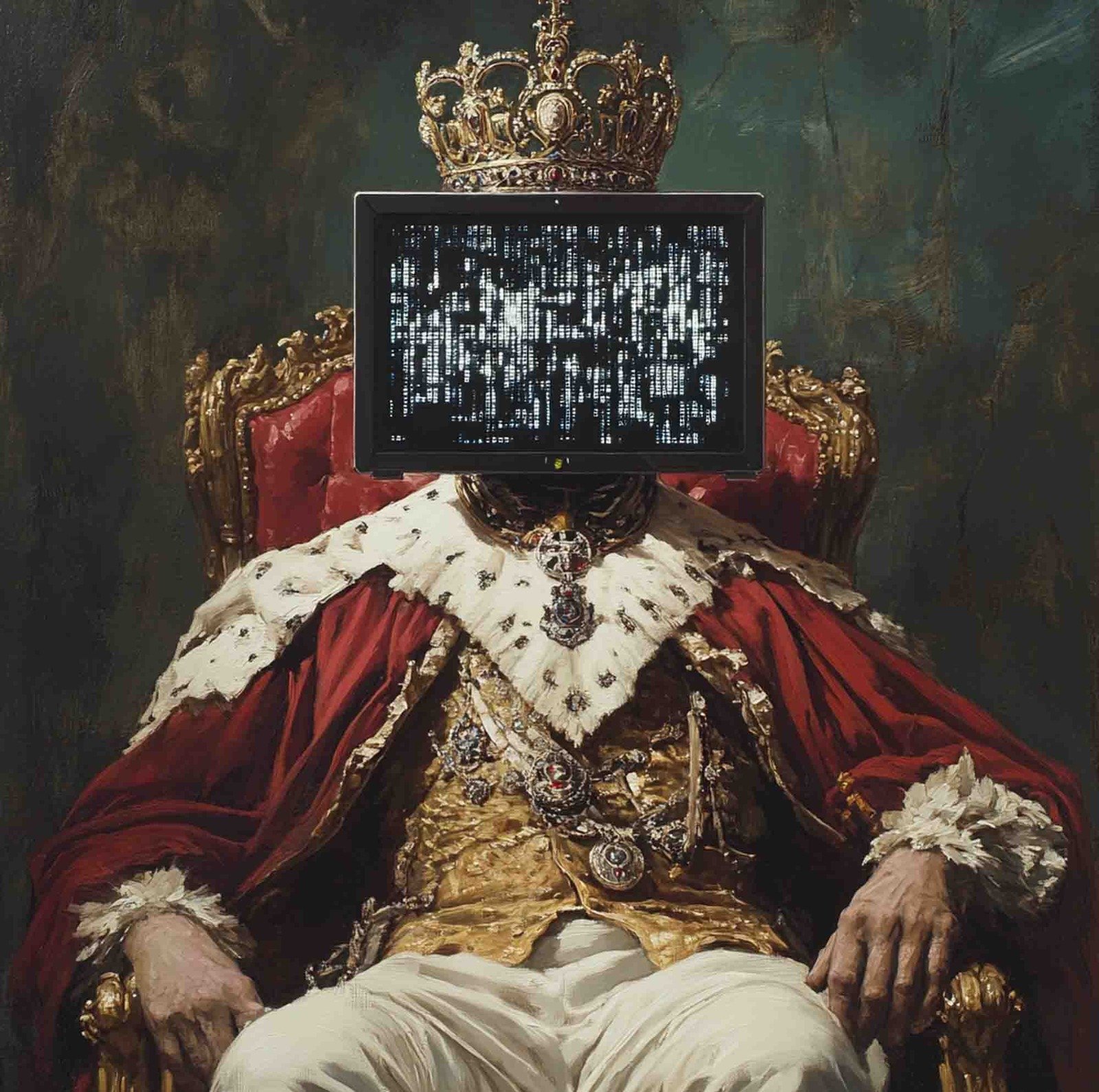
The clearest public marker remains The Matrix. Sold for £147,000 at Marten Stanmore, the work gave Mr Phantom something many emerging and mid-market artists never achieve: a recorded secondary-market benchmark that can be pointed to, challenged, studied and built around. A private sale can remain foggy. A gallery price can be dismissed as ambition. An auction result changes the conversation. It puts the artist into the public record.
The Matrix was not just a price event. It was a narrative event. The work fused monarchy, digital control, code, identity and power into a single image. That matters because Phantom’s strongest works do not simply decorate political anxiety. They compress it. They take the feeling that modern life is being watched, priced, shaped and quietly managed, then turn that feeling into something immediate enough to hit from across a room.
This is why the last year matters so much. The Matrix gave the market a figure. G.A.C vs G.A.S gave the artist a thesis. The Mind charity work gave him public conscience. The Awakening is now being positioned as the next chapter. And the rumoured final Diana trilogy may become the body of work that forces collectors, curators and appraisal specialists to decide whether Mr Phantom is still an emerging phenomenon, or whether he has already crossed into something more serious.
The answer is starting to look uncomfortable for anyone who dismissed him early.
G.A.C vs G.A.S was an important step because it showed Mr Phantom was not only chasing recognisable symbols. The exhibition dealt with originality, copying, authorship, imitation and the way culture gets stolen, repackaged and sold back to the public. That is dangerous subject matter for an artist working inside the commercial market. It means the work is not standing outside the system wagging its finger. It is speaking from inside the machine.
That contradiction is part of the appeal. Mr Phantom criticises power while building market power. He hides his face while becoming more visible. He questions value while creating it. He attacks systems while operating through one of the most systemised art markets in recent memory. The tension would be a weakness if the paintings were thin. Instead, it has become the pressure point.
This is also why the market is beginning to divide his work into tiers. Not every Mr Phantom painting carries the same importance. That is normal. The serious part is how quickly the upper tier is hardening. Smaller works have already been discussed in the tens of thousands. Flagship 100 x 100 cm works have been publicly discussed in six-figure territory. Now, private conversations around Diana-linked works, masterworks and key final-series pieces are pushing into a more aggressive band, with current valuation talk around the strongest examples sitting between £250,000 and £500,000.
The larger number is what changes the atmosphere. Once works begin to move toward that level, buyers are no longer purchasing decoration. They are buying position. They are buying proximity to the artist’s defining chapter. They are buying scarcity before that scarcity becomes publicly understood.
And then there is the seven-figure question.
Nobody serious should pretend every Phantom work is about to become a million-pound object. That is not how markets work. But a seven-figure conversation around grouped holdings, final-series works, Diana-led masterworks and major collector allocations is no longer fantasy. It is the kind of conversation that begins when an artist has several things at once: a public auction result, a controlled supply model, loyal collectors, a press trail, institutional curiosity, charity visibility, and a body of work that can be explained beyond hype.
Mr Phantom now has those ingredients.
The controlled access model matters. Recent reporting around a new Mr Phantom collection described approximately 75 percent of the works as reserved or sold before the wider market had full access. Whether one loves or dislikes that model, it creates a fact collectors understand: access is narrowing. The old habit of waiting, watching and entering late becomes harder when the artist and gallery are actively controlling who gets what, when, and why.
That has always been the hidden engine of important markets. Not popularity alone. Not noise alone. Access.
The comparison to Pictures on Walls is starting to follow Mr Phantom around for that reason. Not because he is Banksy. That lazy comparison should be retired. The more useful point is structural. Pictures on Walls helped create a world around artists, editions, visibility, scarcity, printing and belief. London Art Exchange is trying to build something similar around Mr Phantom: legal structure, print capability, collector access, digital visibility, live auction ambition and a long-term market narrative.
If that machine works, the artist does not need to shout. The market does it for him.
Still, Phantom’s most powerful subject may not be technology, monarchy, war or authorship. It may be Diana.
That sounds obvious until one looks at how badly Diana has been handled by art, media and memorabilia. She is often flattened into softness. A smile. A tiara. A tragedy. A collectible face. Mr Phantom’s Diana work is stronger because it does not treat her as nostalgia. It treats her as unfinished public emotion.
The People’s Queen already made this clear. The work reimagines Princess Diana in a coronation setting, placing her in a position she never officially held but arguably occupied more powerfully in the public mind. That image is not only about royalty. It is about permission. Who grants status? The institution, or the people who refuse to forget?
This is where Phantom becomes interesting as a British artist. We are living through a period where public trust in government, monarchy, media and institutions feels fractured. People are no longer waiting for official structures to repair national unity. They are looking for emotional symbols. They are looking for figures who still carry moral clarity, even from the past. Diana remains one of the few modern British figures who can do that.
That is why she is not just another subject in Phantom’s portfolio. She may be the subject.
In Phantom’s hands, Diana becomes more than a royal portrait. She becomes a test of Britain’s memory. She becomes the place where power, compassion, grief, fame, surveillance, public love and institutional failure meet. In other words, she sits exactly where Mr Phantom’s wider practice already lives.
This is why appraisal conversations around the final Diana trilogy are intensifying. If the trilogy is truly the closing statement collectors believe it to be, it could become the most important and most valuable Diana-linked body of work in Phantom’s career. Current private-market discussion around top Diana works and major masterworks has already moved into the £250,000 to £500,000 range, depending on title, provenance, size, condition, collector placement and whether the work belongs to a final or complete sequence.
The word “sequence” matters. A single important work can create demand. A trilogy creates hierarchy. It asks collectors to think in chapters. It creates the possibility that one owner may hold a piece of the ending, but not the whole ending. That kind of tension is exactly where collector appetite grows.
Mr Phantom’s wider market is now being watched by a different category of person. Not only early buyers. Not only fans of street art. Not only collectors who like the thrill of anonymity. Curators, advisers and appraisal specialists are starting to look at the consistency of the language: the crowns, the children, the animals, the broken systems, the media icons, the institutional symbols, the wounded national mood. The work is becoming easier to track as a career, not just easier to sell as an image.
That is what separates a moment from a market.
A moment is a viral painting. A market is a body of work with structure, proof, demand and repeat buyers. A moment burns hot and disappears. A market builds chapters. Mr Phantom is beginning to look like a chapter artist.
The Mind charity link strengthened that position because it showed the artist’s imagery could operate outside collector rooms. Since You Came Along, donated through London Art Exchange to support HFEH Mind, placed Phantom’s visual language beside mental health, young people, vulnerability and recovery. That sits close to the emotional centre of his work. The recurring use of innocence in Phantom’s paintings is not sentimental decoration. It is a measuring device. It asks what adult systems do to the vulnerable people living inside them.
That concern now feeds directly into The Awakening.
The Awakening is being spoken about as the next major body of work, and its subject feels like the logical next step. Systems. Control. Realisation. Escape. It is not enough for Phantom to keep pointing at the cage. The market now wants to see whether he can paint the act of recognising it, then leaving it.
This is where the next valuation leap may come from. The artists who last are rarely the ones who repeat a popular trick until the market gets tired. They are the ones who turn recognisable language into deeper territory. If The Awakening does that, then the current appetite around the artist may be early rather than excessive.
That is the uncomfortable question for collectors right now. Is Phantom expensive, or is the market still trying to work out what the top works are worth?
There is a difference.
The first means the buyer has missed the early stage. The second means the hierarchy is still being written. With The Matrix now established as a public benchmark, G.A.C vs G.A.S giving structure, The Awakening ahead, and the Diana trilogy drawing serious private attention, the upper end of Mr Phantom’s market has not settled. It is still forming.
For the strongest works, that formation is now happening in six-figure territory, with seven-figure collection discussions beginning to sit around the wider body of major holdings. That does not make the market risk-free. No serious art market is. But it does make the artist difficult to ignore.
The most revealing thing about Mr Phantom is that the absence of a face has not stopped people forming belief. If anything, it has pushed the market back toward the work, the symbolism and the scarcity. Collectors are no longer buying the personality. They are buying the language.
And that language is getting louder.
The Diana works may become the clearest proof of it. If The People’s Queen was the argument, the final trilogy could be the verdict. Not because Diana is famous. Fame is cheap. Diana matters because Britain still has not finished processing what she represented. Phantom’s advantage is that he understands her not as a royal subject, but as a national wound.
That is where value begins to detach from size, medium and surface.
It moves into meaning.
That is the point Art Plugged left us with, even if quietly. Mr Phantom’s anonymity may have started the conversation, but it cannot finish it. The finish will come from the work. The market now appears to be saying that the best of that work may be worth far more than early observers expected.
London has not produced many anonymous contemporary artists with this combination of public tension, collector demand, charity visibility, auction proof and symbolic reach.
Mr Phantom may be one of the rare ones.
And if the final Diana trilogy lands as expected, the question may no longer be whether he belongs in the conversation.
It may be how long the market can still afford to treat him as emerging.
Other Articles