
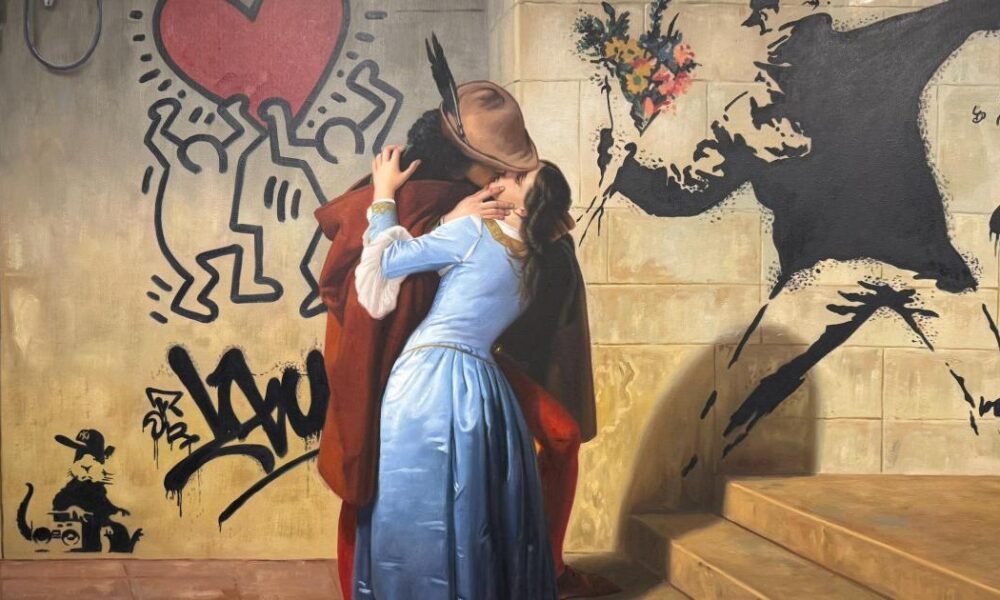
Lee Webster: When can you replicate other artists?
This question has echoed through art history for centuries, but it feels it is resurfacing with force in contemporary and street art culture.
To understand why this debate refuses to settle, it helps to look backward before looking around.
One of the most well-known artists of all time, Vincent van Gogh, is a good place to begin.
Following a period of severe mental health struggles, Van Gogh voluntarily admitted himself to a hospital at Saint-Rémy-de-Provence in 1889.
During his time there, he produced a remarkable body of work, much of it directly inspired by, and in some cases explicitly based upon, existing artworks.
He copied compositions by artists such as Eugène Delacroix and Jean-François Millet, studied engravings by Gustave Doré, and reinterpreted Japanese ukiyo-e prints by Utagawa Hiroshige.
Yet Van Gogh did not simply “lift” these works.
He transformed them.
Colours were intensified alongside his unmistakable brushwork injected movement and depth.

His versions feel less like copies and more like emotional translations filtered through a mind both tormented and visionary.
Critics have often argued that Van Gogh did not diminish the originals; he expanded them.
This pattern repeats throughout art history.
Early artists were rarely isolated geniuses working in a vacuum.
They studied, borrowed from, and openly influenced one another often within the same physical spaces.
Renaissance workshops trained artists by having them replicate their masters’ works before they were ever allowed to develop a personal style.
Influence was not hidden; it was expected.
There was no social media, no global audience, and no algorithm rewarding instant recognition.
Impressionists responded directly to one another’s experiments with light and colour.
Cubism evolved through a visual conversation between Picasso and Braque.
Even rivalry pushed innovation forward.
Borrowing was part of the system, but outright copying, unless clearly transformative, was still frowned upon.
So where, exactly, is the line?
In contemporary art, particularly street art that line has become increasingly blurred.
Today, we frequently see artists lift specific elements: a pose, a character, a symbol, a visual shorthand already loaded with cultural meaning.
In other cases, entire images are lifted wholesale and reinserted into new contexts, sometimes altered, sometimes barely touched.
At what point does this become a unique work?
When does homage slip into appropriation or, worse, creative laziness?
The comparison to music is unavoidable.
Bands routinely draw inspiration from existing bass lines, chord progressions, and rhythms.
Yet musicians have faced lawsuits when similarity crosses into replication.
Copyright case law governs what is permissible in sound with remarkable precision.
Should the visual arts be subject to similar scrutiny?
Street art offers some of the most visible and controversial examples of this debate.
Banksy, arguably the most famous street artist in the world, has openly acknowledged the influence of French graffiti artist Blek le Rat, often described as the godfather of stencil street art.
Banksy’s early stencil techniques and recurring rat imagery clearly echo Blek’s pioneering work.
In this case, influence feels transparent, honest, and historically grounded.
But Banksy’s work also raises more complex questions.
In Choose Your Weapon, Banksy unmistakably references Keith Haring, lifting the iconic barking dog, a central symbol in Haring’s visual language.
The image functions as commentary, but it also relies heavily on immediate recognisability.
More recently, Banksy has incorporated references to Jean-Michel Basquiat, whose raw expressiveness and fusion of street culture and fine art fundamentally reshaped contemporary visual language.
Basquiat himself was an expert in synthesis, drawing from graffiti, jazz, anatomy books, African iconography, and art history.
His work collapsed “high” and “low” culture into a singular, explosive voice.
Yet even Basquiat’s influences were metabolised rather than replicated.
Banksy is neither the first nor the last artist to draw heavily from others.
The key question remains unresolved: is being influenced meaningfully different from directly lifting imagery?
If a musician uses a recognisable bass line, is it a tribute or a copyright infringement?
Similarly, when artists reuse a known image, such as Banksy’s Girl with Balloon, embedding it into their own work, does it become commentary, collaboration, or commodification?
Some artists, such as Mr Brainwash, may have built entire careers repurposing iconic imagery.
Supporters argue this practice continues the pop art tradition established by Andy Warhol, who famously blurred the line between originality and reproduction.
I reached out to several contemporary artists who openly borrow from or reference existing works.
Some conversations, held off the record, were candid and revealing.
Ultimately, this debate will never have a definitive answer.
Art has always been built on influence, imitation, and evolution.
The challenge lies in recognising when borrowing becomes transformation and when it becomes exploitation.
As Pablo Picasso is widely attributed to saying, “Good artists copy; great artists steal.”
Whether that theft is an act of genius, or an ethical grey area is a question each viewer and each artist must decide for themselves.
Lee Webster is the founder of the Urban Art Store.
Other Articles

Students’ artwork displayed in Harrogate CAMHS facility


No Comment! Be the first one.