
[ad_1]
At the height of her fame, the Dutch golden age artist Maria van Oosterwijck counted Louis XIV of France, the Holy Roman Emperor Leopold I and William III of England among her patrons, all of whom prized her richly rendered flower and vanitas paintings. Rachel Ruysch drew on her deep botanical knowledge to depict similarly lavish compositions, selling her works in Amsterdam for prices that outstripped Rembrandt’s. Meanwhile Judith Leyster, as a member of the Guild of St Luke, was able to set up her own thriving workshop in Haarlem.
Why, then, are these women still far less well known than their male counterparts?

This omission is the focus of an ambitious exhibition at the Museum of Fine Arts in Ghent (MSK), organised with the National Museum of Women in the Arts (NMWA) in Washington DC. Unforgettable: Women Artists from Antwerp to Amsterdam, 1600-1750 examines the contributions of more than 40 women active in Belgium and the Netherlands during a period of extraordinary prosperity and artistic production.
Women, the exhibition argues, were not only models and subjects, but participants at every level of the artistic economy. They took on commissions, trained pupils and supplied a burgeoning market, helping shape the visual culture of the Dutch and Flemish Golden Age. Yet their achievements have long been eclipsed by a male canon of Old Masters — a hierarchy still reinforced today by blockbuster shows such as the Rijksmuseum’s record-breaking Vermeer exhibition in 2023.

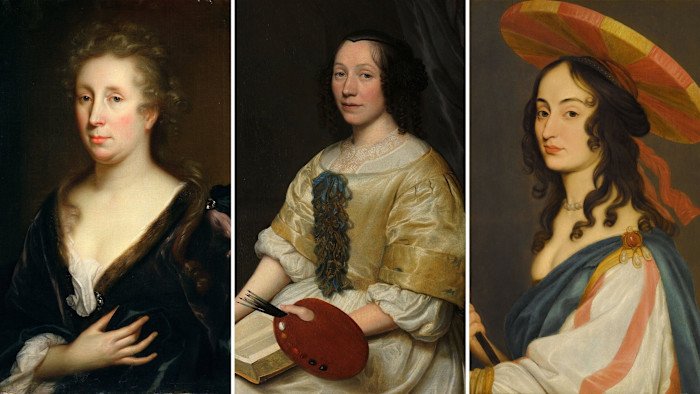
That narrative is beginning to shift. While feminist art historians Linda Nochlin and Ann Sutherland Harris cast new light on Renaissance women all the way back in the 1970s, it has taken decades for institutions to catch up. The recent resurgence of Ruysch, the subject of a major retrospective at the Museum of Fine Arts in Boston last year, and Michaelina Wautier, whose history paintings, still lifes and portraits will go on show at London’s Royal Academy later this month, signals a growing effort to reinsert these artists into the story. Their work appears in Unforgettable alongside the likes of Leyster, Van Oosterwijck, Louise Hollandine and Clara Peeters.

“You feel that people really want to hear and see work by these women,” says MSK curator Frederica Van Dam. Far from working in obscurity, she adds, many of them were celebrated in their lifetimes. Van Oosterwijck, she notes, attracted a particularly long list of high-profile patrons. “She was one of the most important still-life painters of her time, yet despite her contemporary fame and inclusion in early artists’ biographies, later art historians — mainly writing from a male perspective — failed to give her the attention she deserved.”
Van Oosterwijck was just one of many women who slid from fame to footnote after her death. Writing in 1751, the Dutch biographer Johan van Gool praised the portrait painter Margaretha Wulfraet for the “purity of the brush” which “delights connoisseurs and earns their fullest approbation”. Her “Courtesan with a Feathered Headdress and a Lap Dog” (c1700-50), included in the exhibition, showcases her accomplished sfumato technique and adept rendering of a semi-nude figure — all the more striking since women were largely discouraged from studying the naked body. On her death, her estate inventory listed more than 50 paintings, yet only a small number of works by Wulfraet are known to survive today.

Johanna Koerten, a paper cutter, fared similarly. She was the subject of a nine-page panegyric in Arnold Houbraken’s three-volume The Great Theatre of the Netherlandish Painters and Paintresses (1718-21), in which it was declared that “Her noble scissors conquer the chisel and the brush” — and yet few works by her still exist. Such disappearances, Van Dam argues, are a consequence of the gendered hierarchies later imposed by art historians. “Things such as paper cutting or calligraphy didn’t get much attention after the 19th century,” she says. “Because of that, women like Koerten completely vanished from our collective memory.”
It’s why Van Dam and her co-curator, NMWA’s Virginia Treanor, didn’t just focus on painting and sculpture. Their three-year research project brought together 150 objects also spanning papercutting, printmaking and lacemaking. “In the 17th century, there was not such a division between fine arts and decorative arts,” explains Van Dam. “In the 19th century, art historians made this more artificial type of division. But by doing so, they eliminated a lot of disciplines in which women excelled.”

Lace, one of the Low Countries’ most sought-after luxury goods, was almost exclusively produced by women. Yet while their work is everywhere in Dutch and Flemish portraiture in the exquisite ruffs worn by wealthy sitters, Van Dam points out that almost nothing is known today about the lives of the makers themselves. “I think it’s time to bring this art form back into the debate, however, because it was such an important part of the cultural economy in the Low Countries at the time.”
Another factor in women’s art-historical absence was the widespread misattribution of their work to male painters. Because women were more likely to receive artistic training within family workshops, their paintings were frequently absorbed into the oeuvres of fathers, brothers or husbands. “We can see this, for instance, in the work of Maria Schalcken,” says Van Dam. “Her signature was deliberately removed and overpainted with that of her father’s, probably to increase the work’s market value.”

A similar fate befell Leyster, whose remarkable self-portrait (c1630) — on loan from Washington’s National Gallery of Art — shows the artist in her early twenties seated at her easel, turning confidently towards the viewer with a grin. Active between 1629 and 1635, Leyster brought her expressive vision to merry scenes of people drinking, laughing and playing music. She signed her works with a distinctive monogram: her entwined initials and a star — a play on her name, which means “lodestar” in Dutch.
“For a long time, Leyster’s signature remained in the dark,” Van Dam explains. “She used a monogram, and over time it was no longer recognised or linked to her. Her paintings were instead attributed to her husband, Jan Miense Molenaer, or to Frans Hals — and they gained fame for her work. It wasn’t until 1893, when Cornelis Hofstede de Groot identified the monogram, that the connection was made. Even then, it took until the 1970s for Frima Fox Hofrichter to give Leyster the research she deserved.”
Thanks to these efforts, Leyster’s star is once again on the rise. Two of her works will hang in a room dedicated to portraits and self-portraits under the theme of “identity”, a key part of the exhibition for Van Dam. “You can’t get any closer to these women than by looking in their eyes and seeing how they wanted to represent themselves,” she says. The curator hopes these images will stay with visitors long after they leave. “That people will never forget what they saw of these women, that they will continue to be touched by the artworks, but also by their personal stories.”
March 7-May 31, mskgent.be
Find out about our latest stories first — follow FT Weekend on Instagram, Bluesky and X, and sign up to receive the FT Weekend newsletter every Saturday morning
[ad_2]
Source link