
[ad_1]

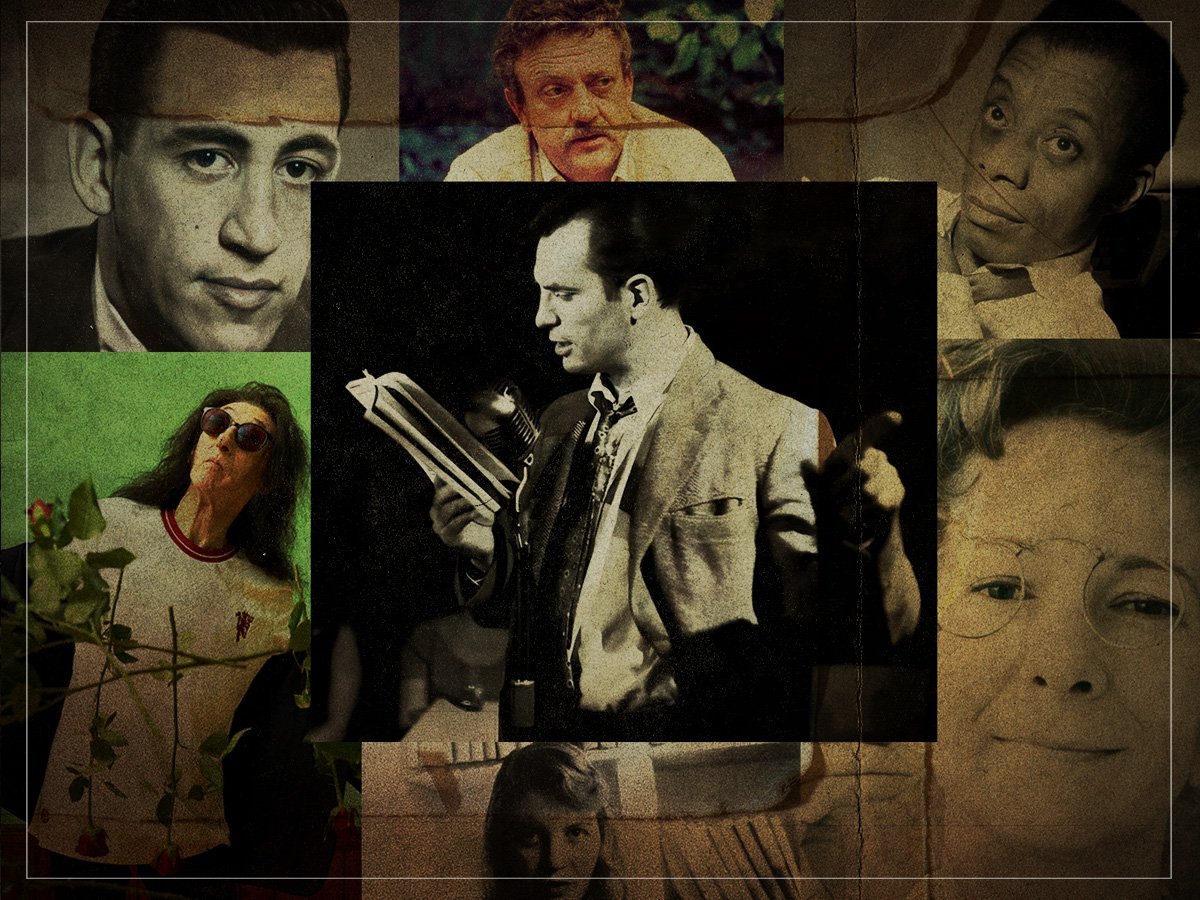
(Credits: Far Out / Alamy / Poetry Foundation / Press)
The famous beat writer William S Burroughs once said, “Artists to my mind are the real architects of change, and not the political legislators who implement change after the fact.” It is a statement that holds more than a grain of truth. It is quite literally impossible to envisage a world where artists like The Beatles simply never came into being. If things feel dystopian now, imagine what it might be like without the subversive stirring of art.
Music’s power to reach out from the sequestered clutches of ‘culture’, grab the world at large by the lapels and shake it like a Skoda going over a cattle grid is not only profound but essential. However, it is no revelation that musicians are constantly trying to distil and impart in five minutes of song what the source material that inspired them did in reams of pages. Prose and print are never far away from treble clefs and crotchets.
In his memoir, Bob Dylan discusses the huge impact that authors like Fyodor Dostoevsky had on him as a young man and how, years later, he turned Anton Chekhov’s works into Blood on the Tracks. The world of literature allows art to meet with its reader one-on-one, and the gut punch of that introspective inspiration is still central to spawning music and the evolution of the arts.
As Bob Dylan once said, “Art is the perpetual motion of illusion. The highest purpose of art is to inspire. What else can you do? What else can you do for anyone but inspire them?” The nature of the printed word still makes this the primary place to plug into to get your brain whirring.
Below, we’re taking a look at the prominent writers who changed culture irrevocably and brought the world of music along, clinging to the coattails of progress through prose and poetry in motion.
The writers who shaped modern music:
Jack Kerouac
Jack Kerouac once commented, “The only truth is music.” It is a short epithet that illuminates his love for the art form and his zest for the soul made sonic or elucidated in print. On his piano-backed jazz album with Steve Allen, he eulogises the formative bebop musician Charlie ‘Bird’ Parker. He describes descending into a dark, dingy, dive bar and having it bloom into kaleidoscopic light like a flower beckoned from bud into blossom by the half-note-sun of Parker’s blistering playing.
Charlie Parker “burst his lungs to reach the speed of what the speedsters wanted, and what they wanted was his eternal slowdown.” He signed off with the lofty assertion that he was “musically as important as Beethoven, yet not regarded as such at all.” Kerouac’s passion for Parker, jazz in general, and a lust for the rhythms of life are eternalised in his seismically seminal novel On The Road, where on the inside sleeve is a quote from Bob Dylan saying, “It changed my life like it changed everyone else’s.”
David Bowie, too, was so stirred up by Kerouac’s life-giving words that he packed up his belongings from the sleepy suburbs and embarked on London life, dizzying himself in the beat otherworldliness of Bond Street that left an indelible hue on his work forevermore. Kerouac may not have been the first to dip his pen in ink and paint the poetry of the street, but he propagated it with such uncompromised profusion that the world of culture would never be the same again.
The beat movement that Kerouac would be crowned king of brought the world Bob Dylan, Odetta, Paul Simon and just about every single musician that followed in the 1960s. Behind the movement was Kerouac’s singularity and steadfast view to conform to a sovereignty of one. Kerouac’s failings and successes were personified by uncompromising creative intent and a desire to be an artist, unlike the ‘entertainers’ of old, yet just as keenly among the people. Teetering on the brink of destitution, his outlook, like many of the folks around him, was that if he was going to fail, he would fail on his own terms, unlike his forebearers. In many ways, that is the mantra that alternative musicians and artists live by to this very day.

William S Burroughs
The beat author, William S Burroughs, was a central figure in the music industry. His friendship with David Bowie, Lou Reed and other prominent musicians meant that his impact was felt in an almost direct sense. These people could quite literally ask him for advice, and he would be forthcoming with it.
Bowie and a range of other artists were not only inspired by the inherent weirdness of his work and its refusal to conform to conventions but also by his word cut-up technique, which would be used by many artists to overcome writer’s block. Channelled in the refrains of The Velvet Underground’s music, he made it clear that things could be rendered edgy how you say things not just what you were saying.
Perhaps the finest distillation of these matters coming together in one song has to be Bowie’s Ziggy Stardust anthem ‘Moonage Daydream’. “I’m an alligator / I’m a mama-papa coming for you,” has to be one of the most unforgivably original and ecstatic opening lines in music. Accompanied by the biting sound of the music, it is truly startling. But in truth, it could easily be taken from the pages of Burroughs.
His most prominent impact on music, however, is simply the extreme daring of his prose. When Junkie was released in 1953, it served as an incendiary attack on decency and controversially challenged American ideals of what can be spoken about in art, much in the same way that fellow New York denizens The Velvet Underground would do over a decade later.

James Baldwin
The point when music became political requires a fine-tuned investigation, but there is no doubting that in the 1960s, music firmly entered the civil rights movement, and protest songs took on a life of their own. Perhaps the most central artistic figure within the movement was James Baldwin.
Baldwin once wrote: “All I know about music is that not many people ever really hear it. And even then, on the rare occasions when something opens within, and the music enters, what we mainly hear, or hear corroborated, are personal, private, vanishing evocations. But the man who creates the music is hearing something else, is dealing with the roar rising from the void and imposing order on it as it hits the air. What is evoked in him, then, is of another order, more terrible because it has no words, and triumphant, too, for that same reason. And his triumph, when he triumphs, is ours.”
This poetic profundity typifies his uncanny knack of being able to judiciously dissect the murky and lift off the fog, making the complex simple and the politically nettlesome morally unambiguous. The impacts of his work on civil rights and egalitarian politics meant that – in the same manner, that he declared of musicians – his triumph was ours too.
During his career, Baldwin bravely took the arts to the frontline. The notion of the male tweed-clad poet with a pipe and a pint of warming bitter is a far cry from the figure that Baldwin cut of a peaceful revolutionary braving firehoses and batons in Birmingham. In his wake was a battalion of musicians inspired by his affirmation that creativity can bring about change. In this regard, his work not only led to an exponential increase in forthright protest music, but it has ties with the inception of rap and other genres that told the unmitigated truth of the streets and exultantly alleviated suffering in doing so.
All in all, Baldwin championed a notion via his passion for the power of expression that when times are unsettled, music makes the path clear; it may not make the path simple, but it certainly blows off the frivolous details masking the potholes and guides us around unseen junctures like illuminating headlights. Sadly, unlike his beatnik contemporaries like Jack Kerouac or William S Burroughs, his relevance is not confined to influence, but more so to the fact that the same messages he was disseminating in poetical tones back in the middle of the last century still need reiterating today.

Wisława Szymbroska
In Europe, rock ‘n’ roll came over like a benevolent gift from America after the horrors of the war, but in many ways, a cultural revolution was already underway thanks to bold creatives like Wisława Szymbroska, who made sure that youth had a voice and women had a place in art and politics.
Her work had a quality that all musicians seem to crave: it was ahead of its time. The sheer caustic force of her words calls out for the vicious violence of a searing guitar. Szymbroska’s emboldened stance and innovative way with words were key to experimental European genres like Krautrock and electronic music.
Her poetry didn’t skirt around the issues of the war and subsequent terrorism in her native Poland; she eviscerated the subject with a pure brute forcefulness that the European rockers who followed would have to attempt to catch up to. In a sense, she not only pioneered something akin to punk poetry but also sent out a message that art could touch on any subject you wished.
How could an aspiring musician read a poetic verse like – “They think as long as it takes, and not a second more, since doubt lies lurking behind that second…” – and not want to set it to music?

Sylvia Plath
In recent years, the legacy of Sylvia Plath has, unfortunately, become embalmed in the melodrama of morbidity. Plath herself had the best answer to this when she wrote, “Even amidst fierce flames / The golden lotus can be planted”. This meddling of beauty and darkness can be seen continually throughout music. Plath is far from the first to illuminate a dirge with the sanguine hue of hope and beauty, but her brutal way of doing so and the very notion of her boldness as a female artist in oppressive times had a reverberating impact on culture at large.
In the same sense as Kerouac, she wrote firmly from the perspective of youth, a trait that rock ‘n’ roll would seize upon. Plath clearly never wrote with a yearning notion of acceptance or appraisal from her peerage in mind. She wrote with the passionate sincerity that only youth can harness. Her work was pop culture in a sense, and it proved that it could be high-brow.
A plethora of artists have eulogised her as inspiration from Patti Smith to Nick Cave, many more have mentioned her directly in a song from Lana Del Rey to Lady Gaga and even the latest wordsmiths on the scene Fontaines DC have written lines such as “None can pull the passion loose from youth’s ungrateful hands,” which she would have proudly housed in an anthology of her own.
Plath came along and seized the seething passions of youth, thrived on naïve recklessness, and made the sort of art that usurpers the status quo, and spawns a new generation of its own in a way that was prognostic of punk at its best. Along the way, she celebrated music too, writing wonderful lines like, “I shut my eyes, and the music broke over me like a rainstorm”.

Kurt Vonnegut
Kurt Vonnegut’s anti-war novels would become central texts within the counterculture movement. He looked at the world in the most colourful way possible without losing sight of what was black and white, and as such, he made it clear to contemporaries that political discourse did not simply belong to those in ties.
This paradoxically clear yet kaleidoscopic view of the world was propagated in simple prose, and as filmmaker Bob Weide puts it: “What high school kid isn’t gonna gobble [that] up!” Many musical schoolkids certainly did, with Jerry Garcia and many others citing him as a major influence on their work.
His impact on music might not have been quite as direct as some of the others on this list, but in terms of turning people onto the arts and elucidating complex philosophies in the most joyously engaging way, he inspired legions of fans to engage in the cathartic practice of creativity. And he informed many more about the vital voice that art has when it comes to political change.
As he put it himself, “Practicing an art, no matter how well or badly, is a way to make your soul grow, for heaven’s sake. Sing in the shower. Dance to the radio. Tell stories. Write a poem to a friend, even a lousy poem. Do it as well as you possibly can. You will get an enormous reward. You will have created something.” We might eulogise our musical heroes to the point that they sit on a shaman-like pedestal, but at the end of the day, that’s all they’re doing too.
Vonnegut made art that inspired change with great humour and a zeal for life that encouraged musicians to follow suit.

John Cooper Clarke
In the paraphrased words of Hunter S Thompson, Dr John Cooper Clarke is one of God’s own prototypes, too weird to live and too rare to die. The eponymous punk poet was inspired by Charles Baudelaire’s poetry of street, but rather than plant flowers amidst the cobbles, Clarkey took note of a notion that the nearly-forgotten folk artist Rodriguez put it forth in lyrical form: “Cause how many times can you wake up in this comic book and plant flowers?”
Clarke is not concerned with planting flowers; he simply wants to laugh at the comic book. His poetry consists of wild wordplay that achieves a level of satire that nobody outwardly hoping to philosophise street life could ever wish to achieve. He makes it clear that encapsulation comes by proxy. And with a bludgeoning lyrical wit, he makes a mockery of bromidic, banal poetry pronounced with faux-poignancy and a stiff upper lip.
He was not only there at the birth of British punk, but his nurturing presence within it added some much-needed style to the snarling substance. He has been ever-present in the world of music ever since.
Alex Turner of the Arctic Monkeys has been a disciple of Clarke’s throughout a career that has seen him become established as one of the most prominent literary songwriters of recent times. Turner took up where his hero John Cooper Clarke had left off, who in turn had been inspired by the soot-covered sonnets of Baudelaire, making Al and a slew of other artists just the latest in a long line of loveable reprobate revellers from the demimonde to propagate the poetry of the street, much like the forbearing Clarke, his wordplay very much the ingrained language of youth culture. A language that Clarke helped make funny and spat out snarls from the side of his mouth that has been emulated ever since.

Dr Hunter S Thompson
The writings of Hunter S Thompson are deeply ingrained with the world of music and the culture surrounding various music scenes. His pure daring and determination to stay well within the mad and groovy demimonde was a freak ethos that musicians have tried to follow forevermore.
As a writer, he engrossed himself in the world of pop culture rather than trying to observe it from a far, and that stretches way beyond his Gonzo style of journalism. He wanted to be in and amongst what was happening not just to place himself in the story or capture a moment from a ground-level perspective. He wanted to change what needed changing and celebrate what he thought was right. In short, this was reflected in the collaborative artistic milieu of the sixties and seventies.
There is, of course, no way to prove this, but I would be surprised to find a musician’s bookshelf that doesn’t include a copy of Fear and Loathing in Las Vegas – it is pure kerosene for music. This relationship flowed both ways, as Thompson put it himself: “Music has always been a matter of Energy to me, a question of Fuel. Sentimental people call it Inspiration, but what they really mean is Fuel. I have always needed Fuel. I am a serious consumer. On some nights I still believe that a car with the gas needle on empty can run about fifty more miles if you have the right music very loud on the radio.”
When you add to that proposition that he also had impeccable taste in music, hailing Dylan’s classic ‘Mr Tambourine Man’ as the hippie national anthem, you have yourself an influential figure in the field of literature and music whose influence is still felt.

JD Salinger
It is perhaps telling that the phrase that JD Salinger’s The Catcher in the Rye helped to popularise was “screw up”. These days, that term is even in the Oxford English Dictionary, and it comes with the concise definition: “To make something go wrong”. Now, it certainly would be the harshest criticism of all to say that the 1951 novel screwed up culture entirely, but it is a mark of the text’s lasting mystique that there is a definite whiff of that lingering in the welter of its pungent societal miasma.
Part angsty juvenile drivel, part visceral cutting prose, the book remains as confounding as ever, but there is no getting away from the fact that Salinger certainly hit upon something given that it is still appraised today. The synopsis may be vague, but that has helped it permeate. In brief, it is about an angry teen battling against the rewards of conformity and trying to drift into adult society like a square peg in a hole that isn’t even there. If that disquietude of a kid who doesn’t really know what he is but is certain that he does not sound like the entirety of MTV, pop-punk, Nirvana and so on, that’s because it is.
The triumph of the novel and the reason for its influential longevity exists in the simple fact that it changed the way that the youth are portrayed in fiction. Suddenly, the notion of American adolescence was touched upon and rendered three-dimensional, albeit that depth was largely coloured a shade of dower grey. Neither hero nor anti-hero, just a humourless kid, the idea of the teen as a societal iconoclast was borne from these pages.
Why then, did this segment open with the notion that The Catcher in the Rye screwed things up if it brought about liberating change, amplified the voice of the youth and helped to propel pop culture? Well, two reasons, really; the first being that it simply isn’t all that great of a book. It doesn’t have the lustrous prose of the likes of On The Road that followed or the gripping colour of something like Junky or even the joie de vivre of the British equivalent, Sunday Night & Saturday Morning. In fact, Catcher in the Rye has nearly always struggled with critical discerning.
But that barely matters in many ways, because it was punk.

Maya Angelou
Maya Angelou once said, “If only one could be sure that every 50 years a voice and a soul like Odetta’s would come along, the centuries would pass so quickly and painlessly we would hardly recognize time.” But her praise for the folk star who inspired Bob Dylan to take up the acoustic was not one-sided, the music world recognised Angelou as a great creative force, too.
Before becoming a renowned writer, Angelou was a singer and dancer herself. She even released the studio album Miss Calypso in 1957. Even in this rather kitsch offering, she looks to channel the experience of women and African Americans through billowing culture—the mode that would become the mainstay of her inspiring writing. Lyrically, the themes that she ecstatically expounded are still pertinently echoed today.
From modern hip-hop stars like Kendrick Lamar to soul stalwarts like Nina Simone, a plethora of artists have cited her soft yet bold and important tone as pure inspiration. She even collaborated with the likes of Quincy Jones, lending spoken word pieces to the film Cactus Flower. As she said herself, “Music was my refuge. I could crawl into the space between the notes and curl my back to loneliness.” Well, hers is the back that helped to prop up countless musical movements in turn. She added soul to protest and plenty of others followed her message: “I’ve learned that people will forget what you said, people will forget what you did, but people will never forget how you made them feel.”

Related Topics
Subscribe To The Far Out Newsletter
[ad_2]
Source link
Other Articles

10 artists that went against their audience
Juried exhibit presents best fine art from across the region