
[ad_1]
When Richard Serra died yesterday, I flashed back nearly 30 years to a morning at the Metropolitan Museum of Art, looking with him and with his wife, the German-born art historian Clara Weyergraf, at Jackson Pollock’s splash and drip painting from 1950, “Autumn Rhythm.”
We had decided to meet as soon as the museum opened, when the gallery, at the far end of the Met, would still be empty. Taking in the painting, Serra had the air of a caged lion, pacing back and forth, moving away, to see it whole, then back in to inspect some detail.
“We evaluate artists by how much they are able to rid themselves of convention, to change history,” he said. Which was Serra’s bottom line — in his case, nudging sculpture into new territory. Why else be an artist? This was how he thought. Old-school. Old Testament. For him, art was all or nothing.
Of course he wasn’t alone in his thinking among American artists of his generation, the offspring of postwar American power and arrogance, of titans like Pollock.
That said, not many artists accomplished what he set out to do, in the process seeing public perception of his work flip 180 degrees.
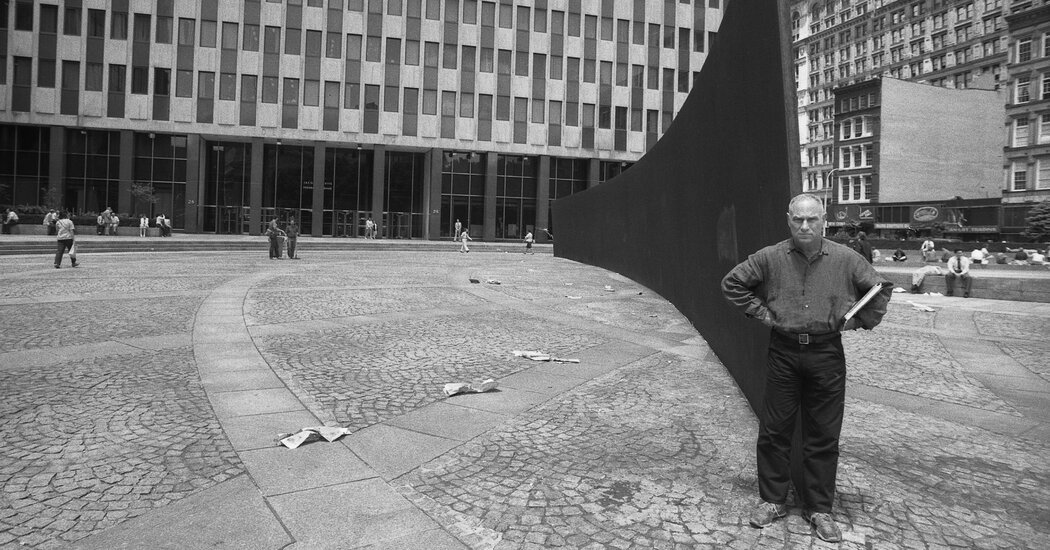
All these decades later, a wide swath of the public today continues to be baffled and occasionally galled by Pollock, just as it didn’t get Serra for years. “Tilted Arc,” the giant steel sculpture by Serra, was still a fresh wound when we visited the Met. Public officials had removed it from a plaza outside the courthouses in Lower Manhattan in 1989. Fellow artists objected to the removal, but office workers who ate their lunches in the plaza implored City Hall. They saw it as an intrusion, an ugly wall, dividing their precious open space. Serra still wore his fury like a badge of honor.
“I think if work is asked to be accommodating, to be subservient, to be useful to, to be required to, to be subordinated to, then the artist is in trouble,” he said.
It was now two decades later and thousands of his adoring fans filled an auditorium in Brazil. He and I had flown to Rio to do a public talk. The audience had come to hear the lion roar. By then, he and his voice had softened. But not his message.
He compared art with science. You don’t advance science by public consensus, he said. Then he described the time he had splashed molten lead against the wall and adjoining sidewalk of a museum in Switzerland, an act that so appalled uptight Swiss residents that the work was removed after only a few hours.
He was thumbing his nose at the stuffy sanctity of the museum, he explained, claiming the side of the building as part of his sculpture, and at the same time swapping industrial materials like lead, steel and rubber for the traditional tools and conventions of his craft, like marble, pedestals and clay.
Around the same time, he lifted up the edge of a sheet of discarded rubber scavenged from a warehouse in Lower Manhattan, making a kind of tent, balanced just so — a topography, implying action. He wasn’t trying to make something crowd-pleasing or familiar or beautiful, he recalled. It wasn’t beautiful. It was an experiment.
Was it art?
That was the question.
It was the same question Pollock raised when he painted “Autumn Rhythm.” Pollock had also stalked the canvas, as it lay on the floor of his Long Island studio. He prowled its edges with sticks, dripping and ladling paint. Lines in the picture recorded his choreography.
“Autumn Rhythm” was a pure abstraction, depthless, describing only itself, not an image of anything else — a floating field of wild, exquisite tracery that viewers would need to navigate and decipher for themselves. Even Pollock wasn’t sure what it signified.
Pollock “had to have remarkable faith that the process would lead to fully realized statements,” Serra said. “After all, he didn’t know where he would end up when he started.”
Serra had started his meteoric career as a volcanic presence in the downtown art scene of the 1960s, which today has the bittersweet whiff of a faded Polaroid. It was a cobblestone and cast-iron version of Russia in the 1910s, driven by ego and revolution. Serra occupied a loft with the sculptor Nancy Graves and without running water that cost about $75 a month and he fell into a community of ingenious and groundbreaking composers, dancers, writers, filmmakers, musicians and other artists, among them Trisha Brown, Joan Jonas, Steve Reich, Philip Glass, Spalding Grey, Michael Snow, Chuck Close, Robert Smithson, Michael Heizer. The list goes on. Cheap rent, available real estate and restlessness. The cocktail of urban creativity and change.
“There was a clear understanding among us that we had to redefine whatever activity we were doing,” is how Serra described the scene to the crowd in Rio.
By then, a global public had come to adore his elliptical mazes of twisted Cor-Ten steel, the culmination of his sculptural pursuits. They were democratic adventures, depending on what you brought to them. A moviemaker once told me that walking through them reminded him of an unspooling film, with twists and turns leading to a surprise ending. A writer on the Holocaust once likened their high walls to pens.
I always found them to be serious fun. They concentrate the mind, stirring fear and anticipation, changing inch by inch, step by step. Serra magically transforms folded, tilting walls of rolled steel into what can almost resemble planes of melted wax. Passages, like caves or canyons, narrow and looming, suddenly open onto clearings. When Serra was given a retrospective at the Museum of Modern Art in 2007, one of the most spectacular shows of the current century, I found a trio of half-naked sunbathers reclining on the ground inside “Torqued Ellipse IV,” which occupied a patch of the museum’s garden.
So what changed over the years to bring the public around?
I’m not sure it was Serra, who stuck to his guns. There is a work by him called “1-1-1-1,” from 1969, which consists of three tilting steel plates held erect by a pole resting on top of them, itself stabilized by a fourth plate teetering on its end. It looks scary and precarious, but the balancing act can also remind you of Buster Keaton.
It used to be described as obdurate and menacing. But that is not, I don’t think, how Serra ever saw his work. After the MoMA retrospective, I passed a late summer afternoon in Italy, watching Serra patiently, quietly accompany my older son, who was still in grade school, around the ancient temples at Paestum. Serra spoke, as if to an adult, about the swell of the weathered columns, the weight of the stones, the way the stones balanced on top of one another and held each other up. For him, sculpture distilled to its essential qualities — mass, gravity, weight, volume — was our shared language and legacy, an eternal poem to which great artists add their contributions over the centuries.
“I don’t know of anyone since Pollock who has altered the form or the language of painting as much as he did,” he told me back in that gallery with “Autumn Rhythm.” “And that was, what, almost half a century ago?”
It’s hard to think of artists who have done more than Serra over the last half century to alter the form and language of sculpture.
[ad_2]
Source link
Other Articles

Gregory Lewis Collaboration Unveiled at Gallery 211