
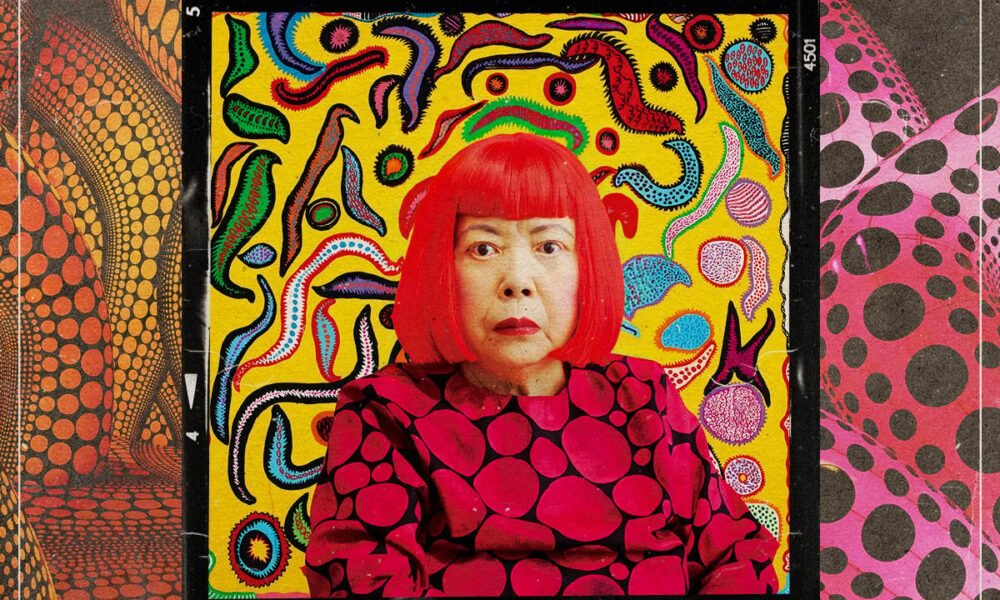
The hallucination behind the polka obsession of Yayoi Kusama

(Credits: Far Out / Yayoi Kusama / David Levene / Manchester International Festival)
Any artist or creative person worth their salt can tell you that the greatest inspiration comes in the most unlikely forms. David Hockney found inspiration in the sunshine of California, L.S. Lowry in the industrial landscape of Salford, and Mark Lombardi in the financial conspiracies of 1990s America. When it comes to the distinctive artistic style of Yayoi Kusama – perhaps the greatest contemporary artist in Japan – the seemingly disparate collection of polka dots, patterns, and vibrant colours comes from a very specific childhood memory.
From her early days of creating avant-garde-inspired work in the desolate post-war landscape of 1940s Japan, Kusama had never been particularly concerned with issues of normality. Her highly expressive, abstract work transcends styles, time and artistic trends. Having influenced everybody from pop art progenitor Andy Warhol to experimental filmmaker Joseph Cornell, Kusama eclipsed her modest beginnings in Matsumoto to become one of the most recognisable and revered artists in all the land.
Seemingly, this lineage of expressionism started in the unlikely surroundings of Kusama’s childhood dining room. “One day, I was looking at the red flower patterns of the tablecloth on a table,” she once explained, “And when I looked up, I saw the same pattern covering the ceiling, the windows and the walls, and finally all over the room, my body and the universe”. Soon, that same pattern would enmesh every aspect of Kusama’s artistic career.
That specific incident within her maternal home would later inspire a 1954 painting of a flower untitled. Eventually, though, these pretty polka dot patterns would become an unavoidable aspect of Kusama’s artistic identity. Over the years, she has envisioned everything from pumpkins to a live horse in her own psychedelic polka dot style, earning her an audience around the world.
In photography, there is the theory of ‘the definitive moment’, purported by Henri Cartier-Bresson. While there is a lot of debate about exactly what Cartier-Bresson meant, the essential idea is that a photograph is capable of capturing an intensely critical moment in time, something that might feel insignificant in a passing moment but, when studied, can reveal something of life-altering importance. If a photographer had been present in the dining room of a young Kusama, then that moment of her gazing down upon a seemingly insignificant tablecloth is the ‘definitive moment’ of her life.
Such a fact was not lost upon the artist herself, who reflected upon this transcendental definitive moment, saying, “I felt as if I had begun to self-obliterate, to revolve in the infinity of endless time and the absoluteness of space.”
If you were to look upon the works of Yayoi Kusama, it would be fair to assume that that feeling of self-obliteration never waned. Even today, the 95-year-old is still as tirelessly creative and groundbreaking as she always was. From the tablecloth of a small home in Matsumoto, Japan, to the most exclusive art galleries around the world, she rules the hearts and minds of art lovers everywhere.





No Comment! Be the first one.