
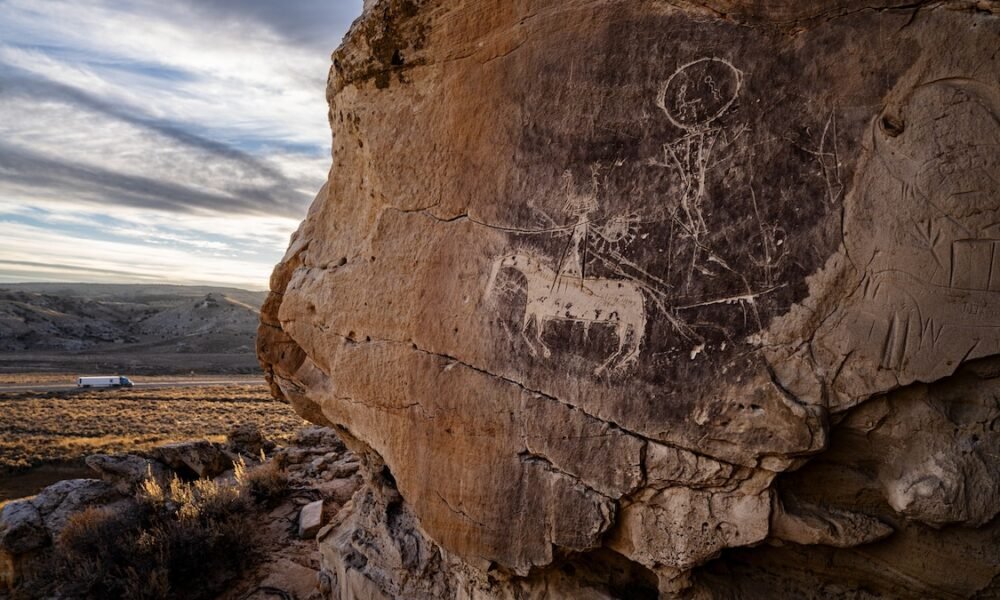
See how ancient Indigenous artists left their mark on the landscape
“We’re so lucky that we still have our religion, our culture, and our language; every tribal nation understands the fight to preserve those,” says Chief Ben Barnes of the Shawnee Tribe, whose ancestors likely built the Serpent Mound effigy in Ohio. “Many Americans have forgotten that land itself can be sacred, that spaces can be holy. Here in the Americas, our holy spaces are Indigenous.”
Photographer Stephen Alvarez has been documenting natural wonders for nearly three decades. He founded the nonprofit Ancient Art Archive in 2016 to act as a living record of prehistoric paintings and engravings worldwide. Now he has focused his lens on America’s murals—an effort to put this nation’s 250th anniversary, in 2026, in the context of millennia-old history. “The landscape tells its own story,” says Alvarez. “What happened to it over time, who lived there, and what they did. You cannot separate the artwork and the landscape.”
(A photographer makes luminous images of Mexico’s Indigenous people.)
For the archaeologists, anthropologists, ethnographers, artists, and other knowledge keepers—both Native and non-Native—who have spent much time studying and preserving these artworks, they are masterpieces, as well as miracles, withstanding the elements for centuries so people may wonder at and about them today.
None of us want to fade away without having made our mark on the landscape.
Joe Watkins, Archaeologist (Choctaw Nation)
“None of us want to fade away without having made our mark on the landscape,” says archaeologist Joe Watkins (Choctaw Nation), who works on Alvarez’s Mural of America project. “Rock art gives us an opportunity to share insights from people who no longer walk this Earth.”



No Comment! Be the first one.