
[ad_1]
Last week, during the Frieze New York contemporary art fair, Lionel a Marca, CEO of sponsor-brand Breguet, and Jenn Ellis, the independent art curator tapped to create an exhibition for the fair, discussed the connection between watchmaking and fine art.
The London-based Ellis zeroed in on the work of Singaporean artist Dawn Ng, who is well known in the Asia Pacific region, but not as much in the U.S. “The brief was to think about time in some way, shape, or form,” Ellis says. “My stepping stone was to think about evolutionary change, the idea that when change occurs, you know time has passed.”
Ng laboriously creates 60-kilogram (about 132-pound) blocks of ice, layering in different colored pigments—acrylics, watercolors, and dyes—that freeze at different rates. With the skills of a chemist and a sculptor, she uses molds, and molds within molds, to create her colorful ice sculptures, sculpting and composing in three-dimensional space.
After two to three months of building her layer cake of ice, Ng photographs the block as it leaves the deep freeze. It is then placed on a giant tray to catch the pigments as they melt over the course of about 18 hours. A 27-minute video documents the melting process as layers peel off and cascade to the floor. When the melting is finished, she manipulates the composition of the colors, covers the melt with watercolor paper, and lets evaporation do its thing. The pigments absorb into the paper creating an abstract “ash” painting, titled Give Me Land Lots of Land Under Starry Skies, which reflects on the original photograph of the “mother” ice block.
“She doesn’t use a template, no two of these ice blocks are the same,” Ellis says. “In a way, they are these intricately created timepieces in visual, sculptural, ephemeral form.”
Advertisement – Scroll to Continue
“Among all the artists that were presented to me, I perceived right away that there was something interesting about what Jenn had done—the choices she had made in the past,” says a Marca, who went on to discuss the art of watchmaking in the context of contemporary art.
What led you to partner with Frieze?
It seemed very interesting because Frieze is contemporary art. I thought about how Abraham-Louis Breguet, in his time, was an artisan, an artist, an astronomer, an engineer, and how he really revolutionized horology.
Advertisement – Scroll to Continue
MORE: Spring Art Auctions Arrive in New York With Modest Expectations
At that time, watches were rather rococo—they had huge dials, enriched with a lot of baroque details, and they were really imposing and impressive pieces. Breguet came along with something very purified, very refined. I also thought about Mr. Breguet and his technical ingenuity, and I thought that’s really what today’s contemporary artists are doing. It’s people expressing their ideas through art.
Why partner with an art fair as opposed to a specific contemporary artist?
Advertisement – Scroll to Continue
It seemed more interesting to participate in a fair where artists and customers would be able to discover Breguet. Or, if they knew it already, they could see what we are up to, rather than try to fit the expression of an artist on a small dial. Whether an artist is working in painting or sculpture or any other medium, the dial seems too small to me.
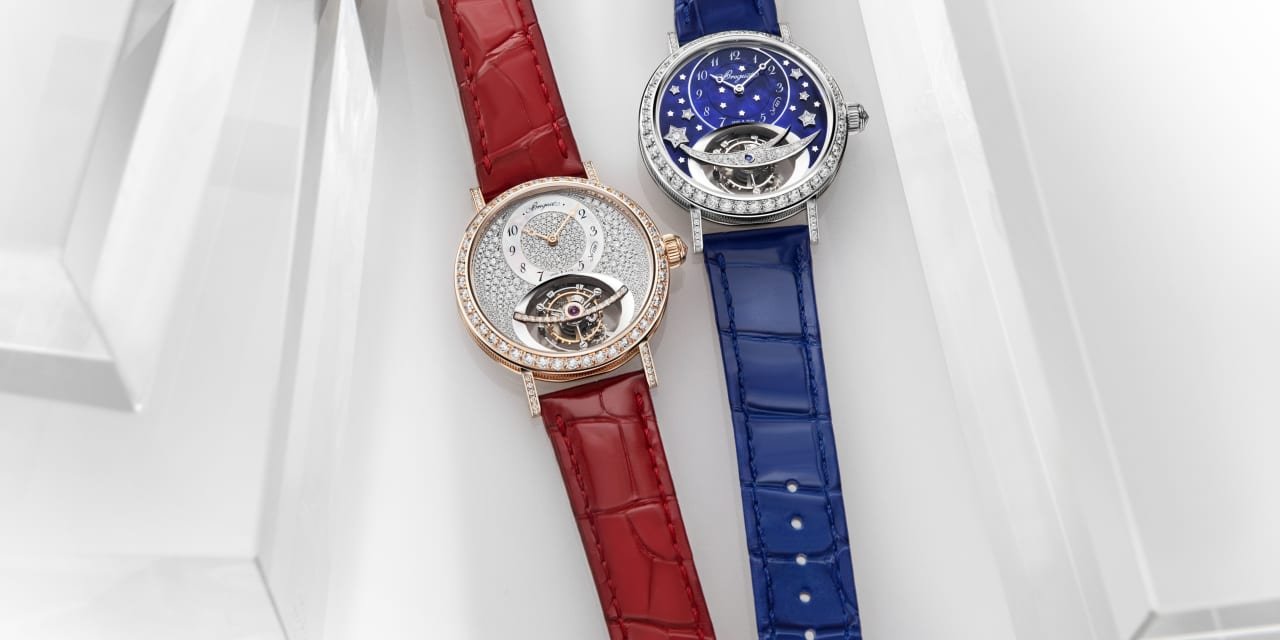
Breguet displayed two recent ladies’ tourbillons. What can you tell me about those pieces?
At Breguet, we have several tourbillons—each collection has at least one. When I looked at the former versions of these two ladies’ pieces, I thought they lacked femininity. So, in one piece, we did something more poetic: On the bridge of that watch, there is a shooting star among other stars. That’s a reference to the fact that in 1801, when Abraham-Louis Breguet invented the tourbillon, he took that name from space, because he was an astronomer. When he was looking at the stars, he got the idea of the name tourbillon, which he gave to his invention.
Advertisement – Scroll to Continue
The other piece is set with different size of diamonds around an oblong opening, giving the possibility to admire the tourbillon mechanism even more.
And what about the minute repeater that was also featured at Frieze New York?
In terms of the minute repeater, which is an emblematic piece for Breguet, what is important is the clarity and the strength of the sound. The challenge here is that it’s a small piece, and for sound, you need air, emptiness. In a closed watch, there is very little air, very little room. This was a technical advance that Breguet did. We have a minute repeater that rings loud and clear. That’s because in the manufacture, we have an anechoic chamber. There is really no external sound coming into this soundproof room, so it’s like a music studio, and we can really measure the clarity of the sound.
This interview has been edited for length and clarity.
[ad_2]
Source link