
[ad_1]

(Credits: Far Out / Rough Trade Records)
To the unsuspecting listener, all of The Smiths‘ album covers may seem like amateurish photographs of seemingly random people or concepts. While it’s not difficult to point out the various themes, like Hollywood, activism, and war, each of these tells a unique story that adds a fascinating additional layer to the thematic and political leanings of the band and the narrations that can be found within the music.
Any fan of The Smiths will know that the music was built to be challenging. Morrissey’s incredibly shrewd conviction mixed with the oftentimes upbeat musical arrangements continues to be a major talking point in discussions about the band’s tone, messaging, and wider implications. During his time within the band, the frontman also liked to tease various aspects of his own personal interests in different ways, toying with the parts of culture that best reflected his views.
This was also delivered in a blunt way that matched his lyricism well, cutting to the chase and presenting ideas and messages that were so abrupt they sparked entire cultural conversations about the importance of satire. As the singer put it in 1988: “I don’t think there’s any time anymore to be subtle about anything, you have to get straight to the point.”
Looking back, it could be perceived that Morrissey was merely priming the world for the forthcoming juggernaut of divisiveness that would become his entire personality, but for those who just want to enjoy the music, delving into each figure fronting their four studio albums is an interesting road to go down. If not for the sheer trivia of it all, it may shed some light on the overt mockery that graces the cracks of each tune.
The figures in The Smiths’ album artwork:
The Smiths
The Smiths’ self-titled debut saw the band using sex symbol, and Andy Warhol muse, Joe Dallesandro, who featured in the artist’s controversial 1968 film Flesh. For a debut album, there are a number of signs that indicate the band’s controversial stance, with Dallesandro’s inclusion merely scratching the surface. The album cover, alongside the satirical appeal of its songs, may suggest a certain self-proclaimed explosion onto the indie scene, with The Smiths arriving as a more cutting version of rock’s preceding outfits.
For a band that, as Morrissey put it, thrived on being “poetic” yet “jubilant”, the album’s cover art seems to be a perfect depiction of the array of contrasting themes. Though simple, the cover represents the ways in which controversy can exist in spaces where it’s likely expected the least. Many listeners enjoy the music without feeling the desire to scratch beneath the surface, unaware of the subtle reference to the sex symbols of 1960s and 1970s gay culture.

Meat is Murder
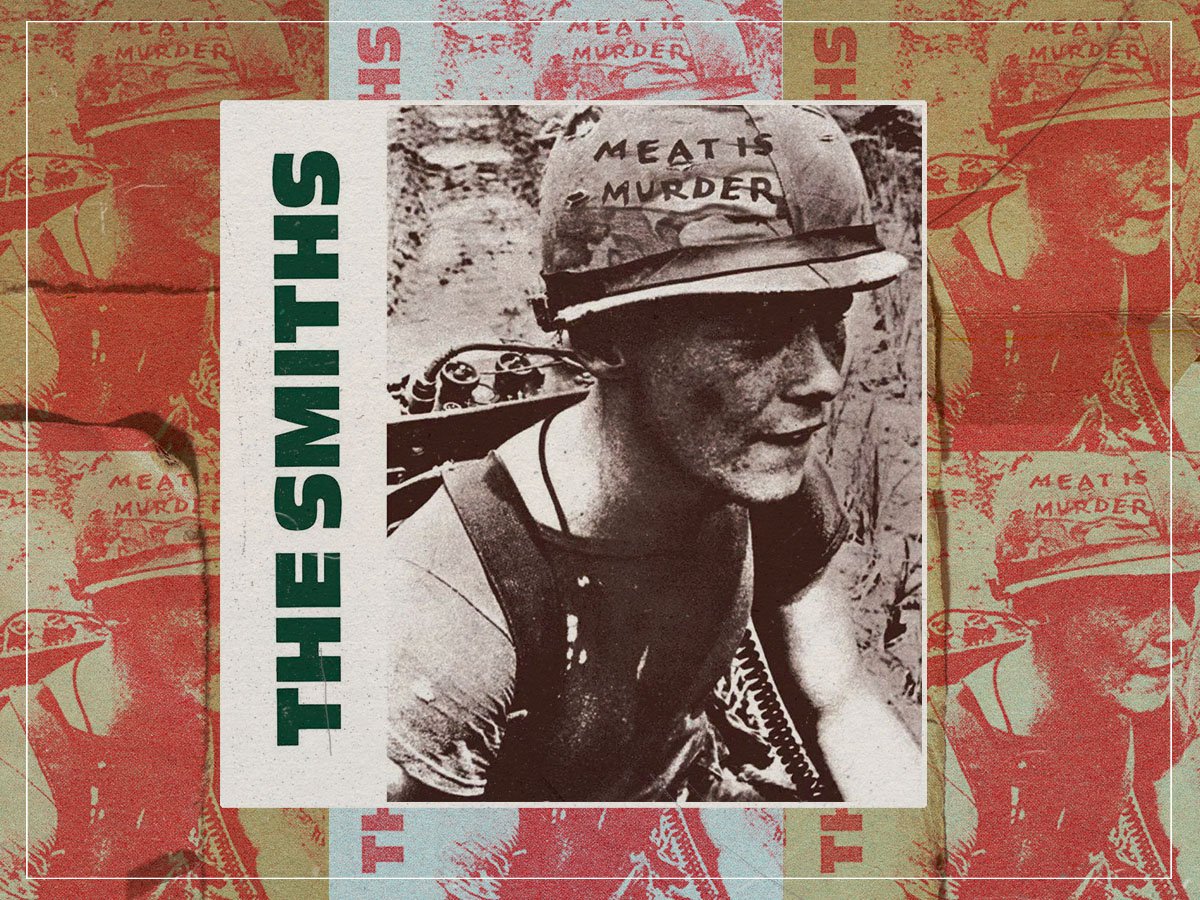
The following year, Meat is Murder showcased a more political version of The Smiths, with an album name that referenced an earlier anarcho-punk band and Morrissey’s pro-vegetarian values. They also addressed various important issues, like corporal punishment in ‘The Headmaster Ritual’ and suicidal mockery in ‘That Joke Isn’t Funny Anymore’. As a result, The Smiths appeared like no other when it came to sensitive subject matter, adopting the forthcoming anti-establishment punk-rock ethos and transforming it into endearing satire.
To complete the look, Meat is Murder adorns Marine Corporal Michael Wynn from Emile de Antonio’s controversial Vietnam War documentary, In The Year Of The Pig, replacing the slogan on Wynn’s helmet with the album title, which originally read ‘‘Make War Not Love’. This documentary was pivotal in American politics as it was one of the first to tackle the country’s involvement in the Vietnam war. Paralleling this cultural significance, Meat is Murder attempted to be revolutionary in its presentation of seemingly controversial subject matter, like vegetarianism, all with the band’s signature colloquialisms.

The Queen is Dead
Throughout the band’s third album, The Queen Is Dead, Johnny Marr’s various influences, like The Velvet Underground, came to the fore more aggressively than before. Considered by many as the band’s most accomplished album, containing hits like ‘Bigmouth Strikes Again’, ‘There Is a Light That Never Goes Out’, and ‘Some Girls Are Bigger Than Others’, The Queen Is Dead came with an album cover that perfectly matched its eloquent yet sarcastic appeal, featuring a shot of actor Alain Delon, taken from the 1964 film L’Insoumis, when he is lying on the floor dying.
Delon gave the band permission to use his image, but he revealed one aspect of the album that made him feel uneasy. He explained that his parents “were upset that anyone would call an album The Queen is Dead.” Of course, the band ignored the feedback, which aligned well with their general attitude towards potential outsider negativity: they desired to appear controversial, and any validation of that fact was worn as a badge of honour.

Strangeways, Here We Come
The band’s fourth and final album, Strangeways, Here We Come, relates to another of Morrissey’s interests, albeit in a more disconnected way. The shot on the cover is of actor Richard Davalos, taken during the filming of 1955 film East Of Eden. The image has been cropped to cut out the actor he is looking down at – James Dean. Although Morrissey’s first choice for the cover was Harvey Keitel, he settled for Davalos after Keitel refused, using a blurry image that would become strongly interlinked with the final album.
Although there are backstories to each of these figures, there remains an element of mystery that is also injected into The Smiths’ musicality. Morrissey admired James Dean, so why didn’t he choose to place him on the front of Strangeways? The various questions that arise likely have no answers, but that’s the beauty of it. The Smiths wouldn’t be The Smiths if they weren’t surrounded by a cloud of contradictions and utterly perplexing conceptions.

Related Topics
[ad_2]
Source link