
[ad_1]
I feel, as an art critic, I should know enough about how the eye works to understand this statement more completely than I do. Nonetheless, the oculist’s grasp of the “speed and intensity” of Matisse’s response to color sticks in my mind, and goes to the heart of what we mean when we describe Matisse as a great colorist. If you believe that color is linked to emotion, the oculist was telling Matisse, in effect, that his eyes couldn’t keep up with his emotions. No wonder he was concerned.
I thought about this again when I read Matisse’s own words, uttered four years before his death in 1954: “The sea is blue, but bluer than anyone has ever painted it, a color entirely fantastic and incredible. It is the blue of sapphires, of the peacock’s wing, of an Alpine glacier, and the kingfisher melted together; and yet it is like none of these, for it shines with the unearthly radiance of Neptune’s kingdom.”
When he wrote this, Matisse was in a wheelchair, wielding scissors and colored paper rather than brushes and oil paint. The sea he was writing about was, of course, the Mediterranean, at Nice, on the French Riviera. He had spent much of his life marveling at the sea, and his creative responses to it are the subject of a beautiful show, halfway between a dossier exhibition and a full-scale monograph, at the St. Louis Art Museum.
The show’s first room features Matisse’s earliest responses to the sea. The paintings are modest — but momentous. Matisse had grown up in a weaving town in France’s gray and industrial northeast. The sea, when he finally saw it, rejigged all his synapses. In the 1890s, he painted the Atlantic Ocean on Belle Île, off the Brittany coast, then the island of Corsica and, most pivotally for the history of modern art, the Mediterranean fishing village of Collioure.
On Belle Île, Matisse had met the little-known Australian John Peter Russell, a wonderful painter who had been friends with Claude Monet and Vincent van Gogh. Both the wild landscape of Belle Île (which I have visited — the blues and greens are indelible in my memory) and the impact of Russell’s innovations cracked something open in Matisse. There was no looking back.
In Collioure with the artist André Derain, Matisse unleashed colored paint in ways that seemed to have no precedent. Color was no longer descriptive in these small, hastily brushed works. Released from the obligation to match the actual appearance of things, color was now free to express sensations, memories, emotions. Color intensity became the new aim.
Matisse’s method was predicated on the understanding that colors were affected by their neighbors: A blue next to a green changed in quality if you placed it next to an orange. In Corsica, Matisse had painted a view of the bay beyond an olive tree and the red roofs of a factory. The sea beyond, he wrote, was “blue, blue, blue, so blue that you want to eat it.”
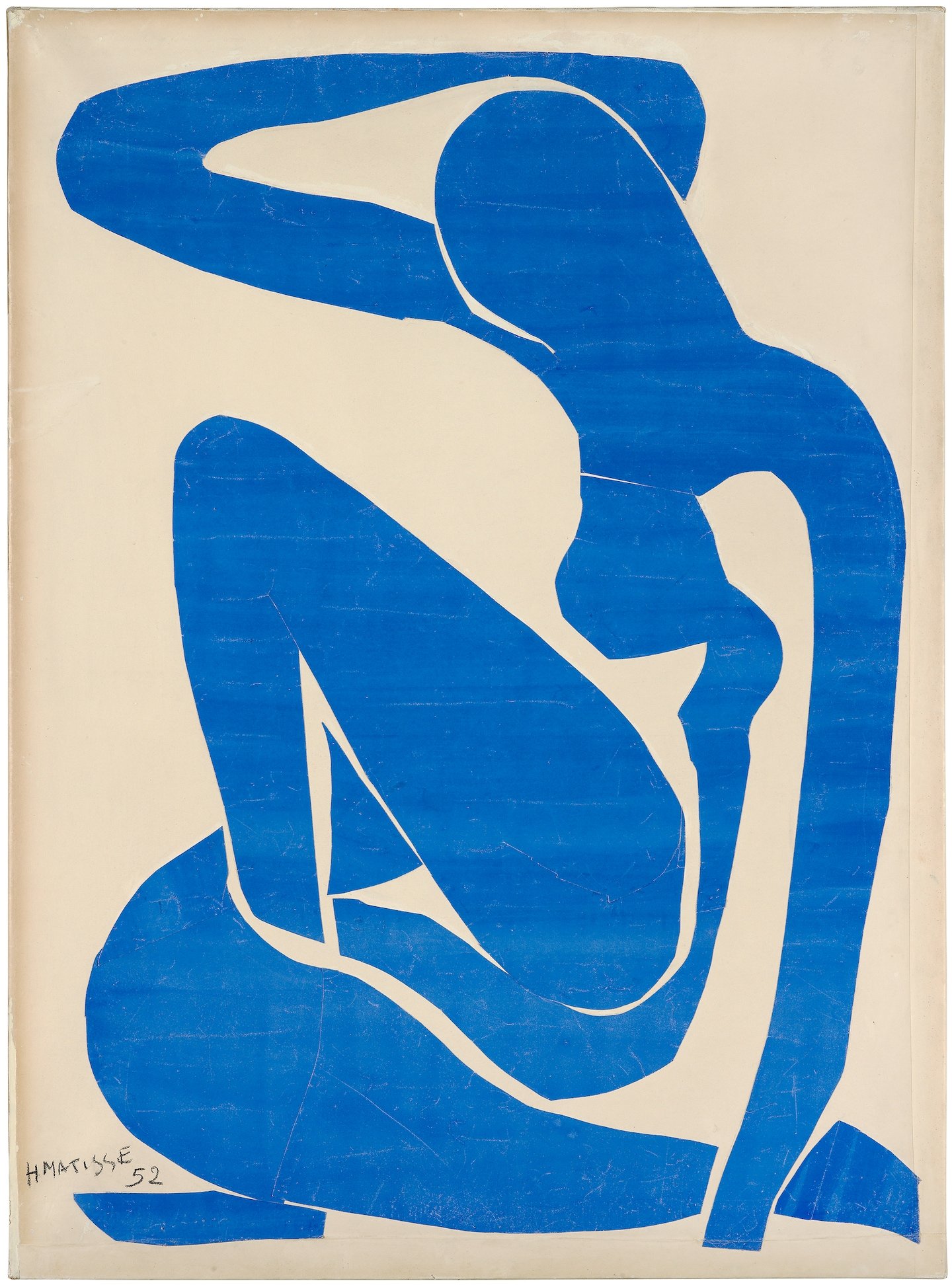
You can’t help but remember these words in the show’s final room, which features Matisse’s late paper cutouts, including his “Blue Nude I,” one of the most famous images of the 20th century. On loan from the Beyeler Foundation in Switzerland near Basel, the work is adamantly an object, a thing. It’s made from paper brushed with blue gouache (opaque watercolor), then cut into distinct shapes and pasted onto canvas.
The sea is nowhere to be seen, but the sensation of blue is astonishingly rich. A whole lifetime of distilled vision — of optics trying to keep pace with sensations — has been funneled into this magnificent work. But Matisse made it in, at the most, 15 minutes, according to his assistant and model, Lydia Delectorskaya.
There is a reason “Blue Nude I” has been reproduced on so many posters and emulated by so many people sitting in art classrooms or at kitchen tables with their own scissors and colored paper. It represents a dream of grace and modesty and at the same time of an unsurpassable sensuousness and self-confident beauty. If someone 200 years from now asked “What was modern art about?” you would show them this before anything else.
It’s pure artifice, but somehow it looks born rather than made. It has that kind of naturalness. But then you look more closely at how it was made — what precise shapes Matisse cut the colored paper into and exactly how they have been arranged to suggest presence and void, light and shade. It almost starts to make sense, but quite how Matisse arrived at these particular shapes, putting these contours in this configuration, remains deeply mysterious.
In between the exhibition’s first and final galleries are many beautiful works, but the show lacks a little in depth. The theme is compelling and worthwhile but feels too thinly spread.
Never mind. The exhibition is an excuse to show off St. Louis’s own “Bathers With a Turtle,” a hauntingly beautiful large-scale work from 1907 to 1908 that I never tire of looking at. The painting was recently studied using infrared reflectography and cross-section analyses. Various things were revealed, including Matisse’s ruthless drive toward simplicity (he removed boats and clouds from the composition and changed the figures).
I was fascinated to learn that Matisse painted the sea using two layers of the same bright ultramarine and painted the band of sky above it with blue on top of black on top of green, creating teal. The third and largest band of color is the green grass, against which the crouching figure’s orange hair and the turtle’s deep red sing out.
Nearby works — including a painting by Cézanne, some masks by the Pende people (from what is now the Democratic Republic of Congo) and sculptures by the Baga people (from Guinea), and various related works by Matisse himself — all suggest the influences and preoccupations that flowed into “Bathers With a Turtle.” But it remains one of the strangest great paintings of the modern era.
Matisse traveled to French Polynesia in 1930, and one section of the show features the paper cutouts and large-scale screen prints he made, many years later, remembering swimming and diving there.
Matisse’s earlier views onto the sea from the series of hotel rooms he occupied in Nice from about 1917 can seem like a slackening off, an exhalation, even a slide into complacency after the strenuously radical years of his great “decorations” and his competition with Pablo Picasso.
I don’t see it that way. The Nice works, often animated at the center of the composition by a slender strip of blue and a palm tree or two, include some of his most fully realized compositions. Very few of them surpass “Interior at Nice,” on loan to St. Louis from the Art Institute of Chicago. The gold-on-tan-and-gray walls of the hotel room and the pink tiled floor chime with the turquoise shutter and the band of blue sea and lighter blue sky, to overwhelmingly beautiful effect.
The graduated shift (like going through the gears) from intimate domesticity to sunny balcony and — finally — aloof, imperious sea struck me as a self-replenishing gift, and a modest, proportionate response to what it can feel like — even amid so much suffering — to be alive in the world.
Matisse looked out his window, and what he saw and what he felt became one.
Matisse and the Sea Through May 12 at the St. Louis Art Museum. slam.org
[ad_2]
Source link
Other Articles

New rail safety artwork unveiled at Rhyl Railway Station
Milligan’s Juried Art Exhibition, April 14-19