
[ad_1]
The Sleeping Woman showed Miguel Camacho-Padilla something he was good at. He was in seventh grade in Tijuana, taking his first art class, and completed his assignment of a little acrylic landscape painting of a dormant volcano in central Mexico known as Iztaccíhuatl, or La Mujer Dormida—the Sleeping Woman.
“After that was finished, I said, ‘Oh, I want to make more,’” he says. “I got a good response. I tried hard and got a good result, and I got good feedback. It was like, ‘Oh, can I do this? Do I have an ability as an artist?’”
Yes, he did. He went on to earn bachelor’s and master’s degrees in visual arts and fine arts from the University of San Diego and the Laguna College of Art and Design, and his work is part of ArtSpectrum 2026, a group exhibition at Gallery 21 in Balboa Park, curated by RD Riccoboni and produced by The Studio Door. This show features the work of 12 LGBTQ artists and will be on display through June 1, with an opening reception from 1 to 4 p.m. Saturday.
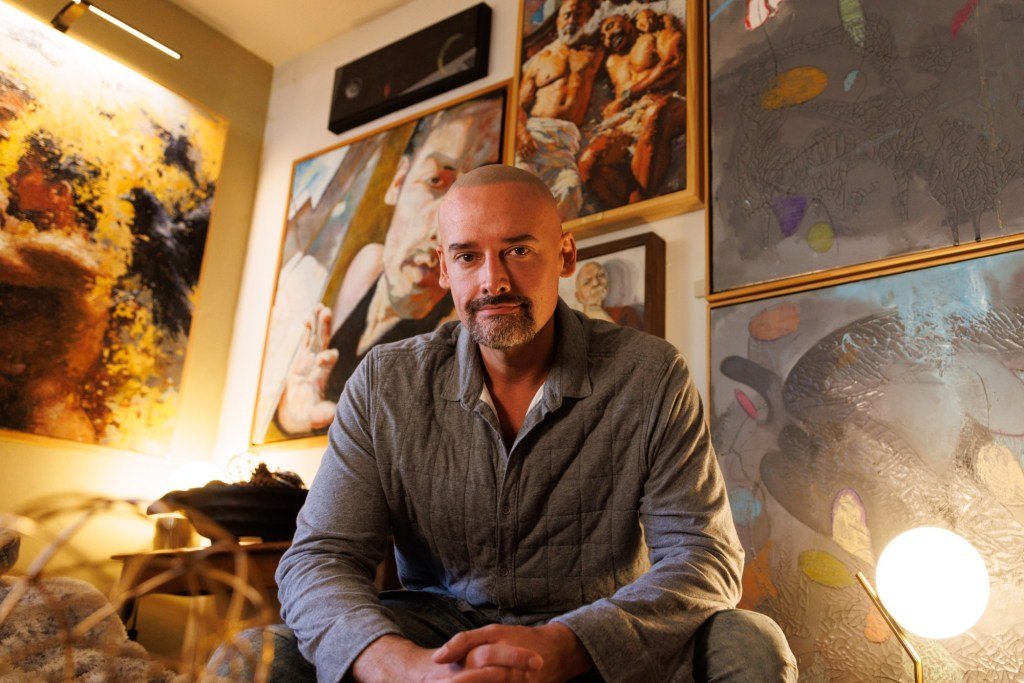
Camacho-Padilla, 42, is a figurative painter and fiber artist (and holistic health practitioner) living in Hillcrest with his partner, Arlyn Hackett. He took some time to talk about his work in this year’s ArtSpectrum show and how he wants to communicate with viewers through his oil paintings.
Q: What led to your interest in painting and fiber art?
A: I kept painting consistently through my teens, until I graduated high school. At USD, I was a music major and then switched to an art major. The fiber work actually came in graduate school, and it came from a moment of crisis because although I got really good feedback in my undergrad for my painting, graduate school was a whole different story. I got a lot of pushback. My painting was really misunderstood, so I was really searching for other ways to express what I wanted to say, and I found fiber. So, my whole graduate world was actually fiber work; I’m talking about embroidery, quilting, a lot of hand needle and thread work.
So much of my work up to that point really was dealing with a lot of issues I had in my childhood—being bullied a lot in school, very strict kind of gender roles and norms, especially growing up in Mexico in the ‘80s and ‘90s. So, the attraction to certain materials, certain kinds of reflective objects, I was dealing with that in the fiber work. A lot of it was kind of reckonings with childhood, really very expressive work. That’s where I took fiber, in that direction.
What I love about Hillcrest…
It really has been, in my experience, a very caring community. Supportive, especially in the arts, and cares to foster creative work. It really has made all the difference for me in finding a turning point because it wasn’t that long ago that I really saw art as this big mistake that I made. Like, I should have become a doctor or something. Being able to show my work and to have that support, which happened in Hillcrest, really made the difference for me.
Q: What kind of influence has your upbringing, your culture, had on the art that you create? Are there ways that you see your upbringing as having informed your art practice?
A: I was raised very Catholic, and everything that that entailed, but there’s so much in the Catholic tradition that’s very visual with churches, religious paintings. There is so much that is visual in that whole package. Even though I eventually would not adhere to the rest of the package because I’m not a practicing Catholic anymore, something about the images and visuals of religion really informed how I paint figures, how I compose images. So, for me, that’s one big influence it had on me.
I did a series in graduate school where I dealt with these old, torn photographs from childhood. It was a sad thing to find these torn photographs, old images. So, I made them into these quilts where I, in some way, symbolically put them back together, or invested all this hand work into these images. I transferred the photographs into these printed, quilted works that work on rescuing these things from degrading even further and making a shrine to them.
Q: ArtSpectrum is a show exclusively featuring the works of LGBTQ artists. Why is this kind of dedicated space important to you and in showcasing the art you create?
A: So, one tiny little anecdote from graduate school is that I had a professor who, when I was putting forward work that had queer themes, he said, “Well, are you making fine art, or are you making queer art?” It was like a segregation between the two. I had a lot of struggles in that school. Unfortunately, it was a little more conservative than I thought it was going to be, going to an art school. From there, it was like there’s two paths, either you’re on the mainstream or this more underground thing that doesn’t count as the real thing. So, finding opportunities to show work where it’s not just a token. Like, ‘Oh, of course, we support the LGBTQ community. Here’s your space to have something for you to show.’ This is one of those opportunities that any artist could feasibly get, which is why I think it’s important that, yes, it’s an LGBTQ-forward show, but we’re all professional artists who happen to be LGBTQ. It’s not because we’re being extended a favor or a separate thing. It’s with everyone else, where everyone else also shows here. We’re good enough to show with any other professional artist, whether they identify as queer or not.
Q: Can you talk about the pieces you have in this show?
A: I have all paintings, except for one, which is a fiber piece, which is a work that I revisited from my graduate show and then I took it in a new direction because, as time goes by, I’ll see that I’ve done many different things and in some ways they all connect somehow. The newer paintings that I was making, I saw certain scenes, certain color stories that I’ve done before, so I wanted to bring back this older piece in conversation with the new ones. They’re mostly paintings, very recent. One that I’m more proud of is one that I made in response to the murders of Renee Good and Alex Pretti in Minnesota, and really expressing how I felt in the face of seeing this happening, my fears of what could happen to me, what can happen to people I love or people around me. I think that’s an important piece that I have there to communicate that message because in a world where speaking out can have consequences and retributions, I think it’s important to put yourself out there. To say what you have to say.
It’s oil and it is a kneeling, male figure with a butterfly on his finger. That theme comes from a photograph my partner took of me when we first met and were having lunch, and a butterfly literally landed on my finger in the picture. He always wanted me to make something based off of that, so it felt right for me to use it for this piece as kind of a symbol of hope amidst a scene that may not have much hope.
Q: Walk us through your creative process for this show? What did you do as you came up with the concept for the pieces you would include in this show? What did you want to say in these pieces?
A: I have had, and probably still have, some important evolutions in my painting in the past couple years where I kind of worked in a looser style where images weren’t as clear, but you can still make out the scene of it. I’ve transitioned back to a clearer style because, for me, that clarity is going to be something very important to the conversations that I have with these images. That as many viewers as possible can come up to one of my paintings and know what’s going on. Even though they’re going to leave viewers with more questions than answers, there is a point where, if they’re not engaged enough, then they leave without having had as good an experience as you would want to have. So, simpler, more clarity, is where I am going with more pieces because the communication with the viewer is more and more important to me.
Q: What inspires you in your art making?
A: As I reflect on that, it’s kind of my own evolution as a human being in life. I had some pretty rough years after graduate school where I didn’t make any art. Life was difficult, so making art was on the back burner. Luckily, I got out of some of those bad situations in a better place, resettling and seeing how I how I faced up to things that were difficult; came out ahead and I’ve done better things for my life. I find that inspiring for me, personally.
Q: You describe your work as autobiographical and that it “draws from his lived experience as a gay, bi-national artist navigating the complex and often contradictory elements that shape a fluid identity.” What are some ways that you’ve seen this autobiographical expression of yourself in your art, and your understanding of yourself, evolve over the years? How would you describe what you were creating and what that work was saying at the beginning of your art career, versus now?
A: I ended up processing a bit of trauma a few months ago. It was suppressed and I’d never processed this trauma, and I didn’t know what it was going to feel like until I was going through it. I realized that when I was in my undergrad and first started really going into painting seriously, I wasn’t making class assignments so much as crying out for help. To be like, ‘Listen to me!’ I was a very shy person. I still have a very hard time communicating with people, just talking to them, and I was doing that through painting. I was screaming my life out through images. If I look back at that work, it’s very chaotic and there’s very little clarity, veering on abstract. That’s kind of where I was at that starting point, just visual diarrhea. Everything was coming out at once, and it made interesting images and fascinated people, but they were like, “We don’t know what it means.” And, I didn’t know what it meant. I had to kind of stand back from my own work. I knew what work I wanted to make, I knew what the image would look like, but if you asked me what it was about, your guess was as good as mine. When you see the paintings I make now, there’s a much clearer point of view. I feel more sure in my visual language, I have better clarity of who I am in the world and what are some things that are important to me that I need to express.
For example, one of my paintings in ArtSpectrum is titled “Shallow End,” which is this kind of David Hockney-esque, Palm Springs pool scene where a figure is lying face down in the pool with a unicorn floatie next to him. To me, I created this piece expressing partly my isolation that I felt coming into a gay existence in society because when I was in Mexico, I was not out. So, moving to the U.S. and coming out and assuming this identity, I had to face the kinds of problems that a lot of people do where you feel isolated, you don’t feel like you quite fit in, that there’s something wrong with me. So, some of these images of isolation, I expressed through this painting that I have that’s much simpler, much flatter, much more succinct. If I look back at my much older work, you’d be hard pressed to find what it was. With this, I’m confident that a viewer will come up to it, and their takeaway is going to be a few of the things that I want them to take away. That’s one important evolution that I’ve seen in where I am now versus where I’ve been.
Q: What’s been challenging about your work?
A: Sometimes I feel like I’m my biggest roadblock, I’m my biggest enemy. Sometimes I’m the one who doubts myself the most, so feeling more comfortable in myself and being a better friend to myself. Putting more self confidence in myself that I can do this, I’ve been doing it, and I’ve been receiving good feedback on what I’ve been doing. It’s OK not to worry as much. That is something I try to work on consistently, is being a better friend to myself as an artist. I am my harshest critic. Then, a struggle that any artist faces, getting seen and selling work is always a huge challenge. Balancing out work, making art that feels authentic, while still having a smartness about commercializing it and finding ways to commercialize it positively.
Q: What’s been rewarding about this work?
A: I’ve seen it have an impact on people’s thoughts. I see them really connect with it and find meaning and joy. That wasn’t always the best part for me. The part I always thought would be the most rewarding, and it wasn’t, was getting to sell work because when I was in undergrad, I never sold work before. So, you kind of idolize how, ‘One day, when they buy my paintings, I’ll be happy.’ But, it’s kind of a neutral thing. Like, ‘Should I feel more? I don’t.’ People’s response to it, how they connect with it, how they see themselves in it, or finding something in common with me that they identify, that what makes it worth it.
Q: What has this work taught you about yourself?
A: Not to take myself so seriously. Getting inside your own head is such a repetitive thing I try to stay out of because there’s no need to worry as much. So many times it’s not broken, but I try to fix it anyway. Teaching myself self-confidence, more personal assuredness, developing mature, radiant wisdom as I age. To trust in myself more.
Q: What is the best advice you’ve ever received?
A: Slow down, on everything. Not only is there no need to rush, things come out much better if you slow down.
Q: What is one thing people would be surprised to find out about you?
A: I think I’ve probably come across more confident in person than I really am. I feel like I’m faking that; I still feel like that shy little boy. I guess I’ve gotten better at that, faking being a confident person. The secret is, it kind of works out. You really do make it at some point.
Q: Please describe your ideal San Diego weekend.
A: I need it to be 74 degrees, not 75 or 73. It’s possible, you can get absolute perfection in San Diego. I really miss being on USD’s campus on a really beautiful spring day. Just the view of the ocean, the breeze, the place is beautiful. There’s so many great spots for you to enjoy perfect weather in San Diego, there’s no shortage of vistas, but a perfect spring day on the USD campus.
To suggest a notable San Diegan for the One-on-One series, contact Lisa Deaderick at lisa.deaderick@sduniontribune.com.
[ad_2]
Source link