
[ad_1]

(Credits: Far Out / Andrew Russeth)
Marina Abramović’s The Artist is Present was neither painting nor sculpture or even anything in between. Perhaps its best-fitting label was ‘performance art’, but even then, it was arguably too fleeting, ephemeral, and fluid to be a “performance” per se. This artwork was a true full-body and mind experience, which is why it sent shockwaves across the globe.
Abramović executed the work as part of her Marina Abramović Institute (MAI), founded in 2007, which was dedicated to supporting and presenting performance art. Its mission was to address the complexity of the present time and shift human awareness and consciousness through performance. The Artist is Present did precisely that for the 30 days it took place.
The fact that this performance piece was part of the institute made it much more formal, assigning it to a solid entity of sorts. In this way, Abramović was ensuring that the spontaneous and finite nature of the performance felt more “serious”, putting performance art on par with other conventionally respected art mediums like painting or sculpture. That in itself is genius.
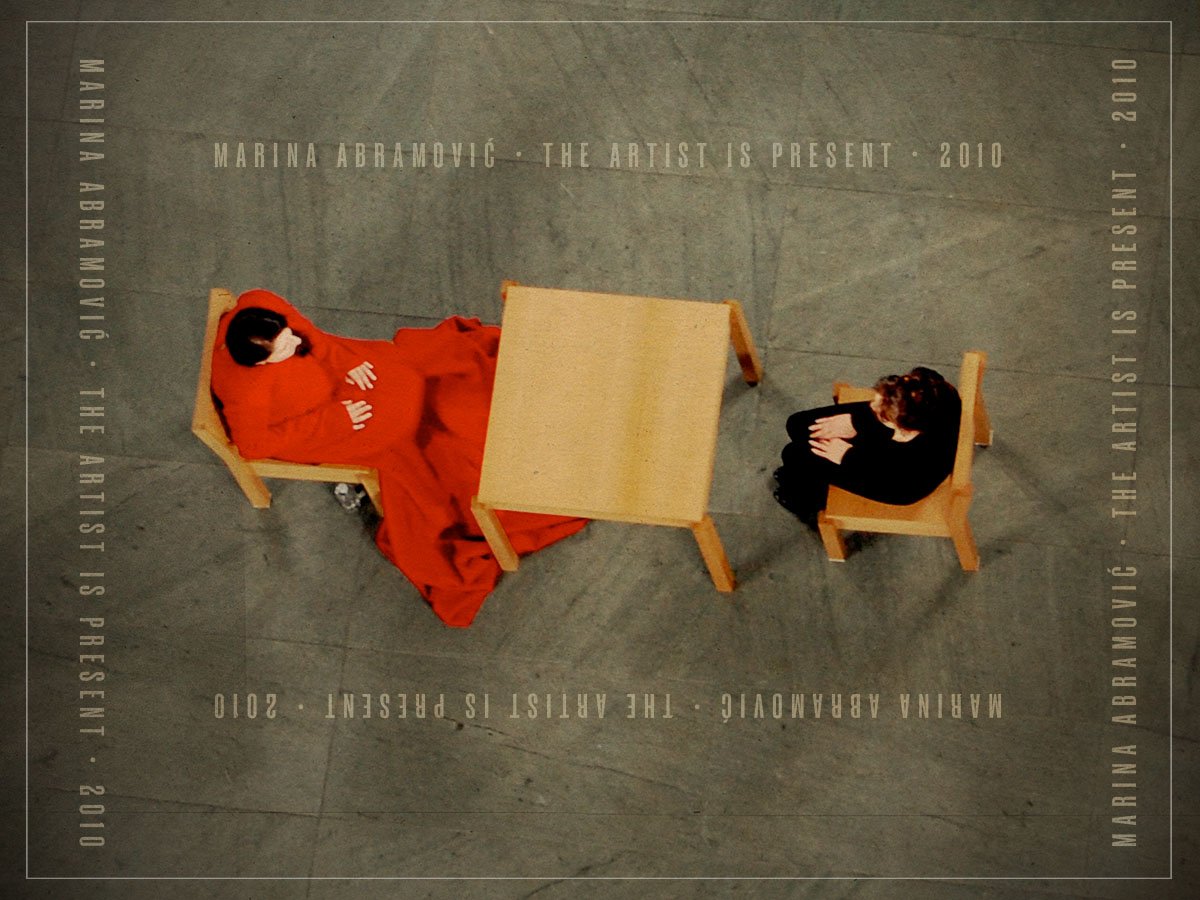
Simply put, The Artist is Present was a 736-hour and 30-minute static, silent piece in which Abramović sat immobile in New York’s Museum of Modern Art’s atrium while spectators were invited to take turns sitting opposite her for as little or as long as they wanted.
Abramović didn’t move once from her seat, not even for food, water, or to go to the toilet. People questioned how this was possible: Was she wearing a nappy under that long red gown? Guests were allowed to sit in front of her at any time before the museum opened, during, and after it closed. This permitted visitors to experience the pure timelessness of Abramović’s performance.
The title itself suggests an unmediated link to the audience that is evident through her body and her body of work, which become inextricably the same entity as artist and viewer unite to form one artwork. Even just waiting to sit in front of Abramović and participate in the performance for hours at a time is an experience within itself. It became a sort of ‘preparation’ ritual to access the performance space. In this way, the audience becomes implicated, almost detached from the outside world, both before and during the performance.
Most visitors sat with Abramović for five minutes or less, but some sat for multiple hours, even entire days. There were no rules. In total, Abramović sat in front of 1,545 sitters, including the famous James Franco, Alan Rickman and Björk. The first guest was by far the most special. Abramović’s former partner, the artist Ulay, came to kick off the performance. The pair hadn’t spoken in over 20 years, and, well, this surprise reunion didn’t change that much.
When Ulay arrived, Abramović seemed shocked but immediately smiled. Quickly, their eyes filled with tears. It seemed like during this brief and silent encounter, so much was shared through so few means. Every change of expression between the two was enough to understand their feelings during the rekindling.
At the end of their encounter, Abramović extended her hands across the table towards Ulay, who clasped them and leaned forward to say a few words no one else could hear. The queue exploded into applause. Ulay was the only person Marina ever touched or spoke to during the entire performance.
Performance is, in many ways, a repetition. Sure, it is produced, but it can be re-performed in various contexts, meaning it is ever-changing. Thus, all of the notions of authenticity that Abramović’s undertaking tries to develop are troubled by the problem of how to represent the history attached to performance.
This is why this artwork relied so heavily on documentation, in the form of video recordings or photography, that could be replayed and displayed in a gallery at a later date. This kind of documentation was enough to reinforce the idea of authenticity and authority of the work as they would be snapshots of an irreplicable moment.
Marco Anelli became the designated photographer to ensure this. He created a series of portraits called In Your Eyes: Portraits in the Presence of Marina Abramović, photographing each visitor in front of Abramović and tracking their emotions as they changed. Many entered a state of shock, became upset, or seemed to be transfixed, demonstrating the unexpected power of this performance in all its simplicity.
Such strong emotional reactions can be easily explained by emphasising the contrast between how little physical activity occurs in the encounter with the artist and how long the actual performance is. The visitor and artist are thus quick to enter a state of self-reflection and communicate this through expression and eye contact. Abramovic often reacted to criers by crying herself, acting as a mirror to the viewer.
The experience was life-changing not only for the viewers but also for Abramović herself, who said the show “changed her life completely—every possible element, every physical emotion”.
Related Topics
Subscribe To The Far Out Newsletter
[ad_2]
Source link