
[ad_1]
More than four decades of work created by master surrealist René Magritte goes on display at the Art Gallery of NSW from Saturday, in the most comprehensive exhibition of the Belgian artist’s paintings ever seen in Australia.
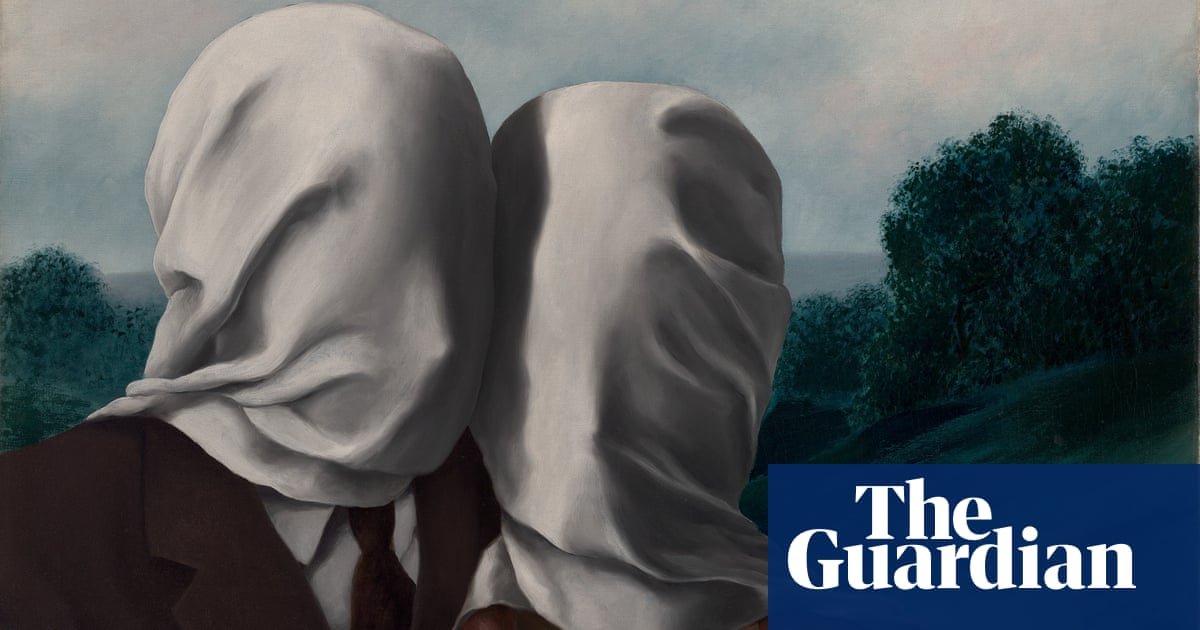
Magritte, curated by Nicholas Chambers, draws works from as far afield as New York, Los Angeles, Washington DC, Sakura in Japan and the Magritte Foundation in Brussels. Works on loan from the National Gallery of Australia and the National Gallery of Victoria are also on display, including one of the artist’s most recognisable and unsettling works, The Lovers.
Presented chronologically, the collection of more than 100 works takes the viewer on an evolutionary journey of one of the 20th century’s most influential artists; from his pragmatic beginnings as a commercial illustrator in the advertising industry post first world war; to his foray into cubism and futurism in the 1920s; his subsequent move to Paris and his transition to the surrealist movement; and finally, his gravitation towards works of scale, influenced by an American art scene on the brink of pop art and culture.
With his recurring motifs of everyday objects – bowler hats and pipes, clouds and green apples – Magritte took the ordinary and placed it in extraordinary settings, challenging his audiences preconceived perceptions of reality.
“To be a surrealist means barring from your mind all remembrance of what you have seen, and being always on the lookout for what has never been,” is one of the artist’s many memorable quotes.
Various iterations of his wife and muse Georgette, whom he married in 1922, can also be found throughout the exhibition across all the artist’s various phases, which in this retrospective are divided into six distinct periods.
“His art has been contextualised in surrealist survey exhibitions in previous decades, but the evolution of his art and the profound impact that it’s had on late 20th and even 21st century culture is not widely known,” says Chambers.
And while many of his images exude a disturbing or haunting aura, audiences need to keep in the forefront of their minds the enduring humour the artist brought to many of his works.
“Magritte was a real prankster, quite a rascal, actually,” says Chambers.
“There is this sort of irreverent, subversive sense of humour, sometimes less explicit, sometimes very overt. He took great pleasure in creating these paintings and while many of them engage with very serious philosophical ideas, humour is always present.”
Here are six of Magritte’s seminal works that make up the AGNSW Magritte exhibition:
Self portrait 1923
The cubist work was created soon after Magritte completed his studies at the Royal Academy in Brussels during the Great War.
“He had a traditional art education, he was taught the traditional subjects and techniques of European painting,” says Chambers.
“But he was always looking for something more experimental as an artist … and Brussels was not Paris, which was a real hotbed of experimentation in the 1920s.”
After his debut solo exhibition shocked Brussels society and received poor reviews, Magritte moved to Paris in 1927.
The Meaning of Night 1927
The Meaning of Night is considered one of the most important paintings demonstrating Magritte’s transition to surrealism.
“He has really declared quite stridently his allegiance to the burgeoning surrealist movement,” says Chambers, a movement that had only been established three years earlier with André Breton’s Surrealist Manifesto of 1924.
The Philosophical Lamp 1936
This is one of a surprisingly small number of paintings by Magritte that are considered self portraits.
“We find this subversive, irreverent sense of humour, where the nose sort of morphs into another organ of the body altogether and plugs into a pipe,” says Chambers.
“So already at this point in the 30s – and we see this more and more in the 1960s – there’s this kind of self reference that’s going on within his work, that’s done with a real sense of self-referential humour.”
Painted in the mid-1930s, the pipe had already become one of the artist’s most pervasive motifs.
after newsletter promotion
A Stroke of Luck 1945
Magritte’s so-called Renoir period, where he painted in the impressionist style of Pierre-Auguste Renoir, only lasted two years.
It was a dramatic departure in style for the artist, brought on by the outbreak of the second world war.
In A Stroke of Luck, a comically suited sardonic looking pig peers back at the viewer, but in the background a cenotaph commemorating the war dead softly looms.
“He felt that surrealism couldn’t continue in the form that it had been in previous decades, that the war had presented very real philosophical challenges to artists,” says Chambers.
“He wanted to dispense with what he thought of as the dark visions that surrealism had been depicting in the earlier decades and instead depict a kind of lighter and perhaps brighter side of life – he actually referred to it as ‘pleasure humour’.”
Golconda 1953
One of the most iconic images of Magritte’s entire oeuvre is the bowler-hatted man, and in the 1953 work Golconda we see a field of bowler-hatted men floating in the sky against the backdrop of a bland Brussels apartment block.
“Magritte increasingly returns to this figure in numerous different configurations and compositions over the decades. The bowler-hatted man represents a kind of everyman,” says Chambers.
By the 1960s however, the figure of the bowler-hatted man had become associated with Magritte himself.
“It’s an interesting turn and one Magritte quite strategically embraces.”
The Dominion of Light 1954
Magritte painted more than 20 different versions of The Dominion of Light, a house by a lake illuminated with a gas light under a cloudy blue sky yet seemingly captured in the depth of night.
“It’s a composition that brings together two completely antithetical times of day or states of light, so it’s a very strange image when you first look at it,” says Chambers.
“There’s just something so uncanny about it and it’s hard to make sense of where the strangeness comes from. It looks perhaps like an image of the dusk, but the more time that you spend with the painting, you realise that the top half of the picture in fact represents the intense light of say 2pm on a summer’s day, whereas the bottom half of the painting is the deep of night. It’s 2am, and somehow, quite magically, Magritte has brought together these two quite opposite states of light within the one painting.”
If the viewer has never set eyes on The Dominion of Light before, yet it still feels vaguely familiar, that could be because the iconic poster for the supernatural horror classic The Exorcist was purportedly inspired by this Magritte work.
It is one of dozens of the artist’s works that have been appropriated by popular culture since his surge in popularity from the 1960s onwards.
The Apple logo for The Beatles’ record company was inspired by Magritte’s Le Jeu de Mourre, and multiple images of the artist’s work are reproduced in the 1992 animation film Toys. Magritte’s painting The Son of Man plays a central role in the 1999 heist film The Thomas Crown Affair, the artist has inspired the writings of John Berger, LJ Smith and Tom Stoppard, and Paul Simon and John Cale have even sung about him.
Magritte is on at the Art Gallery of New South Wales until 9 February 2025.
[ad_2]
Source link
Other Articles