
[ad_1]
A letter dated February 17, 1950, written by Francis Newton Souza from London to his friend Sayed Haider Raza — who was then living in India, but would depart for France shortly thereafter — carries a paragraph that is perhaps one of the most significant in the history of modern Indian art.
Souza writes: “I would strongly advise you to paint now in oils. You are unhappy you say because you have no ideas. Well, I don’t think that is true. Raza, you must work in oils. There are immense possibilities in that medium than you can find in watercolours. And as you work, you will be surprised, you will get brilliant ideas. Don’t buy a small piece of canvas. Start big. Do your first oils on large plywood boards, or on large canvases. I am sure in a short while you will be happy with yourself.”
The Modernist Masters
In 1950, Raza and Souza, 28 and 26 years old respectively, perhaps had no idea where their art would lead them personally, catapulting them to the very forefront of an evolving scenario that would define a new nation’s artistic identity. In fact, along with M. F. Husain, Tyeb Mehta, V. S. Gaitonde, Ram Kumar and Krishen Khanna, among others, they would collectively become synonymous with modern Indian art.
The latest affirmation of this conviction comes from the results of the auctions held earlier this year. The most expensive Indian work of art to be sold at the spring auctions, held at various places by different auction houses in March-April, was S. H. Raza’s Kallisté, a 1959 oil on canvas which sold for $5,619,900 (approximately Rs 46.76 crore) at Sotheby’s Modern & Contemporary South Asian Art auction in New York on March 18. It thus became the third most expensive work of Indian modern art ever sold.
On the other hand, a Souza work too skyrocketed beyond its estimate to achieve the best figure for the artist ever at the auctions. The Lovers, a 1960 oil on board, sold for $4,890,000 (Rs 40.69 crore), at a Christie’s auction in New York on March 20. Kallisté was painted in Raza’s early years in France, just a few years after that important advice imparted by his friend that he heeded to.
Correspondence: The letters also bring the spotlight on the life of a reticent and reclusive artist, V.S. Gaitonde (1924-2001).
Raza would go on to become a highly successful artist in France — where he would live for six decades before returning to India in 2010 — and achieve great heights in his adopted country, while simultaneously climbing up the ladder to become one of India’s most important artists. [As of now, his canvas, Gestation (1989), is the second most expensive Indian painting ever sold, fetching Rs 51.75 crore ($6.27 million) at a Pundole’s auction in Mumbai on August 31, 2023.]
‘Correspondence’: The Artists’ Exchange
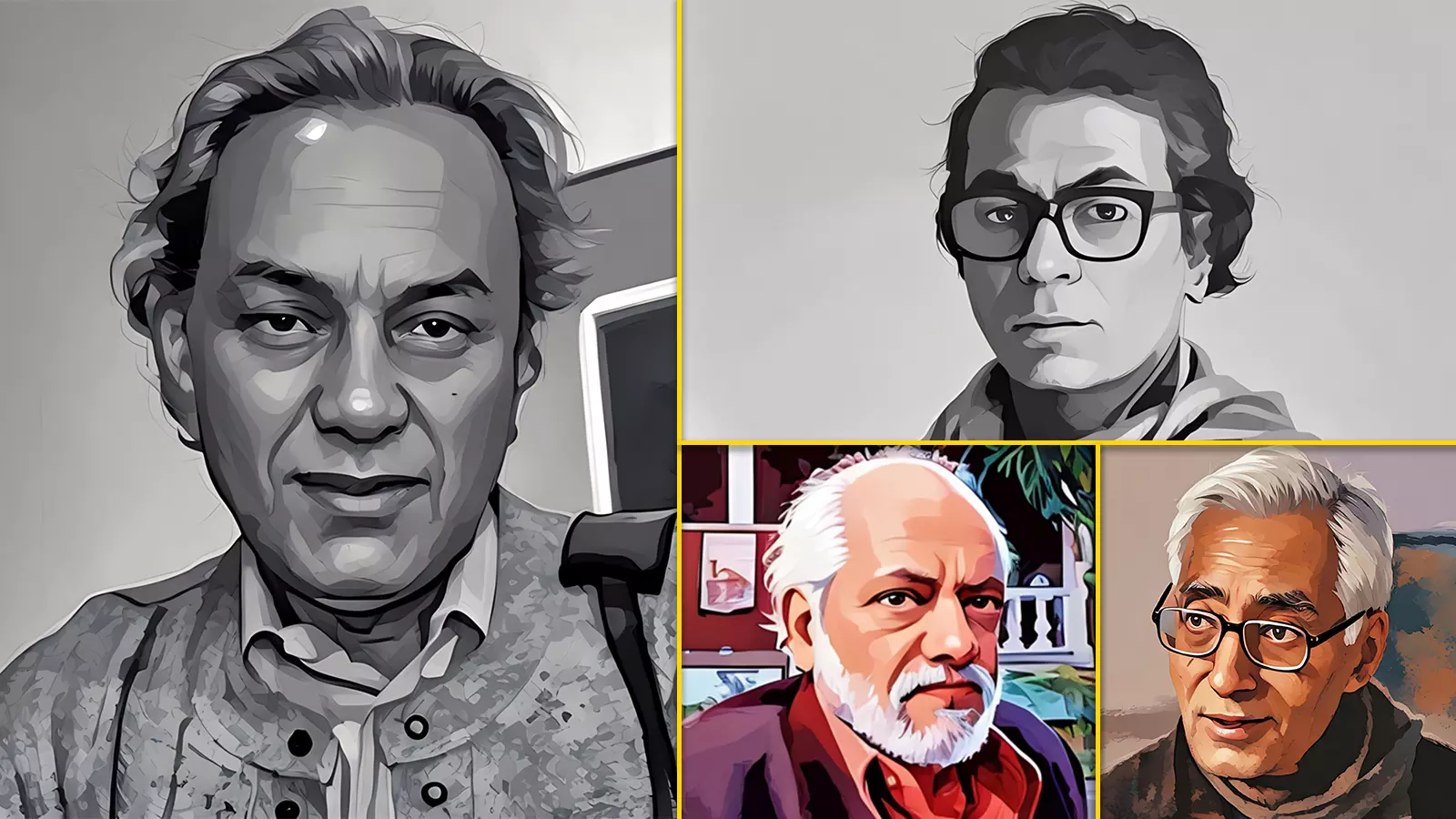
Raza’s phenomenal, lifelong rise as an artist owes partly, but very importantly, to important exchanges on art and its direction with his friends, all of whom wrote liberally to each other. Such fervid writing was bound to push the careers of all of them forward in some or the other fashion. A glimpse of that exchange was recently on view in New Delhi in an offbeat exhibition hosted by The Raza Foundation at the Triveni Kala Sangam. Titled ‘Correspondence’, the exhibition celebrated the birth centenaries of three masters of modern Indian art, F. N. Souza, Ram Kumar and V. S. Gaitonde, featuring letters to and from them to Sayed Haider Raza.’ While Souza was born on April 12, 1924, Ram Kumar was born on September 23 and Gaitonde on November 2 of the same year.
On display were handwritten letters, which youngsters gawked at with wonder as if looking at a relic from the past, an archaeological inscription. Reams have been written, or rather innumerable web pages have been dedicated to the dying art of letter writing, which was one of the most important reasons that the said exhibition assumed importance. But, for the art fraternity, it assumed greater significance for the light it threw on the element of vital, career-defining criticism that letters allowed the friends to exercise, for their collective benefit.
Ashok Vajpeyi, a multi-faceted cultural figure who is also the managing and life trustee of The Raza Foundation, says, “These letters are not just about simply friends keeping in touch. They were having very active dialogue with each other about their practice. Many of those personal suggestions from one friend to another were vital, and were also acted upon, as is the case with Souza advising Raza to begin painting in oil. Because they were placed far away from each other — Raza in France, Souza in London, Gaitonde and Ram Kumar in India — their dialogues had sensitive personal touches as well.”
Another example is when Raza (1922-2016) gently tells Ram Kumar (1924-2018) in a letter from Paris dated December 3, 1958, to not shun artistic groupings or take a pessimistic view of art developments in Bombay and Delhi. Raza writes: “There are contradictory reports about Delhi & Bombay. It’s a bit alarming. You did not give details of the people you met. I wonder what the problems really are. It must be admitted that there are many people with so many possibilities. And there is so much material to work on. Then why this stagnation, reserve, indifference?”
He continues, “Also, I wonder if our attitude to them is wrong. One of the first things I must do is to try to become a part of this society — if I can… I must not start by avoiding others, or by pretending to be clever. This is the big mistake most of us do when we have had the possibility to travel and study, which our other friends did not have. This does not entitle us to feel superior…”
It’s well-known now how Raza encouraged other artists to achieve their potential — G. R. Santosh is an example — even though he may not have succeeded in making Ram Kumar a social being like himself; Kumar, as is no secret, was a reticent artist who confabulated with a few select people.
SH Raza with VS Gaitonde. All photos: The Raza Foundation
Living a Rich And Creative Life
The letters, most importantly, bring the spotlight on the life of an artist far more reticent, and even reclusive, than Kumar. That’s Gaitonde (1924-2001), one of India’s most valuable artists with his canvases often playing musical chairs with those by Raza and Amrita Sher-Gil to be on the top of the pyramid of modern Indian art at the auctions.
A man of few words, and with a restricted social life which comprised artists Ram Kumar and Krishen Khanna, among others, Gaitonde wrote far shorter letters to Raza than Kumar and Souza did. Even in response to Raza’s letters where the latter was arranging for exhibition of his works in Europe, Gaitonde responded briefly. In the exhibition, the most poignant piece of writing was Raza’s thoughts on August 10, 2001, when he was in Gorbio, in the south of France where he had his studio and received the news of Gaitonde’s passing.
Raza wrote: “Gai leaves us today, as quietly as he has lived. In Gorbio, the news reaches me generating great emotion and sadness. Once again, his life and work emerge as a vast space to contemplate, to understand and to admire… His work is not only a very significant contribution to contemporary Indian painting, it has also opened up new possibilities of a spiritual quest in art…”
The contemporary world, with its disruptive technologies, is a far different place than the one in which Raza, Souza, Ram Kumar and Gaitonde lived, where letters were an important aspect of life, strengthening their friendships, reinforcing their beliefs in their chosen field, and propping up each other’s careers. Vajpeyi rues that letters and letter-writing have faded away in the “evolving socio-economic-cultural milieu, which has meant a certain absence of personal contact. Along with that, a certain amount of criticism too has gone away. Post-Swaminathan [Jagdish Swaminathan, 1928-1994], there is hardly anybody raising vital questions on art and art practice. There is no space for criticism. Art, technology, etc., are hardly debated. Creativity and criticality are organically related. With one missing, one cannot expect the other to fully bloom.”
One can draw some consolation, perhaps, from what Ram Kumar wrote to Raza in a letter dated October 15, 1958, from New Delhi. “But Raza, it seems sometimes that in spite of all the hurdles and disappointing atmosphere, one can still have the stamina to lead a very rich and creative life.’ That’s exactly what they all did.
[ad_2]
Source link
Other Articles