
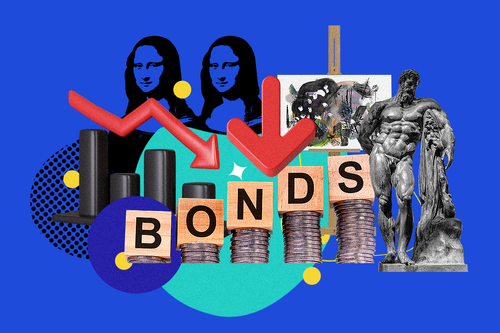
Why Bonds and Fine Art Might Be the Best Assets During a Recession
Investment-grade art, as measured by the Artprice Global Index, came out as the asset with the highest negative correlation to the stock market in our study. The correlation coefficient of -0.6350 found between art and stocks suggests that the two assets moved in nearly complete opposite directions between 2018 and 2021. The Artprice Global Index we used is calculated based on blue-chip art auction results across a variety of mediums (painting, sculpture, photography, drawing, and print) and stylistic periods (old masters, 19th century, modern art, post-war, and contemporary).
Over the long-run, art has largely been shown to be uncorrelated with the stock market. Perhaps surprisingly, demand for fine art has historically been very resilient, meaning that it isn’t significantly impacted by economic downturns. For example, while auction prices fell 27% from 2007-2009, during the Great Recession, this was nothing compared to the 57% decrease in the S&P 500 over the same period. In fact, the volume of sales in the art market wasn’t even noticeably impacted by the financial crisis until 2009, once stock prices had begun to rebound.
Other Articles

NFT art dealer and gallery owner James Ryan


No Comment! Be the first one.