
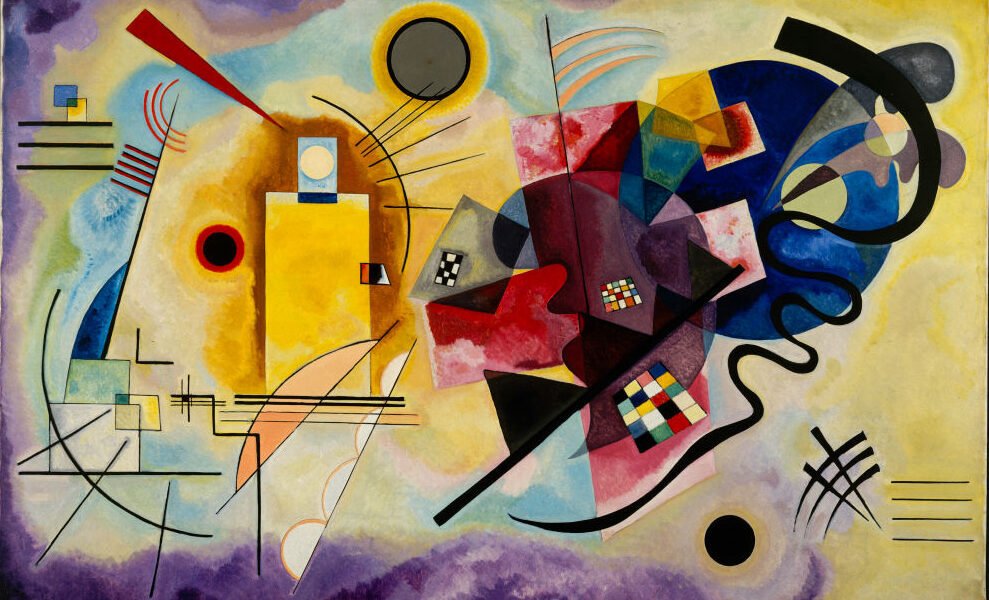
Kandinsky was betrayed by Left and Right
That the Soviet Union effectively hounded out its most creative artistic talents, from Kandinsky in the Twenties to Neizvestny in the Seventies, was not inevitable. Indeed, there is nothing inherently authoritarian about communism. We would do well to remember the historical contingencies that led up to that outcome. The early Marx himself waxed eloquent about “the benefits of a liberal constitution, of a country where there is freedom of discussion, freedom of association, and where a humanitarian seed can flourish for the good of all Europe”. Here was a supremely convincing reconciliation of socialism and freedom. The proles were treated as intelligent grown-ups.
In later works, it is true, he betrayed a regrettable preference for de haut en bas technocratic solutions, the kind befitting the worst kind of Brussels Eurocrat. Still, it was left to Lenin to turn an instrument of proletarian emancipation into a tool of authoritarian centralisation. As for Lunacharsky, he was not such a terrible killjoy, but rather a mondain character with a lively past simply obeying orders; before the revolution, he had moved in rather choice circles in Paris and Capri.
Needless to say, the upshot was most damaging. By the time high Stalinism took hold, the intellectual and artistic energies of Soviet communism had more or less completely fossilised. The baton passed to Western Marxism. From the Frankfurt School in the interwar period to structuralism in post-war France and operaismo in post-war Italy, some of the most arresting developments in Left-wing thought occurred in the free West. More so than Soviet Marxists, their British counterparts recognised — in the words of Perry Anderson — that “to take liberties with the signature of Marx” was to “enter into the freedom of Marxism”.
The new Expressionists show at Tate Modern underscores just how important the freedom of expression was to the development of art. Indeed, it was no accident that Kandinsky thrived not in his native land but in relatively free Munich. The young Wassily knew a thing or two about unfree societies. His parents, clamouring for liberal reform, had been exiled to the tea plantations of Kyakhta on the Mongolian border by Tsar Alexander II. It was only in the 1860s, that radical decade that also saw the abolition of serfdom, that they were rehabilitated along with other dissidents; Kandinsky was born in Moscow in 1866.
University life was dull. Some respite came from a research assignment that took him to Vologda, whose pagan peasants enchanted him. Throughout his life, Kandinsky maintained his fidelity to the Orthodox Church, though the colourful and exotic never failed to fascinate him. A staid, bourgeois life awaited him after his marriage to his bookish cousin — one of very few women at Moscow University at the time — when a professorship in Roman law came through at Tartu University. But then a midlife crisis intervened, provoked by Becquerel’s discovery of radioactivity in 1896. Kandinsky had a eureka moment of his own: academic life, he concluded, was bollocks. There was no certainty in the world. Thereafter, it was only the subjective world of art that mattered. Monet’s Haystacks and Wagner’s Lohengrin, both encountered in Moscow, further convinced him that art was his calling. More prosaically, a loaded uncle kicked the bucket that year. Aged 30, Kandinsky came into a sizeable inheritance that was his ticket out of the professions – and Tsarist Russia.
Munich could have been Mars. It certainly felt like another planet. This was a land where painters “had the status of generals”. So wrote the Irish painter John Lavery. It was also an oasis of tolerance, thanks to the urbanity of its ruling class. Jewish painters like Albert Bloch and Elisabeth Epstein, on the run from antisemitism, found a home there. So, too, did dissidents from the Austro-Hungarian and Russian Empires, and the promiscuous Russian bohemians Marianne Werefkin and Alexis von Jawlensky. Their favourite hangout spot was the famous pink salon owned by Werefkin — an “independently wealthy” polyglot noblewoman according to the catalogue — that doubled as an atelier.
“This was a land where painters had the status of generals.”
It was in this cosmopolitan, permissive milieu that Expressionism was born. For too long, the movement has been both celebrated and denigrated as a singularly German graphic idiom. Even Pevsner, who evidently wasn’t terribly fond of the Expressionists, thought it fitting to summon up the rare word of praise for their Teutonic moral seriousness. Yet as this exhibition shows, it was a fundamentally international cast — led by the Russian Kandinsky — that conjured up the movement.
Munich artists had already laid the groundwork for Kandinsky. Four years prior to his arrival, the Munich Secession had parted ways with the academicism and conservatism of the Munich School; its leading light, Max Liebermann, made it a point to paint working-class subjects. Kandinsky’s move to Munich in 1896 coincided with the birth of the journal Jugend, the house organ of modernism to which we owe the German term for Art Nouveau, Jugendstil.



No Comment! Be the first one.