
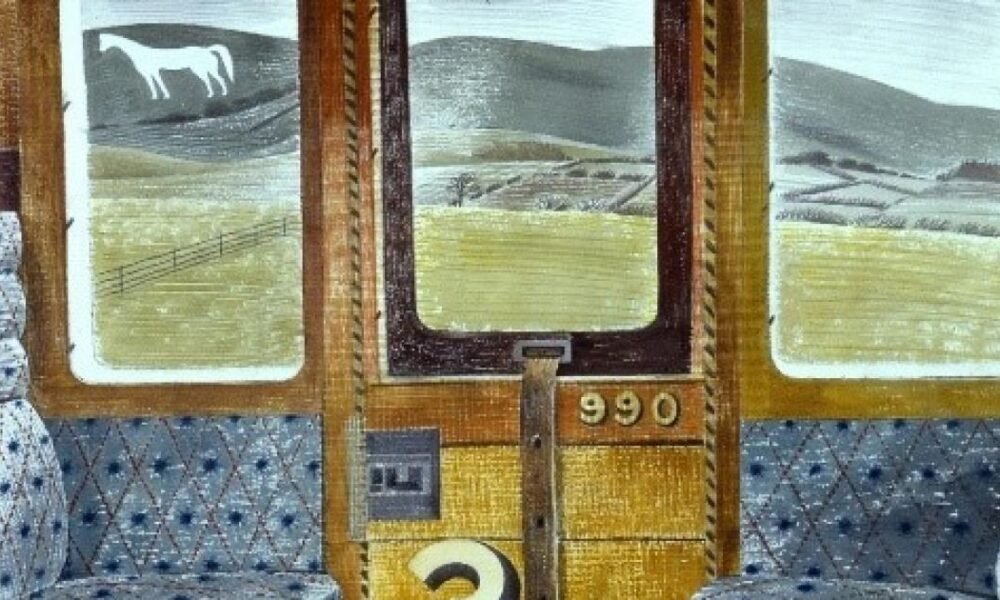
Eric Ravilious’ ‘Train Landscape’ named best-loved artwork
At first glance, it may look like a scene captured – much like a photograph – by an artist travelling by train as it rushed past a scenic Sussex countryside landmark. In reality, celebrated painter Eric Ravilious made several trips in his third-class carriage along the Brighton to Eastbourne line but still didn’t think he had the perfect watercolour. And while the resulting picture is a collage put together by Eric’s wife, artist Tirzah Garwood, from the several paintings he made of his window view, locals will notice that he’s played a trick on the viewer – replacing The Long Man of Wilmington with the Westbury Horse which is, in fact, 136 miles away in Wiltshire.
The watercolour, T rain Landscape , is more popular with the public than it was with the artist as it has been named the world’s best-loved railway artwork in the UK, following a global poll held to mark the 200th anniversary of the modern railway this month. To make it even more poignant, the announcement was made to coincide with the birthday of rail pioneer George Stephenson.
Eric’s granddaughter, Ella Ravilious, said: ‘I’m thrilled that Train Landscape has been voted best-loved railway artwork as it captures travel through the British landscape in a third-class carriage in the late 1930s. This painting was created with the assistance of my grandmother, Tirzah Garwood. Eric rode back and forth on the train, making several watercolours, none of which he was totally happy with. Tirzah collaged the best bits of each painting together to create a successful picture.’
Heritage Minister Baroness Twycross said of the watercolour now on display in Aberdeen Art Gallery & Museums : ‘This evocative watercolour invites us all to experience a railway journey through an artist’s eye, capturing a uniquely British perspective that resonates today. Art offers us a powerful way to engage with our past and this selection of artworks tell the unique story of Britain’s relationship with railways over 200 years.’
The second most popular artwork was the evocative Rain, Steam and Speed by J.M.W Turner (1775-1851) who has close ties with Sussex because of his connection with Petworth, which inspired some of his best work.
This September marks a milestone moment for a British invention that changed the world forever, transforming our lives and livelihoods in ways that were previously unimaginable, and shows how the railway continues to present a constant source of inspiration to artists.
The birth of the modern railway, with the opening of the Stockton and Darlington Railway (S&DR) on 27 September 1825, signalled the start of a global revolution in how we live, trade, work and play.
The bicentenary is being celebrated in a year-long campaign called Railway 200 (www.railway200.co.uk), covering the past, present and future of rail.
The origins of the railway started in the 16th century with coal, when horse-drawn wagons would carry this precious resource to markets and homes. But it wasn’t until Stephenson drove Locomotion No.1 the 26 miles between Shildon, Darlington and Stockton in the North East of England that the modern railway was born. The historic launch of the S&DR was, says the National Railway Museum, the first steam-hauled fare-paying passenger journey on a public railway. Five years later, in 1830, the world’s first inter-city passenger rail service was introduced with the opening of the Liverpool and Manchester Railway.
During the industrial revolution, the impact and influence of the railway boom was immense; similar to that of the birth of the internet in the digital age. The railway crossed continents, created countries and connected communities. It boosted economic prosperity, and revolutionised our lives socially, environmentally and culturally, giving many people a sense of their national identity for the first time. Many of the early rail lines built around the globe were constructed in challenging and sometimes dangerous circumstances, not reflecting modern-day working practices.
Today, the railway continues to be as relevant to our lives as ever. It gives us access to jobs, housing, leisure and many other opportunities. It delivers the goods and services we want and takes lorries off our roads.
The UK mainline railway recognises that there are many things still to fix on a busier, more congested network, such as simpler fares and improved performance, as much of the industry transitions to a planned simpler, greener and more digitally-driven future under Great British Railways.
As an anniversary campaign, Railway 200 has helped to bring the rail industry together, strengthening its relationship with the communities it serves, encouraging more people to travel by train, and attracting the next generation of pioneering talent to a wide range of career opportunities. The campaign has already won the Outstanding Contribution to Tourism award from VisitEngland.
More than 200,000 people are due to visit Inspiration on its 60-stop, 12-month tour of BritainThe Bluebell Railways has a host of activities to celebrate Railway 200. Image: Getty
To date there have been more than 2,000 activities and events, many registered on an interactive map on the Railway 200 website. These include a Whistle-Up of 200 locomotives blowing horns and whistles on New Year’s Day across five continents, a commemorative rail coin from The Royal Mint, an anniversary rail sale, offering two million cut-price tickets for great days out, heritage railway festivals and galas, a merchandise range, the launch of a Great Rail Tales podcast series, inviting people to share their rail-related stories (railway200.co.uk/stories/great-rail-tales/) and the exhibition of the 20 most popular artworks displayed on the Art UK website until the end of December (artuk.org/discover/curations/the-worlds-favourite-railway-artworks )
More than 200,000 people are due to visit Inspiration on its 60-stop, 12-month tour of BritainThe Bluebell Railways has a host of activities to celebrate Railway 200. Image: Getty
Many Sussex towns owe their existence and/or development to the railway and to celebrate that Burgess Hill has created a Railway 200 Trail. Locals and visitors can discover 200 years of railways history in the town with a self-guided trail – which you can cycle or walk – to six railway spots around Burgess Hill. Access the trail, which is fun for all ages, via the Bluebell Railway app or pick up all the details at the Tourist Information Help Point at 96 Church Walk, Burgess Hill.
The railway finally came to Rye in 1851 and to commemorate this transformation the town is hosting an exhibition telling that story and the impact it had on Rye’s history, economy and community over the years. All Change Please shows how Rye looked in the past, the changes it has gone through and its fight for survival resulting in the Marshlink Line it has today. Images, ephemera and text are combined to allow the visitor to interpret how the railways have shaped the town’s heritage in the last two centuries. The exhibiton is free to attend, no booking required, and is being held at Rye Heritage Centre on Strand Quay, TN31 7AY until 30 September. (railway200.co.uk/activity/all-change-please/) or email info@ryeheritage.co.uk
Look out for documentaries on Channel 4 and on BBC 2, with Michael Portillo, as well as tuning in to BBC Radio 3 which will be dedicating its programming on 27 September to mark rail’s milestone moment. BBC Radio 2 has already launched a bicentenary-inspired 21st Century Folk project which captures people’s rail stories and turns them into moving, emotionally-charged songs, written and performed by leading folk musicians.
For more information on Railway 200 and how to get involved visit railway200.co.uk





No Comment! Be the first one.