
Contemporary Native American Artwork On View Across New York This Winter
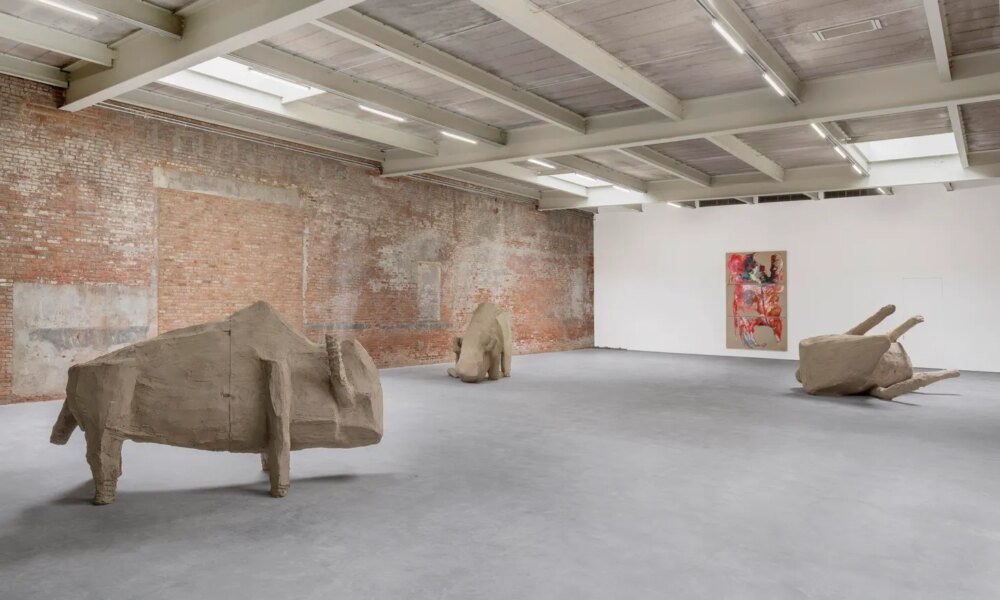
“Duane Linklater: 12 + 2,” installation view, Dia Chelsea, New York, 2025 – 26. © Duane Linklater.
Photo: Bill Jacobson Studio, New York. Courtesy Dia Art Foundation
Native American art has always been contemporary. It’s the museums who have attempted to lock it in the past. Nineteenth century buffalo hides and eagle feathers in dusty cases in the basement.
That practice, finally, is changing. Exhibitions on view at museums around New York this winter demonstrate how Native artists work in the present without sacrificing their cultural heritage, same as ever.
The Metropolitan Museum of Art
The influence of Native American artists on abstraction has long been discounted. Not only the parfleche bags and pottery and baskets that incorporated stunning abstract geometric designs centuries before anything of the kind appeared on canvas, but the Native artists working in “Western” abstract movements. Primary among them was George Morrison (Wah-wah-ta-ga-nah-gah-boo and Gwe-ki-ge-nah-gah-boo, Grand Portage Band of Lake Superior Chippewa; 1919–2000).
Morrison receives a portion of the flowers he’s due at The Met–the top of the museological heap–during “The Magical City: George Morrison’s New York,” an exhibition asserting his significant contributions to American Abstract Expressionism while also exploring his urban aesthetic inspirations rooted in his love of New York, a “Magical City” as he called it.
George Morrison, ‘The Antagonist’ (detail), 1956. Oil on canvas, 34 1/8 × 50 1/16 in. (86.7 × 127.2 cm). Whitney Museum of American Art, New York; gift of Mrs. Helen Meredith Norcross 57.26.
© Estate of George Morrison
Morrison’s adaptation to and embrace of New York were remarkable. He was born in Chippewa City, a remote Native American village on the shore of Lake Superior in northern Minnesota. He overcame poverty and a life-threatening childhood illness before arriving in Manhattan, then racial and cultural barriers once he got there. He became a leader of the American Abstract Expressionist movement which he collaboratively defined both publicly and behind the scenes. He was fully part of the “scene,” forming connections with peer artists such as Willem de Kooning, Franz Kline, Lois Dodd, and Louise Nevelson
Morrison’s influence on the movement began in September 1943 when he arrived in New York City to study at the Art Students League on a fine arts scholarship. Immersing himself in the city’s vibrant cultural atmosphere, Morrison studied painting and drawing, contributed to numerous exhibitions and publications, and openly challenged the mainstream art establishment of his generation.
His deep appreciation for urban life—specifically industrial landscapes, jazz, and literature—shaped his artistic practice and imagery and permanently impacted the trajectory of the New York School.
Technically trained in figure drawing, portraiture, landscape painting, and graphic arts, Morrison shifted to abstract approaches in his New York years, specifically automatism, propelling his unique visual language, a fusion of his interest in the subconscious, Ojibwe aesthetic sensibilities, and ties to his homelands. The artist’s involvement with the rise of Abstract Expressionism enhanced the movement’s broader “American” context by imbuing it with a distinctive Indigenous perspective.
He remained in the City until returning to Minnesota in 1970.
Featuring 35 of his paintings and drawings, including generous loans from the Minnesota Museum of American Art–the holder of the greatest amount of his work–The Met presentation features rare archival material placing Morrison at the heart of the Abstract Expressionist movement in New York in the 1940s and 1950s. The exhibition debuts two works recently acquired by The Met: White Painting (1965), the first oil painting by Morrison to enter the Museum’s collection, in 2021, and Construction in Fantasy (1953), a gouache and ink drawing created in France on the Côte d’Azur, acquired by The Met in 2023.
The show (through May 31, 2026) culminates with Morrison’s Horizon Series, his career-capping suite of small-scale oil and acrylic paintings synthesizing his technical skill and creative imagination with his love for home on the Grand Portage Indian Reservation along the north shore of Lake Superior.
Inside
The Met hasn’t always been as inviting to Native American artists as it is today. American art hasn’t always been as inviting to Native American artists as it is today. To get where you want to be, sometimes you must go without an invitation.
Amplifier, a nonprofit design lab building art and media campaigns to shift culture and amplify movements, created “ENCODED: Change the Story, Change the Future,” a first-of-its-kind unsanctioned Indigenous art intervention within the American Wing of The Metropolitan Museum of Art.
Not a protest, not a takeover, an intervention. A celebration.
This virtual installation transforms the American Wing into a space where Indigenous presence, creativity, and stories take center stage. “ENCODED” features the work of 17 Indigenous artists living across North America–Turtle Island. Using augmented reality and immersive sound, these works engage directly with the museum’s permanent collection of paintings and sculptures, reclaiming space, expanding narratives, and opening conversations as the American Wing marks its 100th anniversary.
Through 3D digital technologies, the intervention challenges past propaganda embedded in American art history to open space for dialogue about truth, history, and representation today.
Begin your “ENCODED” tour at the bottom of the steps to The Met’s 5th Avenue and 82nd Street entrance or pick it up inside the American art galleries by accessing the QR code available here. “ENCODED” is accessible through December 31, 2025.
Outside
Visitors approaching The Met from 5th Avenue are greeted by a series of four large-scale sculptures in the building’s façade niches exploring the metamorphic relationships between all living beings and the environment courtesy of Jeffrey Gibson (Mississippi Band of Choctaw Indians and of Cherokee descent; b. 1972). Gibson draws from his distinctive style fusing abstraction, text, and color to create these new figurative works cast in bronze.
On view through June 9, 2026, “Jeffrey Gibson, The Animal That Therefore I Am,” marks Gibson’s first major exploration of bronze at a monumental scale. Each 10-foot sculpture takes the form of a regional animal: a hawk, a squirrel, a coyote, and a deer. The artist uses cast elements such as wood, beads, and cloth to build texture with abstract patterning evoking beadwork and textiles drawn from a range of Indigenous visual languages.
The works are inspired by Jacques Derrida’s book The Animal That Therefore I Am, which examines the violence inherent in the human domination of animals—a theme Gibson connects to broader cycles of conflict.
By selecting species native to the New York area, Gibson reflects on how these creatures have been forced to adapt to human environments, inviting us to consider what they endure and what they might teach us.
The Whitney Museum of American Art
Grace Rosario Perkins, ‘Now I’m Makin Money and It’s Good To Be Single, To Mingle With the Ladies While Their Earrings Jingle,’ 2023. Acrylic, spray paint, horsehair, fake eyelashes, paper, rose petals, mirror, datura seeds, sand, bubble packaging, sharpie, cut canvas, and adhesive on canvas, 66 1/4 × 67 × 1 1/2 in. (168.3 × 170.2 × 3.8 cm).
Collection of Bockley Gallery, Minneapolis. © Grace Rosario Perkins, courtesy the artist and Bockley Gallery
“Grace Rosario Perkins: Circles, Spokes, Zigzags, Rivers” marks the first solo museum presentation in New York City for Grace Rosario Perkins (Akimel O’odham/Diné; b. 1986). On view free to the public are 10 recent works, the majority large-scale paintings completed between 2022 and the present. Two of these paintings have been created specifically for this exhibition alongside a new sculpture.
The exhibition’s title, “Circles, Spokes, Zigzags, Rivers,” describes petroglyphs that connect the artist’s family to her tribal homelands in the southwestern United States, including the vital, yet threatened, waters of the Gila River and Rio Grande. The influence of such longstanding visual storytelling is evident in Perkins’s symbol-rich art. Flowers, stars, the sun, and spider webs are given significant presence within the systems she creates to record her life.
Working primarily with acrylic, spray paint, and textual fragments, Perkins incorporates an eclectic range of found and personal materials—family photographs, jewelry, book pages, fake eyelashes, plastic bags, botanicals—each serving as a vessel of memory, testimony, and cultural inheritance. Drawing from language, music, and sports, the artist’s references to popular and material culture intersect with intimate meditations on grief, love, and hope, revealing the interwoven nature of personal narrative and collective experience.
On view through February 8, 2026.
Dia Chelsea
“Duane Linklater: 12 + 2 , installation view, Dia Chelsea, New York, 2025 – 26. © Duane Linklater.
Photo: Bill Jacobson Studio, New York . Courtesy Dia Art Foundation
“Duane Linklater: 12 + 2” presents a newly commissioned body of work spanning sculpture, music, poetry, and dance. Linklater (Omaskêko Ininiwak from Moose Cree First Nation; b. 1975) and his collaborators radically reimagine the gallery space as a site of Indigenous presence where animal, movement, and memory converge.
The team reconceives Dia Chelsea’s galleries according to the 12 + 2 structure, which is of cosmological significance to Linklater’s Omaskêko Cree culture and the number of poles required to build a teepee, here forming the basis for the exhibition’s organization. The 12 + 2 structure is subtly marked on the floor with 12 inlaid earth discs and two boreholes, while a teepee cover hangs from the ceiling trusses. Culminating five years of collaboration with Dia, “Duane Linklater: 12 + 2” marks the artist’s first large-scale commission in the United States.
Central to the installation are seven buffalo sculptures, some reaching 15 feet in length, distributed in the gallery in various wallowing positions. Bison and their wallows have, over centuries, shaped and transformed North American ecosystems. Those ecosystems across the vast middle of the continent, the great grasslands and prairie, can never be healthy–the continent can never be healthy–without the buffalo’s widespread return.
On view through January 24, 2026.
The Smithsonian National Museum of the American Indian
Virgil Ortiz, ‘Incubators,’ 2016. High fire clay vessels, underglazes, acrylic paint with corning glass tendrils, from left to right: 12” x 30.5” x 11” and 12”w x 24.5”h x 10”d.
Image courtesy of Virgil Ortiz, Photograph by Virgil Ortiz, © Virgil Ortiz.
Glass beads weren’t always available to Native American artists, yet they became the unquestioned masters of their use. Same for silver among the Navajo. Same as how the Plains tribes didn’t always posses horses, but once they did, they quickly mastered the technology.
“Clearly Indigenous” demonstrates how Native American artists in the past 40 years have taken to another “new” material, glass, and become masters with it.
Featuring approximately 120 dazzling glass art objects created by 29 Native American and First Nations artists as well as leading glass artist Dale Chihuly, who first introduced glass art to Indian Country as an instructor at the Institute of American Indian Arts, the presentation shows how Native artists are reinterpreting traditional stories and designs and expressing contemporary issues newly illuminated by the unique properties that can only be achieved by working with glass.
On view through May 29, 2026.
Admission to the National Museum of the American Indian in New York (and Washington, D.C.) is always free.
The American Museum of Natural History
The American Museum of Natural History’s Northwest Coast Hall reopened in 2022 following a transformative renovation and reinterpretation in consultation with Indigenous communities from the Pacific Northwest Coast. As part of the revitalization, a rotating art gallery was created to showcase the continuity and transformation of Indigenous creative practices.
“Shaping the Future Through Tradition” features 12 interdisciplinary works—including documentary and narrative films, music and music videos, animations, and a multi-channel video art installation—honoring tradition while sharing Northwest Coast Indigenous cultures in contemporary art forms. Explore how seven living Indigenous artists ground their creative work with heritage and history while working in contemporary modes of expression.
The exhibition is on long-term display.
More From Forbes
Other Articles

Rose Gray, Jacob Alon Shortlisted For BRITs Critics’ Choice Award
Radio 1’s Sound of 2026


No Comment! Be the first one.