
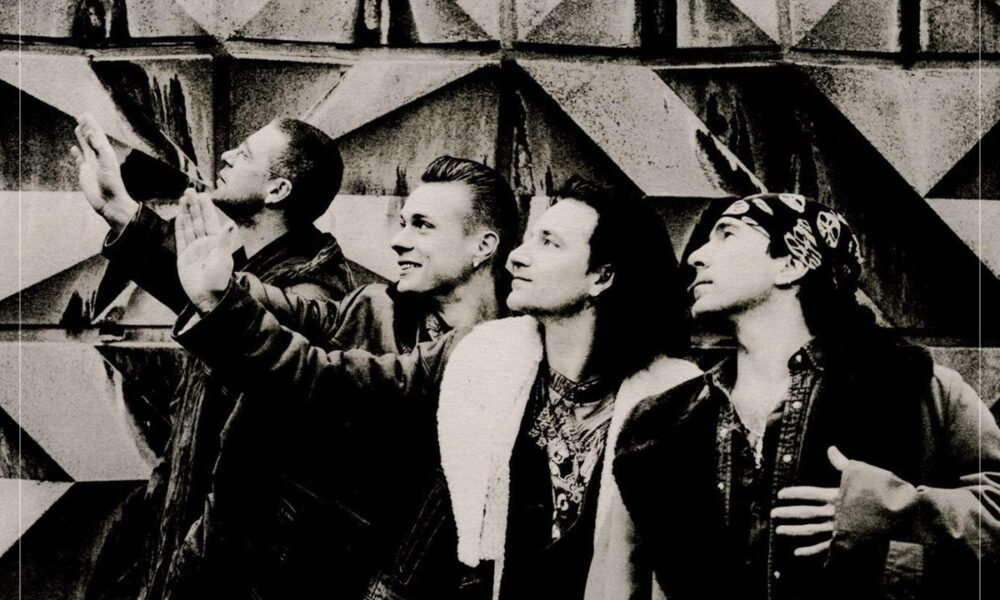
The artists that pulled U2 toward ‘Achtung Baby’

(Credits: Anton Corbjin)
By the 1980s’ close, Irish stadium sellers U2 knew they needed a major rethink of their creative trajectory.
Bono said as much at the time. Addressing Dublin’s Point Depot crowd on the final night of their 1989 Lovetown Tour, the frontman told the audience “we have to go away and dream it all up again”, well aware of the artistic muzzle they needed to break free of. The Joshua Tree’s plundering of Americana’s musical blues and country foundations had struck a captivating peak of stirring anthemic rock authentically connected to the US’ aural and thematic great plains, but the misguided Rattle and Hum studio-come-live sequel, and its bloated concert film, triggered accusations of earnest jumps into their own hype.
U2 didn’t disagree. Looking beyond the States’ musical heritage and national borders, the quartet sought to soak up the sweeping change upending the Eastern Bloc, heading to Berlin’s famed Hansa Studio just as Germany had reunified and immersed themselves in the chaotically liberating air that charged the healing nation. While bassist Adam Clayton and drummer Larry Mullen Jr held some initial misgivings, U2 took guidance from the dance music and electronica blossoming from England’s north and beyond, a movement paying no regard or reverence for the stadium rock shtick U2 had been slogging for the best part of a decade.
“The other thing that was happening was this technological breakthrough that came through sampling, and first through hip-hop, and then through the back door and through the club scene of Manchester, into more guitar-based music, which was this advent of the use of drum loops and samples to inject a kind of more rhythmic quality to the work,” guitarist The Edge revealed to Guitar World in 2021. “So as we went into the songwriting, I felt this was definitely an area we could move into as a band and develop”.
Such expanded palletry spiked their awaited LP with a darker and edgier sound than U2’s fans were prepared for. Dropped in November 1991, Achtung Baby radiated a renewed confidence that well and truly shook off the stodgy parody U2 had lapsed into several short years earlier, toward an electrically contemporary and kaleidoscopic statement marking a definitive Mk II rebirth. Underneath the lashings of groove beats and electronic textures, The Edge draped his signature guitar sirens with gritty shrouds of prickly effects and dissonant crust, all a nod to some of alternative music’s fringe rivetheads at the time.
“I was very inspired by the sonics that were going on in other more sort of subculture music forms,” The Edge furthered. “The industrial music scene was sort of really exciting at that time, and bands like KMFDM and The Young Gods were doing quite extreme-sounding recordings. I liked that as a jumping-off point”.
It’s quite the jump from cutting numbers with BB King and Bob Dylan. While KMFDM are burnished from the more dancefloor end of industrial over The Young Gods’ art rock leanings, the mechanised assault on the world of hard rock and the darker corners of clubland inform Achtung Baby’s fuzzing opener ‘Zoo Station’, an unmistakable metallic clangour hiding underneath Mullen’s snare with heavy, factory resonance.
Achtung Baby would lead to the mammoth Zoo TV Tour, an arch-subversive art project-come touring satire on the era’s media overload and broadcasting landscape, unveiling Bono’s many wardrobe changes and characters and even yielding the thematic Zooropa album sequel that deepens U2’s fling with industrial music on spikey cuts like ‘Numb’ and ‘Daddy’s Gonna Pay For Your Crashed Car’. Finding themselves booked as an opening act on Zoo TV’s Rotterdam show, Berlin junkyard provocateurs Einstürzende Neubauten were never asked again when one of the members lobbed an iron bar into the audience in response to a booing crowd not digging the industrial racket as much as The Edge clearly did.
Related Topics
Other Articles


No Comment! Be the first one.