
How contemporary Dalit artists are asserting their identity in their works
In a 2023 Hindi film, Rocky Aur Rani Kii Prem Kahani (The Love Story of Rocky and Rani), the male protagonist Rocky is purported to be all brawn and no brain, and considered intellectually deficient by the family of the girl he is wooing, Rani. In order to impress them, he starts mouthing key words that would help him rise in their esteem, leading to hilarious results. On one such occasion, he sputters, ‘Black Lives Matter’, eliciting sniggers from the girl’s family.
An important takeaway from that film dialogue is the universal acknowledgment of the simple truth of that message — that Black lives matter. The slogan emerged last century from the struggle of African-Americans in the US to lead a life of dignity and gain recognition for their contributions to American history, which continues to be celebrated in various ways, an important one being the Black History Month, observed annually in February in the US and elsewhere.
It is not a surprise that the Black History Month has inspired the Dalit History Month in India, being observed every year in April since 2015. It was initiated by the followers of Dr. B. R. Ambedkar (1891-1956), the father of the Constitution of India, and a polymath who was the biggest champion of the rights of the ‘untouchable’ or ‘depressed’ classes of India; he was born on April 14. He popularised the use of the term ‘Dalit’ as opposed to Harijan (children of God) proposed by Mahatma Gandhi; the term itself was first used by one of India’s most significant social reformers, Mahatma Jyotirao Phule (1827-1890).
The existence of the Dalit History Month is an epitome of the wider recognition of the suppression of Dalit lives through centuries, and a renewed will among members of the community to embrace their identity and bring as much attention to their stories as Blacks have done with racism, and Jews with the Holocaust. Contemporary Indian art is one of those areas where members of the community are giving expression to their Dalit identity with great vigour, especially in the past few years, energising the art scene ideologically in a way that has not been seen in a long, long time.
Class Division of Creativity
So, is there Dalit art, like Dalit literature? More importantly, doesn’t such classification of creativity reinforce centuries-old division and subjugation, which Babasaheb Ambedkar and other early lawmakers of modern India spent a lifetime effacing with strong provisions in the Constitution? Veteran Gujarati Dalit writer Dalpat Chauhan, who has told innumerable stories of the community through his books, shared with this writer last summer, while talking about the publication of his Gujarati novel Gidh (1991) as Vultures in English: “Unfortunately, yes, it does but that is the only way Dalit stories can be told most authentically. It is helping bring widespread attention to Dalit issues. It’s like Black literature in the US.”
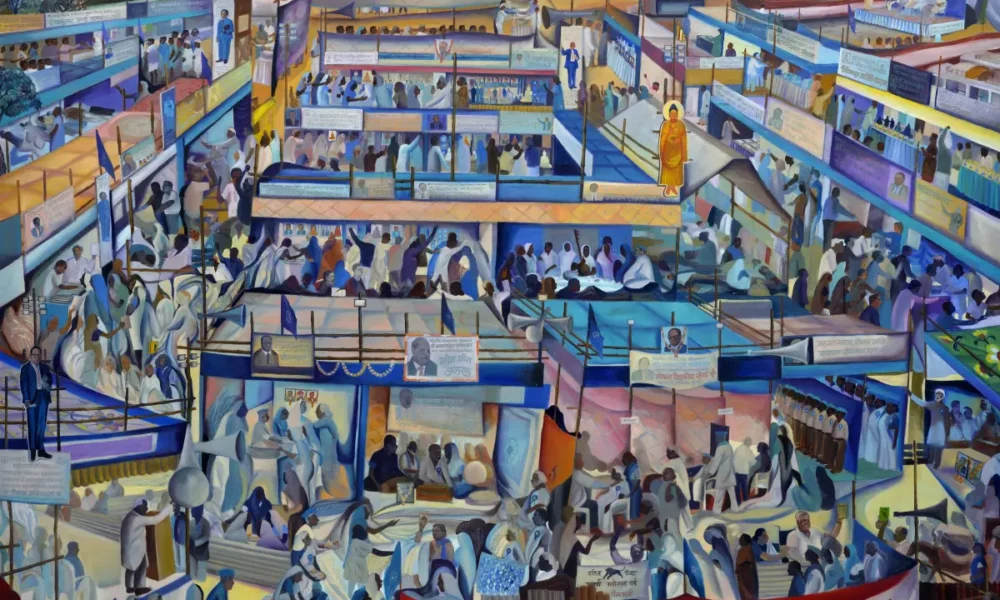
Mumbai-based Vikrant Bhise, 38, one of the most prominent artists telling Dalit stories through his art, would rather not want his art to be boxed in any category. “I don’t believe there should be a stamp of Dalit art, but the centuries-old pain of a community needs to be told,” says Bhise, whose solo show at Noida’s Anant Art Gallery earlier this year, ‘Sense and Sensibilities: A Reflective Realisation’, curated by Dr. Y. S. Alone, remains one of the most powerful expositions of an ideologically rich body of work. With several paintings under different series such as ‘Spine of a Broken Man’, ‘Protest’, ‘Sanitary Workers’, ‘Constitution Crisis’, ‘Nibbana’, among others, his oeuvre has built a compelling narrative encompassing the most fervid emotions of a community that has suffered injustices for centuries. (On top, Vikrant Bhise’s Chaityabhumi: Assembly of parinibbana of a great being, 2023, Oil on canvas).
Vikrant Bhise (left), Preamble Drawings (2022–23), gouache, watercolour, ink and inkjet print on paper. Courtesy of the artist
As is often the case, Bhise’s personal experience became the chief driver of his developing oeuvre. “I know the pain of suffering. I served as a courier boy in Mumbai for four-five years after completing Class X. My father was involved with the Dalit movement, and I was aware of Dalit history. I was even witness to the Ghatkopar incident of 1997 (when Dr Ambedkar’s statue was defaced in Mumbai’s Ramabai Nagar, angering the Dalits who took to the street in protest leading to the police opening fire on them, killing 10). But it was during the lockdown that I read Ambedkar intensely. The ideology of Buddha, Kabir, Ambedkar, Mahatma Phule opened the doors of the narrative to me,” shares the artist, who studied at L. S. Raheja School of Art and Sir J. J. School of Art, Mumbai. He won the Lalit Kala Akademi’s National Award for his series, ‘Impressions’, in 2018.
Vikrant Bhise, Struggle Series (2023) Pen and ink on paper
The zealous focus on the narrative has added inventiveness to art, as evidenced by the use of leather by Madhukar Mucharla, the 28-year-old artist from Hyderabad, known for his sharp focus on Dalit issues. Mucharla achieved early fame in his career with his more-than-life-size leather portrait of Babasaheb Ambedkar, exhibited at the Students Biennale section of the Kochi-Muziris Biennale in 2018 and again at the India Art Fair in New Delhi in 2022.
“Throughout my growing-up years, I was acutely aware of the oppression faced by my people. I come from the community that works in leather, in cobbling, and plays the drum, Dappu (in Telugu) made of raw hide. The Madigas of Telangana, who are a Scheduled Caste community, were rendered untouchable because of their work in leather. They are invited to play the Dappu at family functions but are not allowed to be a part of the celebrations. I remember how I was forbidden by my family from playing the drum while growing up lest it impact my standing in society,” shares the artist. Leather, then, became an obvious choice for Mucharla for creative expression, a material that he started experimenting with while studying. He holds a BFA from Potti Sreeramulu Telugu University, and an MFA from Jawaharlal Nehru Architecture and Fine Arts University, both in Hyderabad.
Madhukar Mucharla (left). Photo: Pramod Kumar. One of his works. Photo: Rishi Raj Jain
By working with leather, Mucharla attacks the very essence of the caste equation in India — the notion of purity and impurity. “I’ve been reading up a lot on the Panchabhutas, the five elements that make up the universe and every living being. I’m working on incorporating this concept in my work as every element also has a skin. Leather is also skin,” he explains. In his intention to make a statement with leather — a type of skin whose touch has rendered generations impure in the eyes of society — he prefers to use it in its most basic form, without any paint.
Mucharla’s work has opened his eyes to a variety of misconceptions that still persist regarding sensitive issues, including leather. “At one of the residencies that I attended at MSU, Baroda, I got great response from students but some of them asked if working with leather was an acceptable thing. I was surprised that such notions still existed in this age among the younger generation. After all, leather is just a material,” he shares, underscoring the fact that history, such that leather has been associated with, is not as easy to renounce.
By working with leather, Mucharla attacks the very essence of the caste equation in India — the notion of purity and impurity. Photos: Rishi Raj Jain and Sai Kumar Bankuru
That lends urgency to bringing more focus on Dalit issues, perhaps. Rajyashri Goody, 33, who is interested in understanding how elements like food, nature, language and literacy are actively used as tools to enforce caste rules for generations, says that a part of her work is to bring attention to the vast body of work created by Dalit communities. “There has always been incredibly powerful art produced by members of Dalit communities, visual art, music, poetry, memoirs, dance… It’s endless. Perhaps just the medium used to spread art has shifted today, and that has possibly added an audience that was previously ignorant of Dalit art practices. Much of my work is to do with pointing back to these works made before me, to place them in a slightly shifted context and amplify certain threads I find significant,” she says. Goody, who hails from Pune, holds a bachelor’s in Sociology from Fergusson College, Pune, and a Master’s in Visual Anthropology from Manchester University, UK. Goody incorporates various mediums in her practice — text, voice, paper pulp, ceramics, photography, printmaking, video and installation.
Rajyashree Goody, Toran, 2022, ceramics. Photo courtesy the artist and Galleryske
Rijksakademie of Amsterdam, the Netherlands, where Goody was a resident in 2021-2023, describes her practice as something that highlights how Dalit identity is being reclaimed and reinvented today through acts of everyday resistance, such as going to school, drinking water from public wells, falling in love, sharing a meal, rejecting Hinduism, and converting to other religions.
Bhise, Mucharla and Goody, along with Swathi Bheemani, Tejswini Narayan Sonawane, Prabhakar Kamble are just a few names among the growing number of artists expressing the voice of a subjugated community powerfully through the arts. Bhise attributes a big part of this phenomenon to the protective reservation afforded by the Constitution of India to the depressed classes. He says, “More than seven decades of the enforcement of the Constitution have definitely worked wonders for the community but the responsibility doesn’t end here. People need universities, and educated youngsters need jobs. I feel it’s my responsibility to get the stories of the community in mainstream art so that it becomes as widely known as possible. It’s a long road ahead.”



No Comment! Be the first one.