
Essay | K. Srilata writes: How poets must navigate the public nature of the l;literary space today
In an opinion piece for the The New Indian Express titled “Politics of new poetry and the Salesman poet” (April 2, 2024), C.P. Surendran bemoans the “explosion” of poetry in present-day India. He speaks of the spurt in online publishing, in poetry readings, and in the publication of anthologies that include rather than exclude. He wonders if this perhaps reflects a certain “dumbing down” of poetry and asks what effect the constant hustling of poets in a post-informational society has on their integrity.
One is equally aware of the opposite position, of course, which is that systems of gatekeeping operate insidiously when it comes to Indian poetry in English. These systems have traditionally kept poets from certain classes and backgrounds, poets from small towns and Tier II cities, and poets with the “wrong” accents out of the poetry space. The tragedy is that we will not know what we have lost for we will never read those poets. And this becomes an argument to democratise the space, to include rather than to exclude.
So how does one respond to these positions? More importantly, how does one navigate life as a creative person, as a poet who is expected to remain at the edge of the world, observing and documenting it?
Also Read | ‘There’s blood on my knuckles’
“Craziness of endurance”
I cut my teeth as a poet in the pre-Internet era of the 1980s and 1990s. I was based in Chennai, a city that, unlike Bombay or New Delhi, is not really a city for poets. Like the handful of other poets I knew, I took joy, great joy, in writing poetry. My fellow poets and I created, from thin air, poems that, more often than not, were destined to remain in our notebooks. At best, we read them aloud to each other. By definition, we were shy, hesitant, and naive. We had little exposure to the work of poets from the rest of the world, other than what came to us as part of our archaic English literature syllabi.
We had no understanding of the marketplace of publishing. We were not looking to publish. Nor was anyone looking to publish us. We were not looking to make money off our writing. The MFA (Master of Fine Arts) route was not a thing yet, nor were literary agents. Some of us were women. Some of us were not of the privileged caste. Some of us were not upper class. This meant that the route (though we did not think of it as a route) was a hard one, with several necessary digressions.
For, while we had no understanding of the publishing market, we saw quite clearly what we had to do: go out and make a living. If we were women, we also digressed into marriage, into motherhood, into the work of care and nurture. What happened to our poetry in the midst of all this? Some of us died as poets—or the poetry in us died. Some of us clung to poetry as a drowning person does to a rope that is thrown to her. I belonged to the latter group. The writer Tillie Olsen speaks of the “craziness of endurance” that was her life. That was us. We did double duty, triple duty even, depending on the circumstances of our lives. But through it all we continued to write. And our lives became the fodder and fuel for our work.
Tiny oases
There is something about the form of poetry that sits well with how fragmented life is. Poetry speaks to and responds to those fragments, and it is in fragments of time that poems get written. At least, that all-important first draft. In the case of a poetry collection, unlike in the case of a novel or a book of non-fiction, you do not have a sense of writing a giant, structured thing. There are no chapters to worry about. With the exception of narrative poetry or themed collections, poetry books do not seek to tell a particular story. There is no grand narrative, or if there is one, it emerges in retrospect. We, my fellow poets and I, wrote one poem after another as life was happening. Poetry allowed us to do that—to pause on those moments and this pause was our reward.
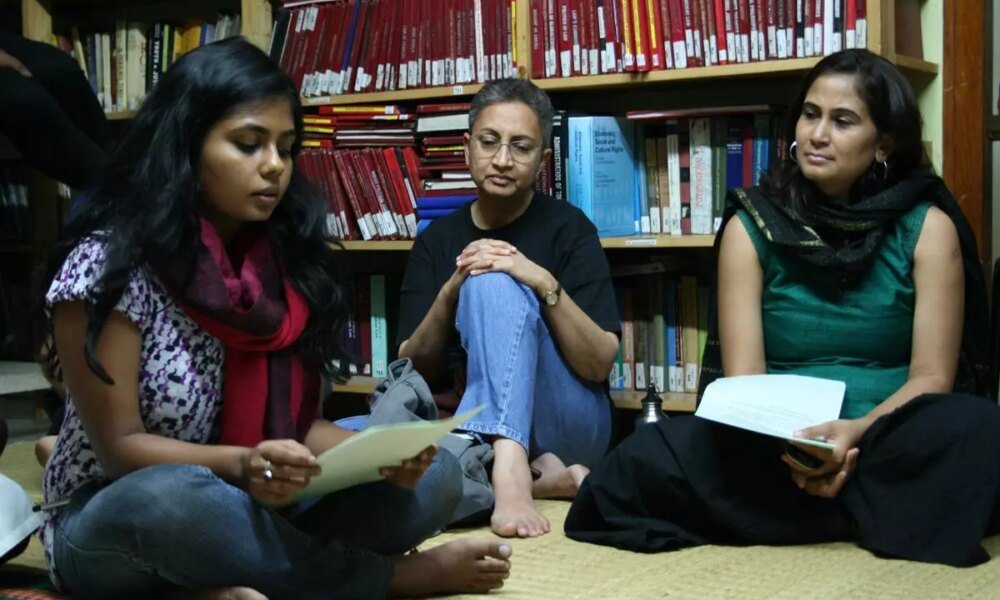
Poets Priyamvada N. Purushotham and Tishani Doshi read extracts from their poems, “Cats’ eyes on a highway” and “Poems in light and dark” in Chennai on October 28, 2003.
| Photo Credit:
KV SRINIVASAN
At some point, I started to publish my work. A few collections came out, collections published by small, independent poetry presses without the clout to publicise or market. But I was deeply grateful to these presses and to the brave folks who ran them. The fact that my poems reached about a hundred-odd people felt enough.
Between those years and now when I have published books—not of poetry—with mainstream publishers, when the world has tilted increasingly to the Right and creative spaces have been reduced to tiny oases, when I have a social media presence (much to the amusement of my adult children), when I have done the lit-fest route and tweeted and posted and felt exhausted all at the same time, so much has changed.
Also Read | Served raw: How poetry from north-eastern India captures the trauma of everyday violence
What have l learnt through all these years, when the literary world as we know it has become such a public one? I have learnt the following: One, that it is still one’s primary duty as a poet to write poetry. Two, that one must pay forward the generosity one has received from other poets, publishers, and readers. This paying forward can take different forms. In my case, it has taken the form of running creative writing workshops, informally mentoring other poets, anchoring and organising readings, and reviewing poetry books. Three, that one must never be blind to one’s own relative privilege. To do time as a poet is its own privilege. Four, that one must fashion collaborative spaces and spaces for constructive, mutual critique. Writing may be essentially solitary, but poets need communities too.
This is a hard world to navigate, and it is really important to be as kind as we can, to not see things or people in black and white, to try and walk in the shoes of poets and writers with histories we know nothing about, to build communities, and to give back as much as we take.
K. Srilata is a writer, poet, and academic. Her recent books include This Kind of Child: The ‘Disability’ Story (Westland) and an anthology of poetry, Three Women in a Single-Room House (Sahitya Akademi).



No Comment! Be the first one.