
[ad_1]
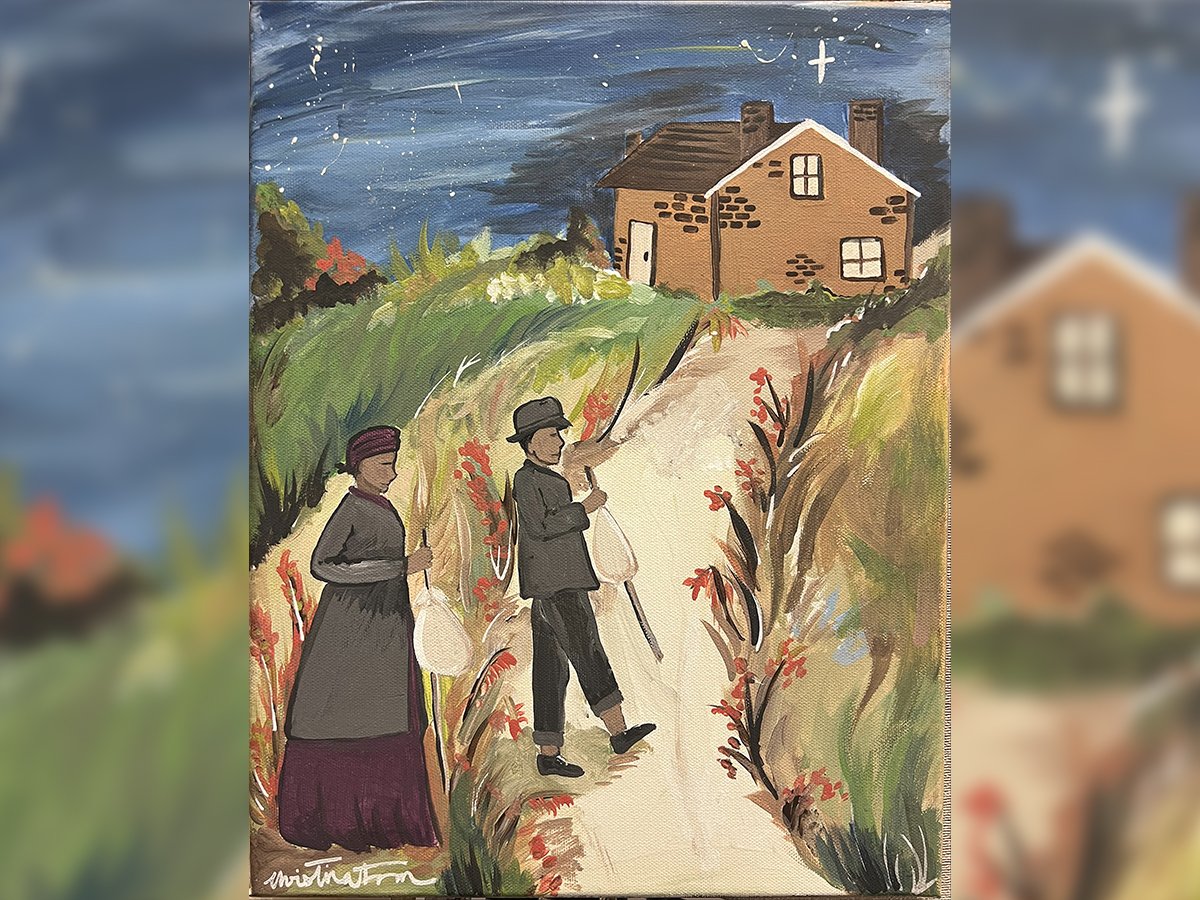
To Christina Tran, a junior at Middle Creek High School in Apex, her painting featuring Harriet Tubman and her brother Ben Ross invokes a sense of resilience. The work, titled “Under the Northern Star,” depicts Tubman and Ross walking along a sand-colored pathway toward the home of an Underground Railroad conductor. A lush green landscape surrounds the figures as they walk underneath a night sky dotted with stars, the largest of these the North Star, to freedom.
Tran created her acrylic painting for a project in English teacher Matthew Scialdone’s fall honors African American literature class. The piece takes inspiration from Tanya Savory’s book Harriet Tubman: Freedom Leader, which details Tubman’s early life and how she became a revolutionary historical figure in the fight to end slavery.
“I wanted to focus on her journey, and we also learned that when she had to escape, she had to leave her family behind, her brothers and others,” Tran says. “I wanted to focus on how she came back after having to leave and all the sacrifices she had to make to earn her freedom first in order to help others.”
The Town of Apex will showcase the artwork of approximately 15 students from Scialdone’s honors African American literature class at its annual “Juneteenth in the Peak” festival on June 15. In addition to visual art, Middle Creek High School will feature other art forms such as poetry, three-dimensional pieces, and videos as part of its digital media and art installation.
Scialdone’s class’s art will comprise most of the school’s student work at the event. Other school groups, including the National Art Honor Society, will also participate.
“Any way we can tie our school community into the celebration, we’re finding ways to do that,” Scialdone says.
This is the first year the festival, taking place at the Depot on North Salem Street, is partnering with two local high schools—Apex High School is also participating and will host an interactive art activity at the Halle Cultural Arts Center.
TJ Evans is the festival’s founder and the recipient of the Town of Apex’s 2024 Think Apex Individual Top Thinker award for his work on the event. He says one of the festival’s goals is to empower the youth, and presenting student artwork is one way to do so this year.
“They’re artistic, and we want them to be able to come out and express themselves for sure,” he says.
The opportunity for Middle Creek to present artwork at the festival came in February. For the Town of Apex’s Black History Month event, “Stories Still with Us Today” at the Eva Perry Regional Library, Scialdone’s students shared artwork that reflected oral histories performed by actors from the town’s historical drama Forged in Fire. The artwork caught Evans’s attention, and he approached Scialdone about the possibility of his students joining the festival, and a new collaboration was born.
Scialdone has taught honors African American literature since 2012. The class is open to students from ninth to 12th grade, and the artwork at the Apex Juneteenth festival comes from classes Scialdone taught last fall and in previous years. It reflects a piece of African American history or culture, typically literature that students have read, from classics to modern works.
Although the course involves extensive reading and writing, Scialdone strives to give his students opportunities to reflect on the content in myriad ways.
“So whether that’s through a piece of artwork, a sculpture, or a song, or if it is the good old-fashioned essay, they can do that, too,” he says.
The course has two main projects that generated the student artwork for the festival. For the first, students choose a book to read and analyze, along with what Scialdone calls an action or a creation. For instance, a student can do something for their community, like build a mini library, as a student did in a previous year, or write poetry in the style of a particular poet they studied.
For the second project, focused on autodidactism, or self-education, Scialdone encourages students to find something they are interested in based on what they learn in class and teach it to themselves. Students can also take this project in various directions, including creating a lesson or artwork.
Junior Alexa Burke wrote her six-stanza poem “Tattered” as a freshman in Scialdone’s class. The poem is about how hatred can turn into love and how that relates to Juneteenth.
“People are using this time not to spread hatred and not to emphasize their division but to show that there’s love and that we’re unifying after all this hardship that both sides went through,” she says.
At the festival, stations with headphones will allow attendees to watch recordings of students reciting their poems, or they can read paper copies.
In addition to showcasing her poem, Burke curated a playlist for the festival, which includes songs from Black artists such as Kendrick Lamar and Lauryn Hill acknowledging Black individuals’ struggles and celebrating perseverance.
She says it is important for students to participate in Apex’s Juneteenth festival so the younger generation can pass on its legacy to future ones.
Senior Xavier Sample wrote two poems, “Culture” and “Past,” this fall in Scialdone’s class. He chose poetry because he believes it requires more effort and wanted to challenge himself.
“Culture” emphasizes the importance of Black culture in the United States. In the piece, Sample intends to send a message that the culture is one of love and hard work, which he says is what makes it beautiful.
“Past” is about the history of injustices African Americans have faced, including enslavement. Phillis Wheatley—the first African American woman to publish a book of poems, and whose poem “On Being Brought from Africa to America” describes Wheatley’s experience as an enslaved woman through the lens of her Christian faith—inspired Sample’s work.
“At first, I didn’t really think it was all that special,” Sample says about “Past.” “But then my teacher encouraged me that ‘Hey, you have something great here; I feel like you can expand upon that.’”
Sample appreciates the festival’s collaboration with high school students for the upcoming event because he believes students like himself should have a voice and gain the same recognition for their artwork that older artists do.
For Scialdone, art is a powerful outlet for students to express their ideas and emotions. It allows them to slow down and process meaning at a deeper level, such as that of the historical significance of Juneteenth, he says. In this way, students can educate their elders and the community at large about the holiday.
“I’ve been teaching for 22 years,” Scialdone says, “and kids continually find ways to blow my mind and make me very heartened for the future.”
Comment on this story at backtalk@indyweek.com.
[ad_2]
Source link