
[ad_1]
When Cara Merrill won a grant a year ago to go overseas to visit historical Holocaust sites in Poland, she had no idea where the experience would take her students.
The Ashland District School English teacher will accompany her seventh-graders to Augusta later this month as their World War II-inspired artwork takes center stage at the Holocaust and Human Rights Center of Maine in Augusta.
The slaughter of six million Jewish people by the Nazi regime has long echoed around the world, but so has the strength of the people who resisted and endured. That idea led Merrill and the center’s education coordinator, Erica Nadelhaft, to challenge the class: learn about resistance and create art to celebrate it.
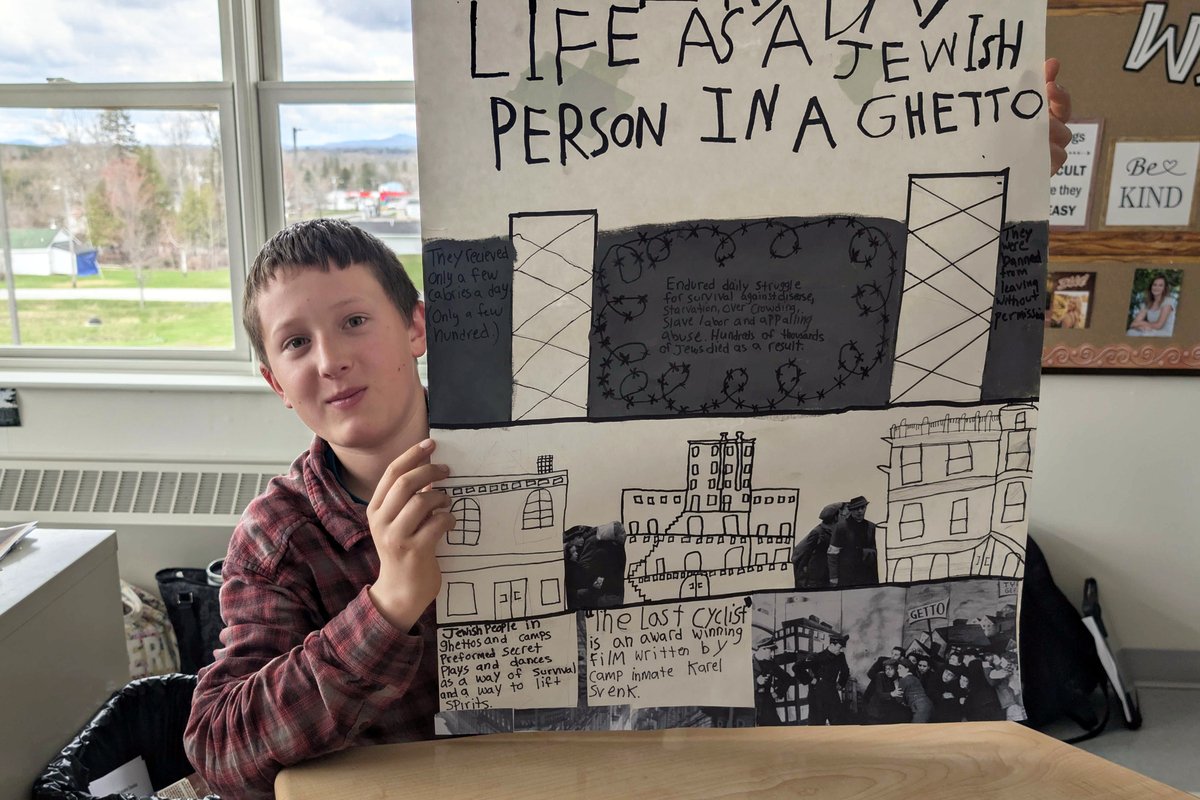
So, with images and narratives, Merrill’s seventh graders shared what they learned. Nadelhaft was impressed. Now, they will become the first Maine students to show their art in the center’s newest effort.
“This is a big opportunity, because some of them have never been to Augusta. The rest of us as adults should be able to look at what they’ve done and see things as they have,” Merrill said. “Resistance gave people a voice.”
Merrill, who has worked with Nadelhaft before, weaves history into her middle and high school English classes, including the Holocaust. She traveled to Poland last summer, visiting sites such as the former Auschwitz concentration camp, and returned with scads of photos and details that she turned into lessons.
Learning about a Krakow pharmacy fascinated students, she said.
Many Jewish people were forced into ghettos, where disease and poor conditions flourished, according to the American Institute of the History of Pharmacy. Taduesz Pankiewicz owned a pharmacy in a Krakow ghetto, providing medicine and helping many people escape the Nazis.
-

Ashland District School students Wyatt Wood (left) and Jude Robinson explain their depiction of Heroes Square in Krakow, Poland, which memorialized people who died in the Jewish ghetto during World War II. Credit: Paula Brewer / BDN -

Presley Kinney talks about her illustration of the Auschwitz concentration camp, part of a history project with Ashland District School and the Holocaust and Human Rights Center of Maine. Credit: Paula Brewer / BDN -

Ashland District School English teacher Cara Merrill talks with seventh grade students Elizabeth Walker (left) and Maizie Ouellette about their projects depicting Krakow, Poland, during the Nazi occupation of World War II. Credit: Paula Brewer / BDN -

Ashland District School seventh graders in Mrs. Merrill’s class pose with their artwork that will hang this summer at the Holocaust and Human Rights Center of Maine in Augusta. From left are, front: Matthew Fasciani, Jude Robinson, Anna Pomerleau, Eloise Michaud, Elizabeth Walker, Byron Marves and Urijah Palmer. Back: Mrs. Merrill, Emma Belanger, Maizie Ouellette, Carson Willey, Presley Kinney, Lydia Bonville, Grant Eastman, Odin Clifford, Gilead Janoch and Wyatt Wood. Credit: Paula Brewer / BDN
Besides medicine, Pankiewicz provided hair dye and false identification cards, several students said as they shared their projects on Thursday. Hair dye made people look younger so they appeared able to work, and false IDs hid their Jewish heritage – potentially saving them from the death camps.
The class projects illustrated the pharmacy, concentration camps, life in the ghetto and different ways people resisted the Nazi regime.
“It wasn’t just physical fighting, but silent resistance, like helping Jewish people get out of the Nazis’ grasp,” Jude Robinson said.
He and classmate Wyatt Wood created posters and a three-dimensional representation of Heroes Square in Krakow, which memorializes those who died in the ghetto.
People who helped save lives showed another kind of resistance, Urijah Palmer said. His poster depicted Irena Sendler, who smuggled Jewish children out of Warsaw.
Lydia Bonville’s poster showed someone jumping from a window. Some people would rather die by suicide than be under Nazi control, she said.
Learning about the Holocaust “makes you speechless,” Wood said.
“You don’t know how bad it was,” he said. “People should learn about it to understand what happened and feel bad so we don’t let it happen again.”
“When we were learning about it, I felt sad to know how many families lost mothers, fathers, siblings,” Elizabeth Walker said. “We had heard of the Holocaust, but not the details. It helps you feel what they felt.”
The students’ exhibit is the first in a pilot program, Nadelhaft said Friday. She wants to do the same every year with a different group of students.
The Augusta center provides free programming about the Holocaust, human rights and confronting bias to students all over Maine from middle school up, she said.
Last fall, staff decided to boost student interaction with projects that could follow their presentations. Nadelhaft suggested art activities that could culminate in an exhibit at the center.
She chose Ashland to kick things off because she was impressed with the students’ engagement during her previous visits, as well as Merrill’s commitment to teaching and learning about the Holocaust.
“They were really serious about doing the work,” Nadelhaft said. “These kids were listening, they were taking notes, they were engaging with me, asking good questions and answering questions. It felt like they committed to the project right away.”
Big plans are underway for the students’ May 29 visit. After all, they’re having an art opening, and the fact their work will be displayed all summer is a big thing, she said.
There will be food and presentations, and she will invite Merrill to speak.
Merrill is proud of her students and excited about the opening, she said.
She appreciates that she has more to share since her trip to Poland. She didn’t know about Heroes Square, or that Auschwitz was the only place that tattooed people who were kept there, she said.
She recalled an overwhelming sense of sadness, grief and disbelief at Auschwitz, but also hope because some did survive. Visitors have to wash their shoes when they leave out of respect, because they have stepped on people’s ashes, she said.
“I wanted to visit these sites not because it’s a happy trip, but because they should be remembered. It’s very emotional and very hard,” she said. “The trip has made a big difference in what I can teach and what they can learn.”
[ad_2]
Source link