
[ad_1]
She was arrested in April 1944 and eventually deported to the Auschwitz-Birkenau death camp in Nazi-occupied Poland, where she died in a gas chamber a few months later.
Paisley has been chosen for the first wall mural in Scotland in her memory because she worked as a secretary at J&P Coats’ Ferguslie Mill in the town for 10 years before moving to Budapest in 1932 to take up her role at the Church of Scotland school.
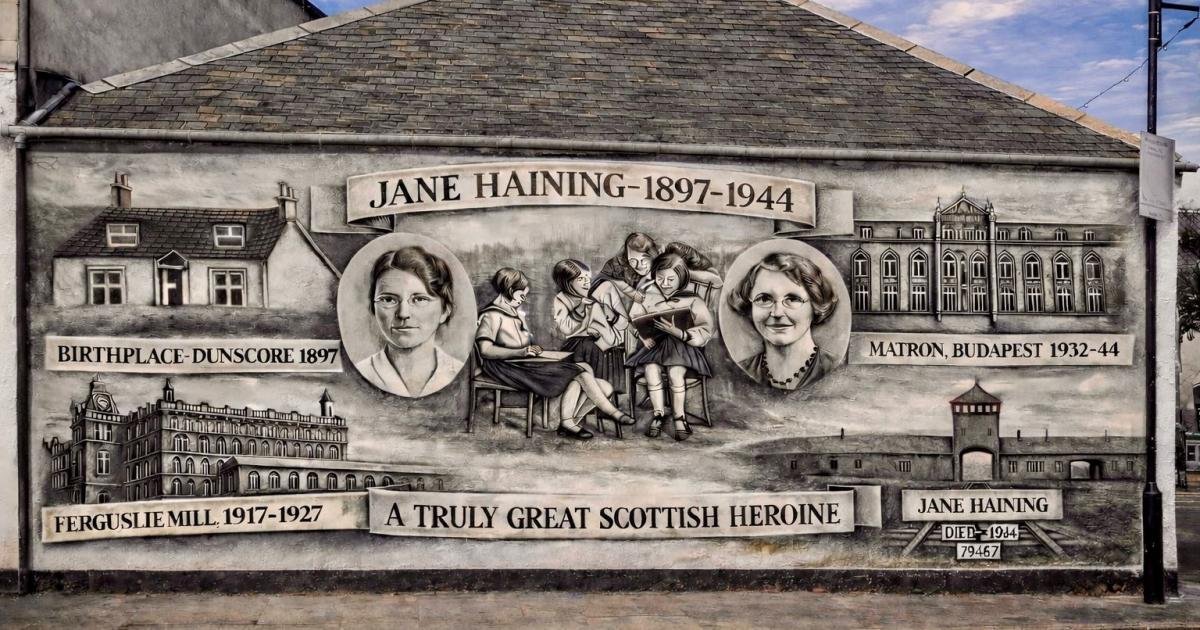
The black and white mural will adorn a wall at Brown’s Lane and Shuttle Street, thoroughfares that Miss Haining used on her way to and from work.
Measuring approximately 9ft high and 65ft long, an image of Miss Haining surrounded by children reading a book is at the heart of the mural with portraits of her as a young woman and older woman on either side.
READ MORE:
Billy Connolly mural in Glasgow city centre covered up
Lost portrait of Rabbie Burns found after 220 years
The Glasgow schoolgirl who went viral after selling first painting aged 11
It also depicts buildings that were central to her life – the cottage outside the village of Dunscore in Dumfriesshire where she was born, Ferguslie Mill, the Scottish Mission School and Auschwitz-Birkenau, where she was branded prisoner 79467 and forced to work as a slave labourer until she was no longer able to.
Commissioned by the Renfrewshire branch of Unison, the mural was designed by Paisley-based artists Alexander Guy and Caroline Gormley, who consulted with Miss Haining’s family and Mark Ferguson from the public services trade union.
They hope to start work on it in the spring of this year and estimate that it will take around 25 days to complete.
Mr Guy, known as Sandy, said: “I did not know the story of Jane Haining before we were asked to do this and I found it fascinating to research the information about her life.
“Initially I thought to myself ‘why this woman because millions of people died during the Holocaust’ but the more I read about her, the more I realised how remarkable she was.
“Jane Haining was a true heroine and her story needs recognition, whether it’s in Budapest, Paisley or Dunscore and I’m very honoured and privileged to produce a mural that hopefully does her and all her relatives proud.”

The Scottish Mission School had around 400 day and boarder pupils aged from six to 16 years old, a mixture of Jews and Christians.
Miss Haining helped keep the children safe for more than four years after the war broke out in 1939 until she was betrayed by the cook’s son-in-law, whom she scolded for taking scarce food meant for the girls, many of whom were orphans or abandoned by their parents.
She was determined to stick to her post and repeatedly ignored Church of Scotland requests to return home, saying: ‘If these children need me in days of sunshine, how much more do they need me in days of darkness?’
Miss Haining was arrested by German officers in April 1944 and former pupil Agnes Rostas said her haunting last words to sobbing children were: “Don’t worry, I’ll be back by lunch”.
But the kind-hearted Scot never returned to the school and was charged with eight separate offences and jailed in Budapest before being transported along with Hungarian Jews to Auschwitz in Nazi-occupied Poland on May 14, 1944.
Miss Haining was 47 and her death certificate said she died in hospital, succumbing to cachexia following intestinal catarrh, on July 17 but it is widely accepted she died in a gas chamber and her remains remain on the Auschwitz site.

Ms Gormley said: “Like Sandy, I did not know the story of Jane Haining and I was very moved it when I started researching it.
“Knowing she had the opportunity to leave Budapest but didn’t because of the children, that takes a really special person to stand her ground, and not just think of herself and think of other people.
“That’s a strong, strong character and I was struck by the amount of empathy Jane had for people, I think that’s missing in a lot of people nowadays.
“I hope the mural makes people inquisitive to find out more about her and what she did to protect children during a dark time that wasn’t that long ago.
“People think ‘oh, it’s history, it’s such a long time ago’, but it wasn’t really, so you can’t forget what people did as a lesson to what people should do in the present day and in the future.”
Mr Guy said: “After consulting with Mark Ferguson and Jane’s family, we decided to go with black and white as a palette.”
READ MORE:
Calls to pause Scottish church sale to explore community ownership
Potential community buyout of historic Scottish church step closer
Edinburgh hosts first of its kind Holocaust memorial
He said he examined the work of muralists in Mexico, Belfast, Northern Ireland, Soviet propaganda, banners used during the coal miners’ strikes in the 1980s and the style of Dutch Delft blue pottery for inspiration.
“What we came up with is an amalgamation of all these influences combined with what I would call our own handwriting because I don’t like using the word style,” explained Mr Guy.
The mural will be painted with oil paint, which is resistant to rain, and it will be sealed beforehand and then varnished afterwards.
Ms Gormley said: “We won’t be using spray paints, we will be using brushes and just treat it like fine art canvas, that’s how we’ll approach it.”
Mr Guy and Ms Gormley run the Made in Paisley studio and gallery, offering art classes for children and adults, in addition to producing their own work.
Unison Renfrewshire is committed to ongoing work to raise awareness of Miss Haining’s life, values and sacrifice through education and community engagement.
The union runs an annual Auschwitz study tour, where delegates learn about her story and attend a memorial service near the block where she was imprisoned.
Mr Ferguson said: “The mural has exceeded my expectations, we wanted it to tell the story of Jane Haining in the various locations she was in.
“But one of the things the family and I were very keen on was that centre photograph of Jane with the children, because that’s who she was.
“I’m absolutely delighted with the image and with the very powerful presence that it will have in Shuttle Street in Paisley, it will generate a lot of interest.”
Renfrewshire Provost Lorraine Cameron said: “I think the mural is just wonderful, it’s a really modern way of sending a message and telling a story.
“I think the location is perfect because it’s right at the heart of that old historical part of Paisley, which Jane Haining would have visited many times while working here.”
The artwork was unveiled at a special event to honour Miss Haining in Paisley and to mark Holocaust Memorial Day on Tuesday.
Hundreds of people packed into Coats Memorial Church including members of the Kirk matron’s family, representatives of civic society, the Jewish community and the Kirk, including Rt Rev Rosie Frew, Moderator of the General Assembly of the Church of Scotland.
A new film titled Jane Haining: A Mission of Love was screened at the event alongside the launch of educational resources for schools across Renfrewshire.
There were music and theatre performances and wreaths were laid and candles lit in memory of Miss Haining.
Mrs Frew said: “The artwork for the mural is striking and I hope it, along with the new film, will help share Jane’s story because it is vitally important that people learn the lessons of history.
“She was simultaneously an ordinary and extraordinary woman and her story is one of courage, heroism, decency and personal sacrifice, reminding us that when we feel powerless, there is always something that we can do.
“Her life is a fine example of service over self-interest.”
[ad_2]
Source link