
[ad_1]
Be honest, you have – and be even more honest, it was fun.
We might call it ‘romanticising life’. Gen Z might call it ‘main character energy’. Regardless of what it is called, artist Ryan Gander says how “it’s really good for supressing anxiety to imagine your life as a movie because there are little consequences to it, so you float through life not stressed out, which is a nice strategy.”
Erving Goffman’s The Presentation of Self in Everyday Life (1956), talks of dramaturgical analysis being defined as the study of social interaction in theatrical performance.
Gander talks about how when many of us go to a museum we look at others looking at art – that we often understand what art is by looking at how others interact with it.
With the Instagram generation, many of us are so concerned with how we are going to depict the experience online, that perhaps we are also looking at ourselves during the experience, as well as others.
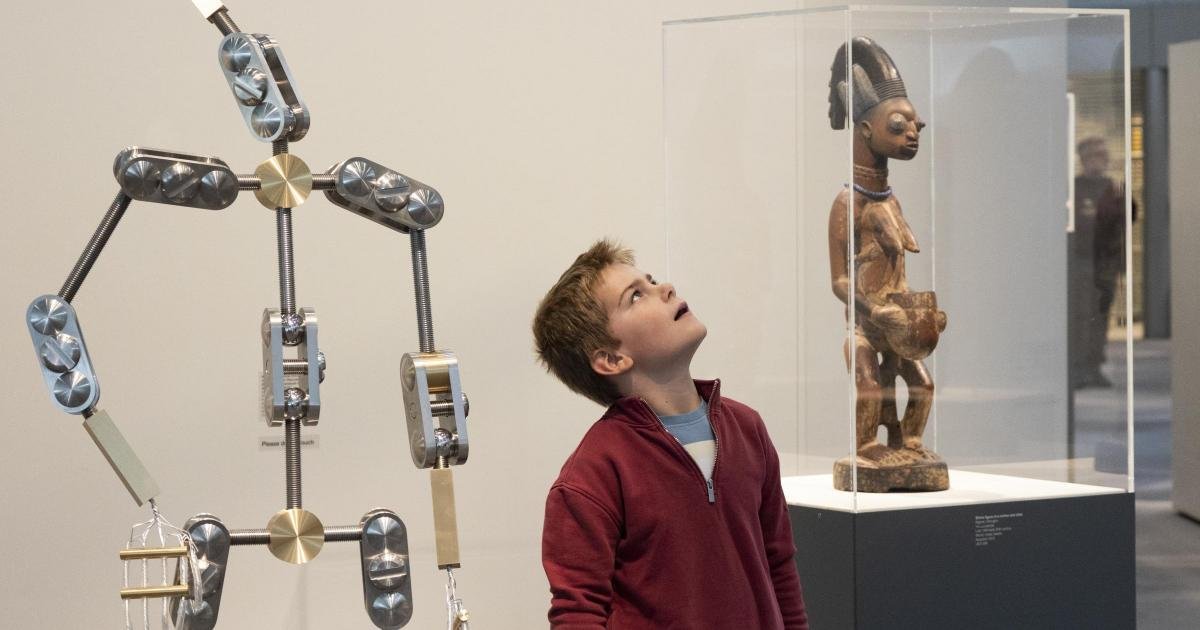
The Sainsbury Centre is now home to a newly commissioned sculpture by celebrated artist Ryan Gander: Ms Modern Classical Conceptualist, or Their Shadows Obscured (Dramaturgical framework for structure and stability) (2025).
The extraordinary installation, an intriguing life-sized human armature made up of stainless steel, brass, aluminium and plastic, looks up at a copy of themselves disarticulated, their limbs gently circling around the ceiling, high above the Sainsbury Centre’s Living Area gallery.
Positioned in the Sainsbury Centre’s Living Area, the figure is reminiscent of a person waiting in a public place alone – evoking familiar, even universal feelings on the performative nature of living, and the experience of being observed.
For Gander, there are always multiple realities, and variations on projections of the self. Beyond the multiplicity of individuals in the world, there are many more still when the individual interpretations of others are accounted for.
We all have a version of ourself which goes to work, another who socialises with close friends, another who meets new people, and more.
We cannot possibly be the same in every situation, so are there many versions of ourselves in existence – even more if this does not include the versions others see of us?
Gander’s installation invites us to think about what makes us human; how we position ourselves in the world, and in turn, how we see and study others.
This new work explores the Suffolk-based artist’s reflections on qualities like empathy and humility in which, in his own words, he contrasts with strength and power as opposing states.
These tensions are central to the non-specific form of Gander’s work – which is itself extremely politicised, though “without political motivation” – commenting on the nature of power, without that power being for any given position.
But ultimately, Gander expresses: “equally if a seven-year-old kid comes in and she says ‘it’s a robot’, that is a valid interpretation, and it is one that I would treasure.”
The work takes on a new personality with every visitor’s perspective. Gander has no set idea or projection of one thing that this work is – that decision is down to the individual viewer – “as long as they’re honest”.
Is this not how museums should be? No right or wrong ways to enjoy or experience, no right or wrong interpretations of the facts – just peaceful, creative and enriching exploration.
Hear more from Ryan Gander, here: https://sainsburycentre.ac.uk/channel/in-conversation-with-artist-ryan-gander/
[ad_2]
Source link
Other Articles

The official website of the Republic of Korea
Faculty of Fine Arts – Concordia University