
[ad_1]
Located at the very tip of one of Canada’s most easterly points, the Bonavista Biennale is a free public art event that brings ambitious artworks to unconventional spaces across the small Newfoundland peninsula.
Held every two years, it’s a festival worth visiting to learn about the vibrant local culture as well as what this historically significant community has to say to the broader world of contemporary art.
“What we’re trying to do is bring contemporary artists to the Bonavista Peninsula and put them in conversation with one another, the landscape and the communities that are here,” says Rose Bouthillier, artistic director of the Bonavista Biennale.
“We also like to challenge artists to work in ways that they don’t normally work. Often, that’s making work for the outdoors or different specific contexts outside of the museum, in places like historic homes or industrial buildings, places where their art is in conversation with the environment that it is situated in.”
The fifth edition of the biennale, entitled String Games, curated by Dr. Heather Igloliorte, encapsulates this ethos. Grounded in the land and cultures of the province, the festival also draws in multiple international collaborators for the first time. From Aug. 16 to Sept. 14, the work of more than 20 artists is installed across the peninsula in different family businesses, community halls, municipal parks, shacks, coves, meadows and other landmarks.

Hopping from one site to the next, visitors are immersed in the stunning visual landscape of craggy cliffs, nesting puffins and early settler infrastructure, which temporarily plays home to a variety of artworks.
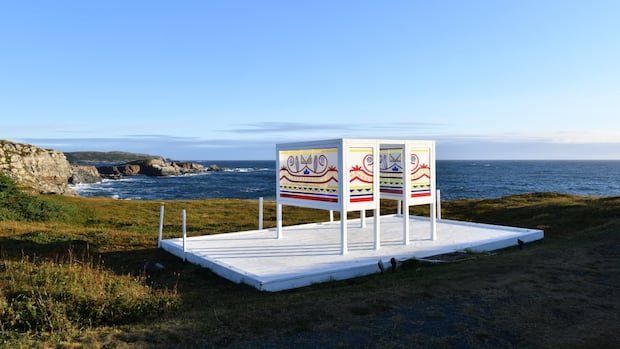
Take for example Melissa Tremblett’s installation dreaming of caribou, which transforms the South Bird Island picnic platform in the hamlet of Maberly. A freestanding, wooden structure with transparent red, blue and yellow plexiglass patterns, the work draws from traditional Innu caribou coats. Tremblett’s observation deck filters light as well as the view of the surrounding landscape, reminding visitors of the Indigenous communities that have inhabited these lands for generations.
“The development of the theme was very much collaborative between myself and Rose Bouthillier,” says Igloliorte. “We were definitely interested in artists who come from small places.”
The biennale is filled with delightful contributions from artists who have lived in the region for generations, those who came and settled, as well as a selection of national and international creators bringing outside perspectives. Each creator shows mastery of their materials in ways that transform the viewer’s perception of otherwise simple objects and symbols. Many blur the edges between craft and visual art, embodied knowledge and acquired skills, and tradition and change.

Corner Brook, N.L., resident and fine arts professor Larry Weyand‘s oversized, bejeweled lobster and disco-ball-like cracking tool are a fine example. While playful, bright and alluringly festive, they also carry questions about queerness, excess and the transition of the once working-class food to a symbol of wealth.
On the other side of the peninsula, in the town of Trinity, Sancia Miala Shiba Nash‘s immersive video Kuroshio (Japanese for “Black Current”) guides the viewer through a dreamscape that is uniquely hers. Through a series of intersecting stories, using both found and filmed footage, the artist reflects on her birthplace of Kīhei, Maui, and her ancestral roots in the Japanese archipelago. The two-channel projection is meditative and visually rich, and the traditional woven floor mats — called moena lauhala — ground the audience in the space while they dive into the artist’s universe.
First presented at the Hawai’i Triennial earlier this year, Shiba Nash’s contribution links Bonavista to issues in Hawaii. The work illustrates how memory, dreams, oral histories and archives are passed down by generations. Presented inside the Lester-Garland House, a heritage building that memorializes cultural ties between Newfoundland and the west of England, Kuroshio underscores how these historical sites were once living places, where joy, love and loss continue to linger.

“Having Kuroshio present here has made me think about the currents that shape the Atlantic, and how this body of water, like Moananuiākea (the Pacific) has connected different regions across time,” says Shiba Nash. “I’ve learned a lot by being here — especially from the people of this place — about Newfoundland’s pasts, present and hopes for its futures.”
With so many perspectives on display, String Games challenges the idea that Newfoundland is a province that lacks diversity. Artists like Brian Amadi and Clara Clayton Gough highlight the complex histories specific to the Black community in the province. The former’s photographic intervention depicts young Black Newfoundlanders from his community occupying positions of agency and power, while Clayton Gough transforms her handwoven baskets — a family tradition dating back to the War of 1812 — into formidable, life-sized figures.

At each of its 17 sites, String Games moves between now and then, showing how the people who came before us continue to carry us forward. At the Port Union Women’s Institute Craft Shop, founded in 1967, local craft is put on display with a variety of family quilts, felted puffins, wool socks and mittens, as well as other forms of dexterous handiwork and visual storytelling.
Just down the road at Union House Arts, there’s an exhibition titled Stitches We Share: From Grandmothers’ Hands to Ours, co-curated by Jessica Winters, Ella Jacque and Vanessa Flowers with the assistance of Igloliorte. The project displays sealskin mitts and boots, grass basketry and other objects connecting the young women, who come from different parts of the province, to their grandmothers — Nellie Winters, Sarah Baikie and Andrea Flowers. The exhibition weaves together the past and the present, promoting the works of elder craftswomen matriarchs through the vision of today’s generation.
“As a teenager I spent countless hours with Nan, learning from her steady hands and deep knowledge,” writes Vanessa Flowers in the exhibition panel next to a pair of her grandmother’s beaded sealskin boots. “Over the years, she passed her gifts to my siblings and me. Today, as teachers of traditional crafts ourselves, we carry her legacy forward — a privilege I hold close to my heart.”

For Igloliorte, who now resides on the West Coast, where she teaches at the University of Victoria, this biennale is in many ways a homecoming. An Inuk scholar and independent curator hailing from Nunatsiavut (northern Labrador), she feels a deep connection to these young women, curators and makers. With notable care and a sensibility to the realities of everyday life in Newfoundland, String Games builds the legacy of art making in the province.
“I think that there’s so much knowledge and it needs to proliferate,” says Igloliorte. “There are so many Inuit curating, winning awards and doing spectacularly. It’s so heartening to see how much change has happened since I started my career 20 years ago.”
The 2025 Bonavista Biennale runs through Sept. 14 across the Bonavista Peninsula in Newfoundland.
[ad_2]
Source link