• Contact
  • Privacy Policy
  • Terms and Conditions
My Art Investor
  • Home
  • Art Investing
  • Art Investments
  • Art Investor
  • Artists
  • Artwork
  • Fine Art
  • Invest in Fine Art
  • Home
  • Art Investing
  • Art Investments
  • Art Investor
  • Artists
  • Artwork
  • Fine Art
  • Invest in Fine Art
Artists

Artists travel back in time with work created from ancient wood discovered at site of lost London river – The Art Newspaper

July 17, 2025 3 Mins Read


London’s rivers—the Thames, the Lea, the Wandle—are a source of endless fascination. But its lost rivers are even more intriguing, especially the Walbrook. This northerly tributary, which emerges somewhere around Shoreditch and roughly follows what is now the A10 to enter the Thames near Cannon Street, is thought to have marked the western limit of the first Roman settlement. It is famous for the many Roman skulls found in its bed.

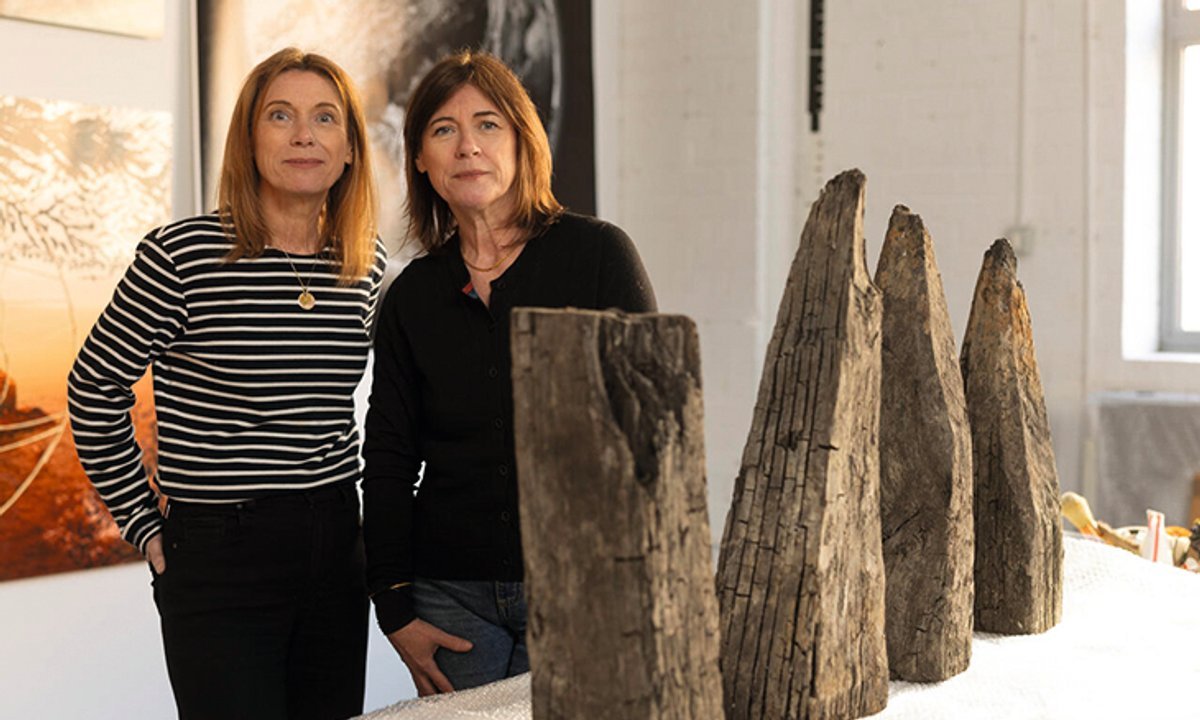
From 17 July, visitors to London Mithraeum Bloomberg Space will have a thrillingly tactile encounter with the Walbrook’s hidden depths. In the show Performance of Entrapment, the artist twins Jane and Louise Wilson are installing several 2,000-year-old oak stakes along with films and layered works.

When the Museum of London Archaeology (Mola) undertook extensive excavations from 2012 to 2014 at Bloomberg’s European headquarters, it unearthed around 14,000 Roman artefacts, 70,000 pottery shards and an unseemly amount of butchered animal bone. It also found a vast quantity of engineered, utilitarian timber, in superlative condition.

“What was amazing about the Walbrook river valley, as a sort of archaeological feature, is that it’s often still wet,” says Sophie Jackson, Mola’s director of developer services. “The river has gone away, but there’s still water in these reclamation deposits, and the water keeps out oxygen, which would otherwise cause decay.”

The first dated evidence for Londinium was dug up at the 1 Poultry site in 1994: a conduit made of wood harvested in AD47. The reason the Bloomberg site has yielded so many interesting findings is that as the Roman settlement grew, its authorities kept trying to reclaim land from the river by “filling in and tidying up” its boggy surrounds, Jackson says. First, they lined its banks with timber revetments to stop erosion and flattened a lot of ground on which they built structures. Subsequent flooding saw them repeatedly bring in rubbish from one of the dumps in the city to raise and stabilise the ground. They also built a bridge and road over it, of which the Wilsons’ stakes are surviving components.

Timbers dated to first century AD

The excellent condition of the timbers has made it possible to date them to AD50-80. They were cut from trees that were 400 to 700 years old, felled in the oak forests that once covered swathes of Kent and what is now Greater London. This in turn has made it possible to date the layers of rubbish. “And that rubbish tells us who was in London,” Jackson says. In the early years, the people arriving were from Gaul (western Europe). “Very quickly that changes and you get the more local, Iron Age, native British population moving in and becoming part of this population—becoming Roman,” she says.

It is extraordinary that once the archaeologists have weighed, studied and recorded all these ancient pieces, most of them go in the bin. “It’s just too much stuff, and it’s not stable,” Jackson says. As soon as water-logged timber is removed from the preserving vacuum of clay, the only way to maintain its integrity is to replace the water with polyethylene glycol. The team did keep some pieces aside for contemporary artists in the Bloomberg programme. “What’s lovely is the reaction of the twins to getting this wood,” she says. “I don’t think I’ve ever seen anyone be quite so enthusiastic.”

The Wilsons first put fragments of the timbers under a scanning electron microscope, which resulted in otherworldly images; samples of moments that haven’t been seen for 2,000 years. The excitement, they say, comes simply from the timbers still being around at all: “They feel totemic.”

• Jane and Louise Wilson: Performance of Entrapment, London Mithraeum Bloomberg Space, 17 July-1 January 2026


Source link

Share Article

Other Articles

Previous

From Punk Riots to Persian Ballads: British Artists Tearing Up the Rulebook in 2025

Next

A hundred years on, Cork Street is the beating heart of London’s art scene once more – The Art Newspaper

Next
July 17, 2025

A hundred years on, Cork Street is the beating heart of London’s art scene once more – The Art Newspaper

Previous
July 17, 2025

From Punk Riots to Persian Ballads: British Artists Tearing Up the Rulebook in 2025

No Comment! Be the first one.

Leave a Reply Cancel reply

Your email address will not be published. Required fields are marked *

Recent Posts

“We’re selling out shows, we’re climbing the bills, but there’s so much pressure to reach more success”: As one of the UK’s leading bands stop touring, we need to talk about the toxic effect a ruined music industry is having on heavy metal – Louder
February 12, 2026

“We’re selling out shows, we’re climbing the bills, but there’s so much pressure to reach more...

“Income from streaming simply isn’t enough to sustain most artists and that 99.9% them face a funding gap”: New app launched that could provide grassroots artists with a much-needed revenue stream – MusicRadar
February 12, 2026

“Income from streaming simply isn’t enough to sustain most artists and that 99.9% them face a...

This is how we do it: buy a Ryan Gillett fine art print | Illustration
February 12, 2026

The Guardian Print Shop presents a curated selection of works from This is how we do it – the...

Epstein Files: Maria Farmer's Painting Depicting the Elite? Survivor Maria Farmer's artwork shows Epstein's twisted network in a chaotic scene. In the released version, many figures are blacked out but the unredacted file exists, this time hiding Maria's name in – x.com
February 12, 2026

Epstein Files: Maria Farmer’s Painting Depicting the Elite? Survivor Maria Farmer’s...

"Anyone that wants to succeed in anything knows that it comes at a sacrifice." One of the UK's best metal bands announce that they won't be touring for the foreseeable future, fiercely criticise the cynical grind of the modern music industry – Louder
February 11, 2026

“Anyone that wants to succeed in anything knows that it comes at a sacrifice.” One of...

Related Posts

“We’re selling out shows, we’re climbing the bills, but there’s so much pressure to reach more success”: As one of the UK’s leading bands stop touring, we need to talk about the toxic effect a ruined music industry is having on heavy metal – Louder

February 12, 2026

“We’re selling out shows, we’re climbing the bills, but there’s so much pressure to reach more...

“Income from streaming simply isn’t enough to sustain most artists and that 99.9% them face a funding gap”: New app launched that could provide grassroots artists with a much-needed revenue stream – MusicRadar

February 12, 2026

“Income from streaming simply isn’t enough to sustain most artists and that 99.9% them face a...

"Anyone that wants to succeed in anything knows that it comes at a sacrifice." One of the UK's best metal bands announce that they won't be touring for the foreseeable future, fiercely criticise the cynical grind of the modern music industry – Louder

February 11, 2026

“Anyone that wants to succeed in anything knows that it comes at a sacrifice.” One of...

“It’s no good saying, ‘I’ll be dead by the time this becomes a crisis.’ We are the generation who created the problem. We owe it to the generations to come to clear it up. If it hasn’t gone too far”: Jethro Tull – a warning from history – Louder

February 11, 2026

“It’s no good saying, ‘I’ll be dead by the time this becomes a crisis.’ We are the generation who...

© 2024, My Art Investor, All Rights Reserved.

  • Contact
  • Privacy Policy
  • Terms and Conditions
  • Home
  • Art Investing
  • Art Investments
  • Art Investor
  • Artists
  • Artwork
  • Fine Art
  • Invest in Fine Art